
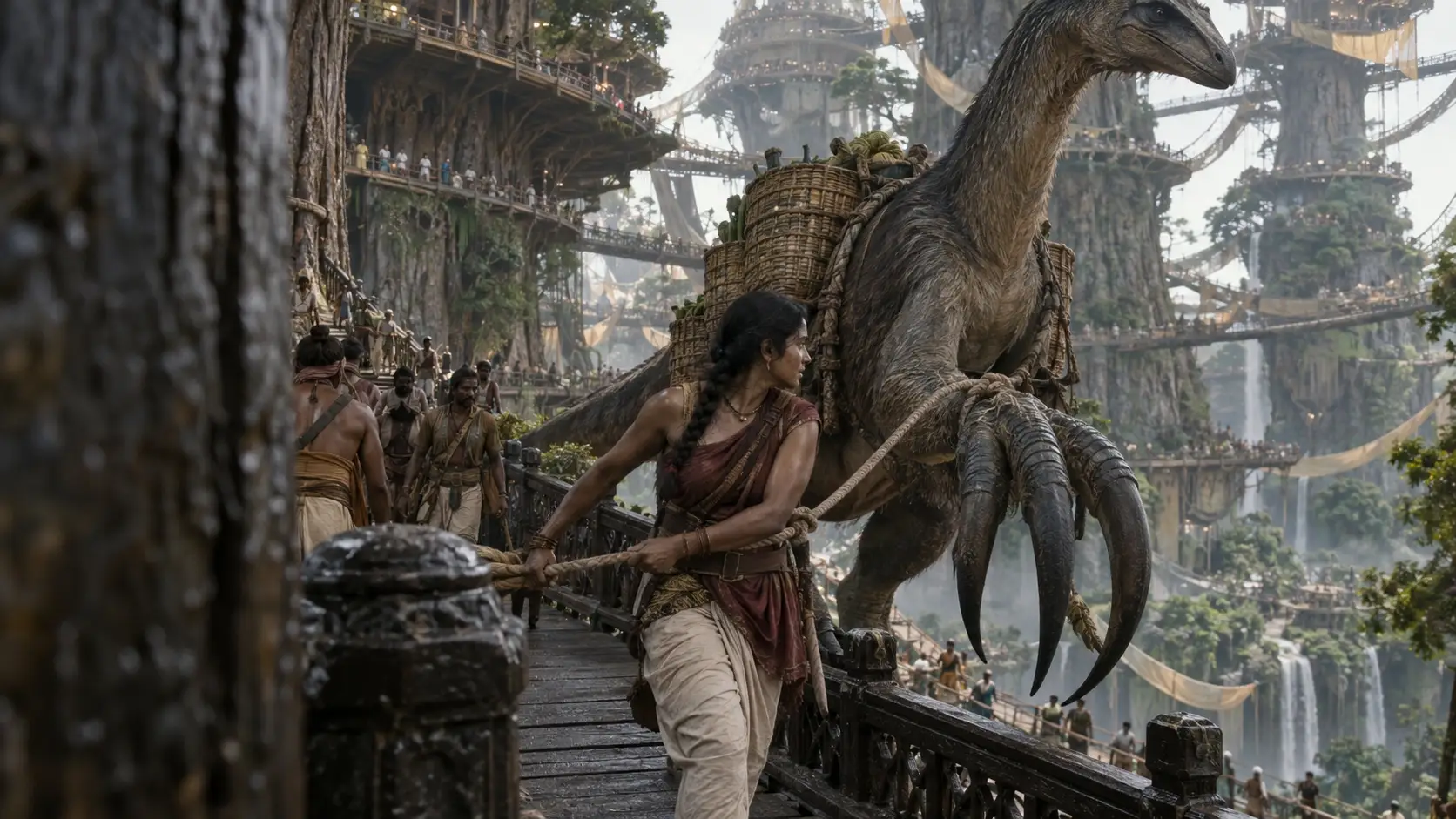
Therizinosaurids
The great hands of the canopy: princely mounts and helpers of the hanging farms of the High Jungles.
An animal of the heights
The canopy therizinosaurid holds a central place in the High Jungles, a principality that lives entirely above a ground it considers impure. Bipedal and long-limbed, it has a long neck, a small head and three great curved claws on each hand: a body made for reach and precision.
The Rampes de Griffes and load-bearing structures give it its own wide, reinforced access. Its routes cross the same heights as human ones, with their constraints; the heavy therizinosaurids are not sent down the small human slides of the Chutes. These animals can close off a jungle and make an army vanish.
Mount and helper
The princely mount is also a working animal. It carries loads, works on structures and helps maintain the farm-trees: its hand reaches high branches and crops. Slowness, stability and precision are valued; the handler must know the available footholds, the width of passages and the state of the structures before moving a load.
Ishtir’s Garden Sickle
In Ishtir, the Garden Sickle, a therizinosaurid whose enormous claws are not a predator’s, defends the orchards and performs ritual cutting; it prunes vegetation and harvests. It is called the hands of the sun.
Five tonnes of patience
The canopy therizinosaurid weighs about five tonnes. Standing on its hind legs with its neck raised, it reaches branches no other working animal can touch, and its three curved claws, a metre long in the largest, serve to catch, pull down and hold. It is no predator: it feeds on tender leaves and young shoots, nearly two hundred kilos a day, and never grazes on the ground. It is adult at about seven years and lives thirty to forty.
Its temper is calm, almost slow, but it knows how to defend itself. A threatened therizinosaurid rears up, spreads its arms and sweeps the air with its claws; few predators persist. Its handlers learn to read the signs that come before that movement — the lowered head, the arms drawing away from the body — and to step back in time. In the Hautes Jungles they say the animal never strikes first, but never needs to strike twice.
The Keepers of the Claws
In the Principality, therizinosaurids are entrusted to a clan, the Keepers of the Claws, which brings together the lineages of princely mahouts. The Keepers hold the Claw Ramps, raise the young and train the animals to saddle and to carry. There are about a hundred and twenty of these animals in the whole Principality, and each has its appointed keeper, often for life.
Their eggs never touch the ground. They are incubated in hanging nests, sometimes by oviraptorids trained to brood other species’ eggs and to defend the nest; the young, fed on canopy foliage, learn to climb the ramps before they carry anything at all. A young therizinosaurid takes years to become a safe mount, and the Keepers say you do not train such an animal: you persuade it.
The little pickers
The great therizinosaurid is not the only one working in the trees. The farms of the Hautes Jungles also use a much smaller cousin, the erlikosaur, which weighs little more than a hundred and seventy kilos: it picks at mid-height, between the low branches and the crown, and carries the harvest baskets along the Feeding Spirals. Livelier than its great relative, it works in small groups, each led by a farmer who guides it branch by branch.
Every animal thus has its storey. The little pickers gather the fruit within arm’s reach, the great therizinosaurids pull down the high branches and carry the heavy loads on the Claw Ramps, and people work in between. A well-kept canopy farm thus looks like a living ladder, where each level has its animals and its people.
The Lamier of Velasar
Volonia, which breeds hardly any large land animals, makes an exception for the Lamier. This therizinosaurid of about five tonnes is bred and trained in the pens of Velasar in the same way as the hauling plesiosaurs, and its function is guard duty. It is posted at gates, in passages and on building sites, where its tall outline and its claws are often enough to stop a large land animal coming on too fast.
For war its claws are fitted with blade extensions forged in Korath, and its harness carries an insurance policy sewn into the leather, as befits Volonia. Lamiers are few and expensive, more than twice the price of a Hautes Jungles therizinosaurid; the companies that hire them out to guard a harbour or a depot present them as the only wall that can walk.
The claw: insignia and sickle
When a therizinosaurid dies, its claws are not lost. They are taken, cleaned and dried, and each, a metre long, becomes an object of honour: a ceremonial sickle wielded at the ritual cuttings, or the insignia of the Keepers, which the eldest wear on their backs. These claws are rarely sold, and those that leave the Principality are court gifts.
Therizinosaurid riders are the elite of the Principality’s fighters. Their war harness, which costs several years of a craftsman’s wages, carries fastenings for weapons, abseiling ropes and a high saddle from which the lower canopy is commanded. In the forest these riders go where no other mount can pass, and it is to them that the Hautes Jungles owe their reputation: they can close a jungle and make an army vanish in it.