

Armies
Volonia’s ship classes
The register of the Volonian fleet sets out twenty-six ship classes, twelve for combat and fourteen for support. Sails, oars and towing plesiosaurs are combined according to the mission.
A register of models
Volonia describes its fleet through a register of classes. For each class it gives a length, a crew, an armament, a propulsion and a mission.
The register describes models; the number of ships of each model in service, the list of named hulls and their dates of commissioning do not appear in it, so the nation’s tonnage cannot be drawn from it. The fleet is over-armed for a simple reason: Urnok, Ishtir, Arkhan and the pirates also have real navies.
Combat, defence and interception
Twelve classes fight. The Souverain des Marées carries the admiral; the Grande-Coque de Ligne holds the line of battle; the Brise-Port attacks quays and walls; the Fort de Marée defends straits and anchorages. The Coupe-Courant closes passages, the Nid d’Alizé carries pterosaurs and the Tour des Ciels commands the sky through signals and mirrors.
For the high seas and the policing of routes, the Croiseur des Grandes Routes escorts armed trade, the Chasseur de Pirates pursues and boards, the Frégate d’Écume and the Escorteur de Convoi protect, and the Harponneur class neutralises large animals. Two facts stand out: naval aviation is a military branch in its own right, and the navy knows that a threat may come from an animal as much as from a ship.
Support, special operations and training
Fourteen classes are not built for the front rank. The Porte-Barges prepares landings; the Maison des Plésiosaures, the Grenier du Large and the Citerne des Profondeurs feed and resupply; the Atelier des Coques repairs; the Hôpital des Marées heals; the Cloche d’Abîme sends divers under water; the Récupérateur d’Épaves brings back survivors, prizes and hulls.
Others serve navigation and knowledge: the Phare Mobile, the Baliseur de Courants, the Navire-École des Pilotes. The Galerie des Pavillons hosts house councils and negotiations, the Voilier de Course serves racing, mail and prestige, and the Pêcheur du Grand Océan fishes, processes and stores.
This second half best explains Volonia’s superiority. An enemy fleet can build a large ship; Volonia already has the ships that repair it, keep its animals, heal its crews, resupply distant operations, renew the charts, train the pilots and recover the losses.
Sails, oars and plesiosaurs
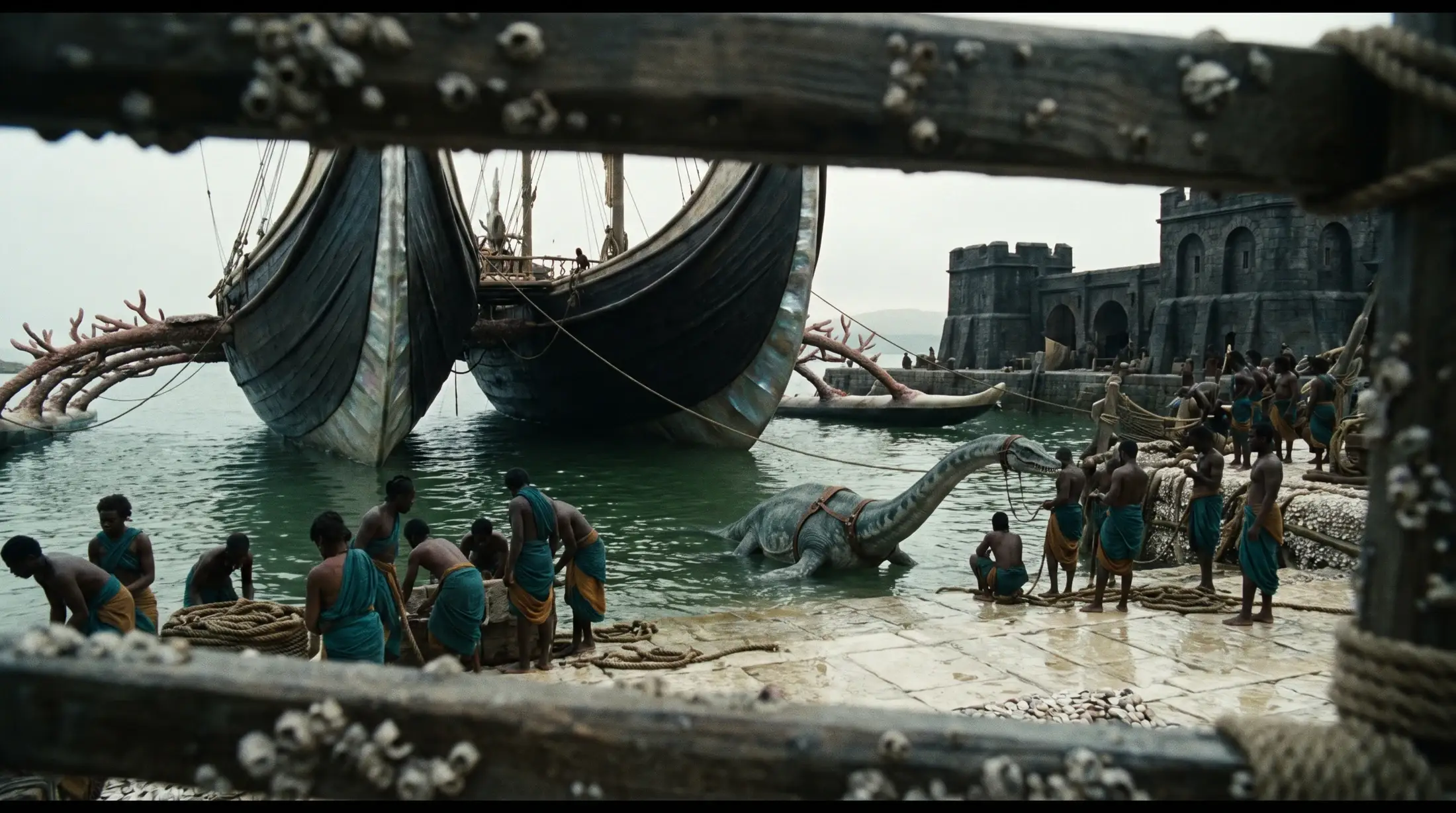
Propulsion is hybrid. Depending on the class, a ship combines sails, oars and teams of towing plesiosaurs, from one to eighteen animals; a few ships go by sail alone, and the Atelier des Coques can be towed. Towing plesiosaurs work at towing, on the high seas, in manoeuvre and in rescue, harnessed at the side and relieved by rotating teams. In a fair wind, a Great Hull covers forty to sixty leagues a day, roughly one hundred and sixty to two hundred and forty kilometres.
The plesiosaur is Volonia’s central animal: towing, shipyards, fishing, the high seas, rescue, racing, transport and war. A saying sums it up: the mosasaur protects Volonia, the plesiosaur made it possible.
A hull of three nations
The Great Hulls come mostly from the shipyards of Velasar, the country’s leading private shipbuilding power, heir to the traditions of Orlantis and employer of Korathi engineers. The builder of Great Hulls designs articulated hulls, multiple keels and watertight compartments.
A great hull remains Volonian in its shape and Orlantine in its timber, but several joints, iron parts, recoil mechanisms and safety pieces may be Korathi. The Korathi recoil engineer adapts ballistae, tension and damping to the Great Hulls: an imported technology, and a very expensive one. Without the timber and resins of Orlantis, there is no fleet.
Sky, surface, depth
The fleet fights in three dimensions. Above, sea pterosaurs scout, signal and relay. On the surface, heavy ships carry the war machines and the troops. In the water, riders mounted on fast ichthyosaurs, plesiosaurs carrying platforms, divers and very large keel-breakers act beneath the hulls.
In ordinary times the houses line up their private fleets under their own flags. A recognised war triggers the Réunion des Pavillons: operational command then passes to the Admiralty of the United Fleets, and the houses keep ownership of their ships.
Hulls outside the war register
The twenty-six classes of the register are not Volonia’s only ships. The ports fit out many others, which do not belong to the fleet but serve the sea day after day. The trading double-hull, a merchant ship of two hulls joined by a deck, steady and deep in the hold, carries most of the long-haul trade; it is sold in twenty-fourths to captains’ families. Cage ships, fitted with ventilated floating cages, fish wells and keepers, carry live animals and sensitive cargoes under insurance.
In the lagoons, living barges guided by a lantern-hung Voilecou carry pearls, perfumes, manuscripts and passengers of note. At Girvane, the pearl boats, small craft with a davit and a light bell, serve the teams of women divers. The Traqueurs de Dents hunt great wild marine reptiles for their teeth, hide and oil; the pass pilot boats take the College’s pilots aboard incoming ships; and the mist privateers, low grey hulls flying no house flag, sail under the League’s letter of marque.
Recognizing a Volonian hull
A foreign sailor recognizes a Volonian ship from afar. Its sides carry, at the waterline, the reinforced fastening points of the lateral harnesses, and the necks of plesiosaurs can often be seen rising from the water ahead of the stem. Below the waterline the copper sheathing turns green with the years; above it, tarred timber and rigging carry the colours of the owning house, faded turquoise, slate, gold or purple, on sails, flags and painted planking.
The Register of Hulls and Routes also sets its mark. Every registered hull has its registration number carved into the stem, which it keeps for life, and a hull book follows it from port to port. The great houses add their own signs: a mother-of-pearl stamp, a figurehead, a name painted in Quay Notation. A Port Volon captain used to say he read a hull like a bill of exchange: everything that matters is written there, for whoever knows where to look.
Facing the other navies
The other powers have their fleets, but none fields comparable hulls. Ishtir fits out solar galleys some forty metres long, with rams and perches for signal pterosaurs, and fast patrol boats that watch its coasts; its strength lies in the sky more than on the water. Urnok sails troop-carrying galleys on its rivers and, along the coasts, grain cogs whose cargoes are almost always insured in Volonia. Arkhan makes do with landing rafts and the coastal sailing craft of Port de Sable.
The true sea rivals are elsewhere. The Broken Isles fit out privateer coursers that slip out of the fog, the Dents Noires black-lacquered raiding galleys, and the Pirates du Nord low, fast ships built for boarding, around their three black mosasaurs. None of these vessels exceeds a few dozen metres; but they are numerous, know their waters and force Volonia to keep a fleet far larger than the mere defence of its ports would require.