
Creatures
Ornithomimids
The running theropods of Arkhan’s trails: very fast messengers and carriers for the long marches.
The messengers of the trails
The messengers’ Gallimimus, which the Arkhans call Gali-vaa, is a very fast and fragile runner. The Marcheurs du Vent use it as a messenger and as a decoy; it carries mail and runs races, and it can also be seen on Urnok’s roads. Its speed is its worth on the trail.
The carrier of the Longs-Os
Among the Longs-Os, the khanate of long trails, water and endurance, a carrying ornithomimid loaded with sacks serves for light transport and long marches. An enduring runner, it embodies the humility of the trail.
A runner’s body
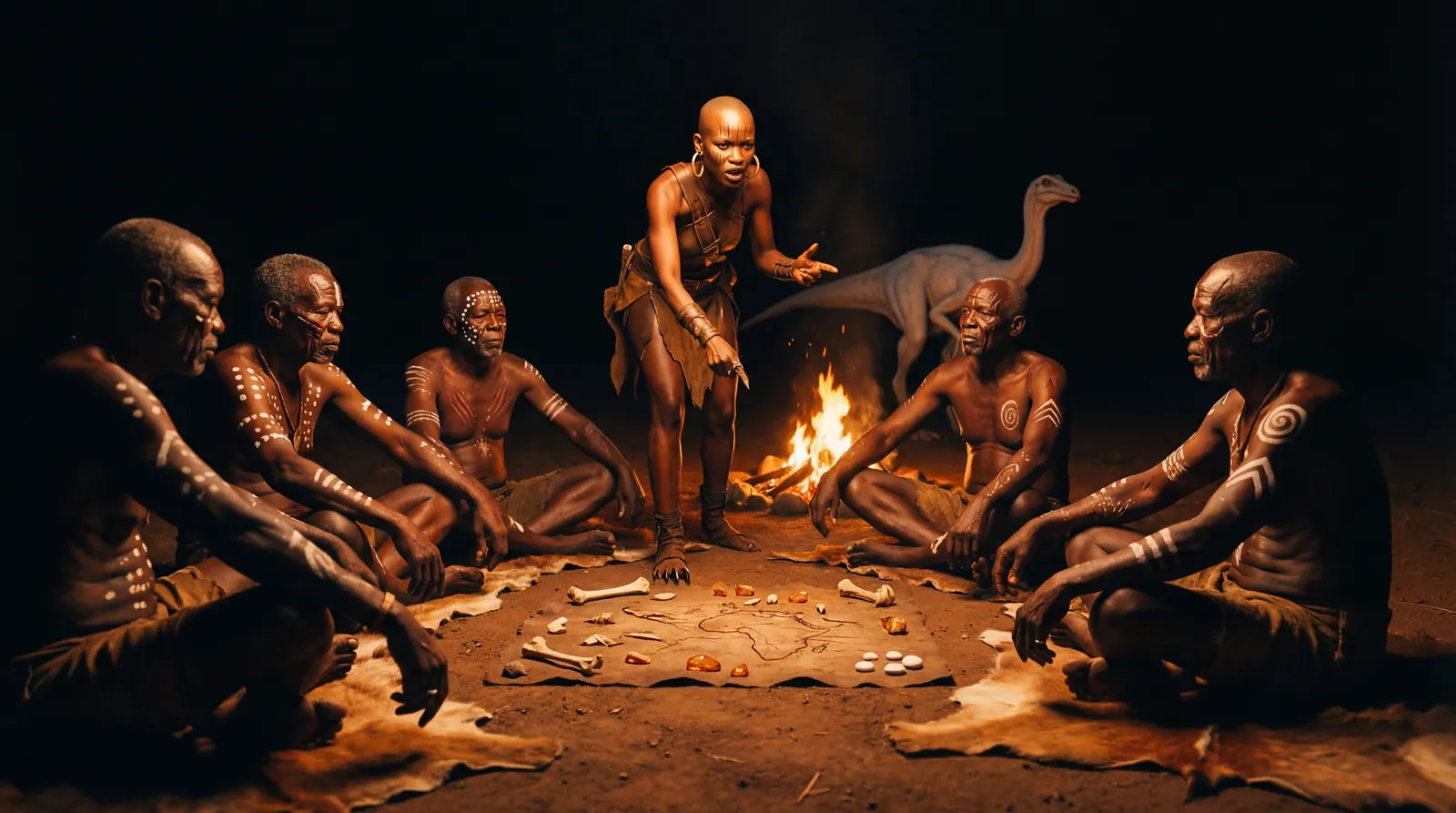
Ornithomimids are running theropods, dinosaurs with a long neck, a small head and a toothless horny snout, set on long slender legs made for speed. Their bodies are light for their size, their tails long and stiff, their hands long and weak. Their skin is scaly, sand-grey or pale ochre depending on the stock. They do not hunt large prey: they eat shoots, seeds, oasis fruit, insects and small animals, which makes them far cheaper to feed than a raptor.
The messengers’ Gali-vaa, the best known, weighs in the order of four hundred kilos and reaches a speed no other Arkhan mount can hold, nearly eighty kilometres an hour on a good trail. The Marcheurs du Vent also ride a smaller stock, of about a hundred and fifty kilos, lighter still, for the most urgent mail. Their weakness is that of their speed: thin legs that break on bad ground, and a nervousness that makes them flee at the first danger.
The relay runners
The Gali-vaa is the beast of the Relais du Vent. Every relay keeps a few in its enclosure, rested and fed, and a courier carrying an urgent dispatch changes beasts at each halt without waiting. Riders are chosen for lightness, often young, and ride on a short saddle almost on the beast’s neck, to weigh as little as possible. A relay run covers forty to sixty leagues a day on a good trail, and the arrival of a lathered Gali-vaa in a camp always announces news that was awaited or feared.
The Marcheurs du Vent also use them as decoys. A Gali-vaa released in front of an enemy troop, or in front of a great wild predator, draws it in a chosen direction: the beast runs faster than its pursuers and leads them away from what is to be protected, or towards the ambush prepared for them. The rider who leads this chase must know when to stop before his mount is spent. It is one of the most dangerous trades of the trails, and the khanate’s scouts speak of it with respect.
Raising a runner
An ornithomimid is harder to train than a raptor. It does not bond with its rider in the same way, keeps all its life its fear of hunting beasts, and lets itself be ridden only after long habit. It is therefore raised from the egg, in separate enclosures, far from the packs. Females lay eight to fourteen eggs, incubation lasts a little over two months, and the young run before they know how to obey. A Gali-vaa is adult at about three and can serve for fifteen years or so.
Its food is that of the relays: short-grass hay, salt brush, oasis seeds and fruit, supplemented with insects and scraps. An adult runner eats some twenty kilos of it a day, much cheaper than a meat ration. It is housed apart from the raptors, which see it as prey, and relay enclosures always separate the two kinds of beast with a stockade and a ditch. The keepers know that a Gali-vaa that smells a raptor too close can break a leg trying to flee.
The junior of the long marches
Among the Longs-Os the carrying ornithomimid has none of the runners’ glory. Heavier, calmer, slower, it carries sacks, light waterskins and bundles of cords on the long marches, in file behind the riders. It is entrusted with what must arrive safely rather than quickly. It walks whole days, drinks little, eats what the trail offers and costs almost nothing. For heavy loads, tents and children, the camps prefer khaans, which are sturdier; the ornithomimid carries what is left.
This modesty earns it a particular affection among the people of the Bone Sea, who say it embodies the humility of the trail. It is readily called “the junior”, because it always walks behind, and a man who does his work without waiting for praise is said to “carry like a junior”. Children of the Longs-Os often learn to lead a file of ornithomimids before they ride their first raptor.
On other people’s roads
Ornithomimids are not peculiar to Arkhan. They can be seen on the roads of Urnok, where relays use them for fast couriers, and in the ports of Volonia, where they are raced for wagers. Arkhans sell some every year to the merchants of Port de Sable, and in turn buy a few foreign stocks to renew their runners. The Gali-vaa races around the wells and lakes of Savresh, on the lands of the Marcheurs du Vent, draw gamblers from all over the Confederation and beyond.
Everywhere the beast keeps the same reputation. It is admired for its speed and a little despised for its fear; in camp speech, calling a man a Gali-vaa means he runs fast, but in the wrong direction. The messengers answer that a Gali-vaa never fights, and always arrives.