

Culture
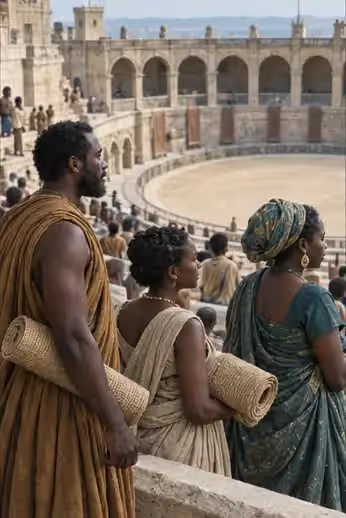
Friday at the maritime theatre
Aquatic dramas, crossings and races are ordinary family entertainment.
A popular outing
Going to the maritime theatre on Friday evening is a mass family practice. Performance belongs to regular port life as well as special occasions. Families and visitors can watch an aquatic drama, a reconstructed crossing, a plesiosaur ballet or a race. The sea becomes a storytelling space as well as a workplace.
The theatre among workshops
Lagoon terraces bring together middle-class housing, markets, workshops, theatres and basins. Performance thus belongs to a city where people live and work near water. Walkways, service channels and high refuges also structure this neighbourhood. An evening’s entertainment takes place within the same constraints of tide and movement as the port’s working day.
Programming and sustaining a stage
The maritime theatre master programmes family performances, races and reconstructions. Artists and animals work in a space requiring different skills. Plesiosaurs also serve fishing, construction, transport and rescue: their presence in performance belongs to a culture of working with living animals, of which the stage is another use.
Basins, tiers and animal access
A maritime theatre is organised around a basin lined with tiers. The basins, tiers and animal access are maintained so that shows can take place; pilots, trainers, artists and carers take part in preparing them. In Port Volon, these theatres add crowds to the port’s ordinary movements, amid the lagoon terraces, markets and workshops.
A place of spectacle and justice
The maritime theatres host family shows, races, executions and propaganda. The greatest fraudsters risk public execution in a maritime theatre; those condemned to be devoured there are deprived of the ceremony that normally gives the dead back to the sea. The sentence combines spectacle, the breaking of the political contract and funerary exclusion.
A Friday programme
An evening at the maritime theatre nearly always follows the same order. It begins at dusk with music, while families settle in with their baskets. Next comes a neighbourhood comedy, played on pontoons, then a plesiosaur ballet, the necks crossing to the rhythm of the swimming drums. The heart of the evening is a re-enactment: a famous crossing, a rescue, or a naval battle played out with real boats, called a naumachy. The evening ends with a race around the basin.
A seat costs little, roughly the price of a meal of fried fish, and that is what makes the theatre a mass outing. Sellers of crab-shield cones pass along the rows, children fight over the bottom seats, closest to the water and the splashes, and regulars find the same neighbours every week. The great houses rent boxes for the season and receive their partners there.
What is performed
The repertoire mixes laughter and memory. Comedies mock the great houses, the insurers and the collectors of the Fifteenth; the actors wear red masks that allow them to ridicule everyone without naming anyone. Dramas tell of drownings, unhoped-for returns, storms and fights against pirates. The best loved stage ordinary people: a woman diver who saves her team, a docker who became a captain, a widow who makes a house give way before the Court.
The houses and the League willingly pay for shows that serve their reputation, and nobody hides it: the playbill says who is financing the evening. There is no censorship, but a house that feels insulted can stop renting its boxes, which is often enough to make a theatre master think twice. Actors, musicians and trainers band together in companies, and the most famous are as well known in the ports as racing riders.
The theatre in wartime
When the Gathering of the Flags is pronounced, the theatres become places of war. The act of mobilisation is read there, maps of the threatened routes are put up, and the contract companies recruit between two shows. The naumachies change subject and replay the republic’s old victories; captured predators, hired in cages for the evening, are sometimes shown.
During campaigns, the theatres read out each Friday the news from the open sea, the news the racing sailers have brought back during the week. The crews’ families come to hear it as much as for the show. When a hull is lost, its name is announced from the stage, the music falls silent and the audience rises; nothing else is played until the bell of the nearby chapel has rung.