

Places and landscapes
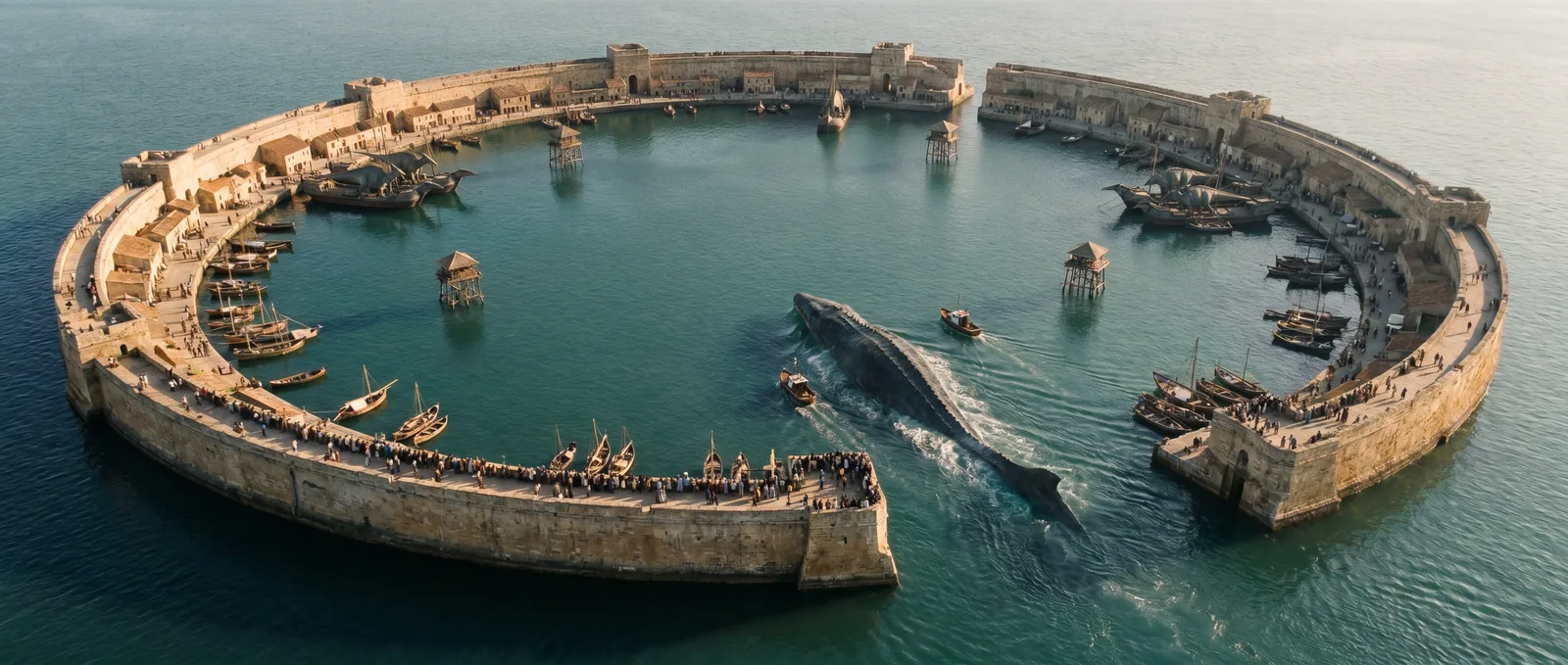
The bastion rings
Port-forts carved into an atoll, a reef or a crater, the bastion rings close deep basins behind narrow passes. They protect arsenals and exceptional basins; they are never the plan of every Volonian city.
A fortified circle around water
The bastion ring is a defensive harbour: a fortified circle around a central body of water, with deep basins, narrow passes, batteries and refuges. It makes use of an atoll, a reef or a crater. It is found in a port-fort, an arsenal, a pass fort or an exceptional basin of Port Volon or Velasar.
It is an exceptional arrangement, kept for certain major facilities. Residential districts follow other forms, and no Volonian city is built entirely on this model.
Separate channels
In a bastion ring, channels and secondary passes are kept apart and protected by breakwaters; floating quays, tide stairs and high refuges make it possible to work with the sea. Chests and tables are lashed down, hulls protected by fenders, jars stored in baskets, and signals show the current. People, boats, great hulls, plesiosaurs, swimmers and strategic animals do not share the same channel: in Volonia, a distance is measured in tide, current, depth, breath and premium.
Rings and wealth
In Volonia’s social geography, risk can be read in housing: the poor live on wrecks, stilts and exposed islets, the middle classes in the lagoon terraces, the visible rich in the harbour rings, island villas and palace-ships, and the greatest fortunes beneath the sea.
Ports like reefs
The most fortified of these ports look like reefs: toothed quays, defence through nautical mazes. They shelter arsenals and maritime defence yards, with cages, ballistae and patrolling ichthyosaurs.
Why no one gets in
The strength of a ring-bastion lies in its pass. The entrance is narrow enough for a chain floated on barrels to close it within a tide, and its approaches are strewn with shoals known only to the watch pilots. Ballistae mounted on the ring cover the pass from several angles, net-throwers protect the sky, and a Fort de Marée or a Coupe-Courant can be moored before the entrance in wartime.
Inside, the central basin offers deep, calm water where hulls are repaired and loaded under shelter. Some arsenals keep a great pliosaur in a closed basin there, whose mere presence discourages an attack from below. An attacker who forced the pass would find himself inside a circle of walls, under fire, facing separate channels he does not know: this is why ring-bastions are more often blockaded from outside than attacked head-on.
Building in an atoll or a crater
A ring-bastion is not built just anywhere. Engineers look for an atoll, a circular reef or the drowned crater of an old island, whose rim already provides part of the wall. They widen or dig out the pass, fill the gaps in the reef with wooden caissons packed with a lime that sets under water, then raise the walls with blocks of coral and stone. Construction plesiosaurs move the heaviest blocks, and generations of masons may follow one another on the same ring.
Such a work costs more than any house can pay alone. Arsenal ring-bastions belong to the League or to the great trust-houses that draw their revenues from them, as at Velasar, and their upkeep never stops: the sea works at the joints, storms tear away the breakwaters, and every season brings its list of repairs.
Living behind the ring
A ring-bastion houses more people than one might think. Arsenal workers, the garrison, the masters of traction and their families live in the buildings set against the inner wall, and the high refuges shelter the whole population in case of storm or attack. Entry is by pass only, and pedlars are searched at the sea gate.
Volonians carefully distinguish these war ports from the harbour rings where the visible rich live. Those take up the circular form and the calm basins, but for villas, gardens and palace-ships; their walls serve to keep the swell and prying eyes at a distance rather than to withstand a siege. A sailor will say of an upstart that he “has made himself a ring”: he has the walls, but not the ballistae.