

Armies
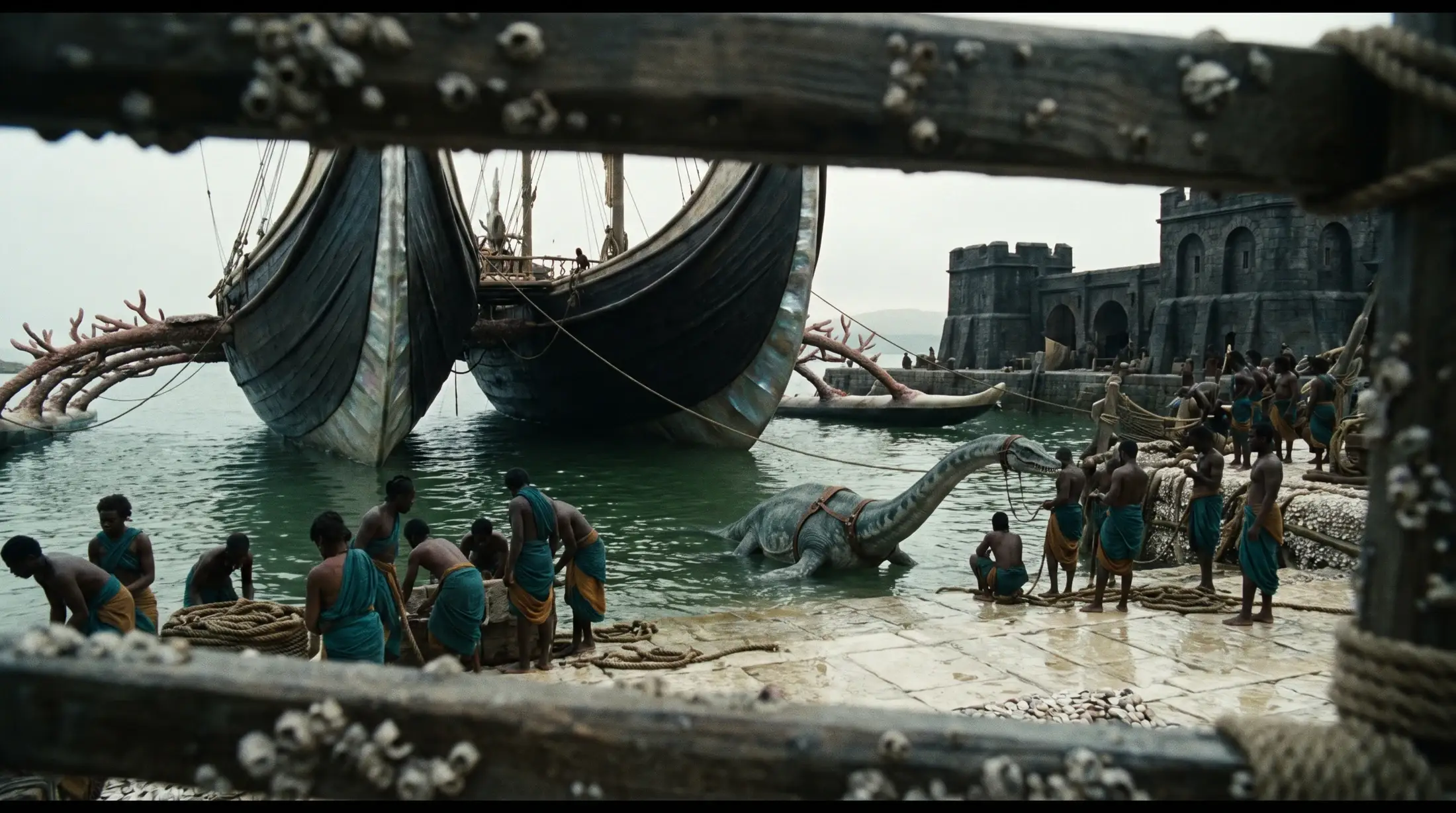
The Harponneur class
A small anti-animal ship (“Harpooner”), armed with Korathi harpoons and chains, which neutralises large and very large sea animals.
Against animals
The Harponneur is the smallest combat class in the register, twenty-eight to forty-five metres for one hundred and twenty to two hundred and fifty people. Its mission is to neutralise large sea animals, up to the very largest. It moves by oar and with plesiosaurs.
Its weapons come partly from Korath: Korathi harpoons and chains. Korath supplies Volonia with the metal points of its harpoons. With the Coupe-Courant, the class forms the branch of the navy specialised against enemy animals.
The Korathi harpoon
The Harponneur’s weapon is a heavy harpoon, launched from a deck ballista or thrown by hand by the best marksmen. Its shaft is of Orlantis timber, its head of Korathi metal, forged into barbs that open in the flesh and keep it from pulling out. It is linked to the ship by a chain, then by a salt-tendon line long enough to follow a diving beast. Volonian houses have tried to forge these heads themselves; none has matched those bought from Korath.
The harpoon does not kill. It hooks, holds and tires: a harpooned beast drags the weight of the ship and its chains behind it and wears itself out trying to flee. The kill, when it is wanted, comes afterwards, with a weighted lance, when the animal surfaces to breathe. Harponneurs also carry heavier chains, wound around the flippers of a weakened beast to disable it without killing it.
Wearing down a giant
Against a giant, a Harponneur never fights alone. Several ships share the beast: the first hooks it, the others drive in their own harpoons, and each hull pulls in a different direction to keep it from diving or turning on any one of them. The plesiosaurs give the ship the strength to resist the pull, and its rowers the suppleness to follow every change of direction.
The hunt can last for hours. It is the most dangerous phase: a beast of that size can tow a Harponneur at full speed, capsize it with a blow of its tail or strike its hull from below. The captain keeps an axe within reach to cut the line if the ship is about to be dragged away. On the quays of Girvane it is said that old harpooners can tell from the vibration of the chain alone whether the beast is about to dive or to surface.
A crew of hunters
Harponneur crews often come from the hunting ports. Many have served on Traqueurs de Dents, the ships that hunt great wild marine reptiles for their teeth, hide and oil; others are harpooners of the house of Calystrëa, whose workshops supply part of the hull-mounted harpoons. They know the habits of the beasts, their hunting hours, their ways of fleeing and of turning back.
The trade is among the best paid and riskiest in the fleet. Bounties depend on the beast: a great reptile brought down earns the crew a share of its value in teeth, hide and oil, when it is not captured alive. Insurers cover a Harponneur only at a steep price. A sailor who accepts a berth aboard is said to “go up the chain”, and his family rarely says it with a smile.
Against the enemy’s beasts
In war, Harponneurs accompany the formations and stand ready against the enemy’s great sea beasts: war plesiosaurs, great reptiles loosed against the hulls, pirates’ raiding beasts. Their presence alone often deters an opponent from launching his animals at the line. They also protect the fleet’s anchorages and immobilized ships, Forts de Marée and Coupe-Courant, against an attack from below.
They then work in packs of three or four hulls, which the Admiralty places on the wings of the formation, where an enemy beast would try to turn the line. A Harponneur does not pursue an animal that flees far from the fleet: it drives it off, then returns to its post.
Escorts and captures
In peacetime, Harponneurs escort the fishing fleets of the Great Ocean, where great wild predators follow the shoals, and step in when a dangerous beast approaches a port or a traction basin. Breeding grounds and show basins call on them to capture rare animals alive, which demands still more skill: a captured beast is only worth something if it reaches the basin unharmed, and the harpoons are then replaced by nets and leather-sheathed chains.