

Armies
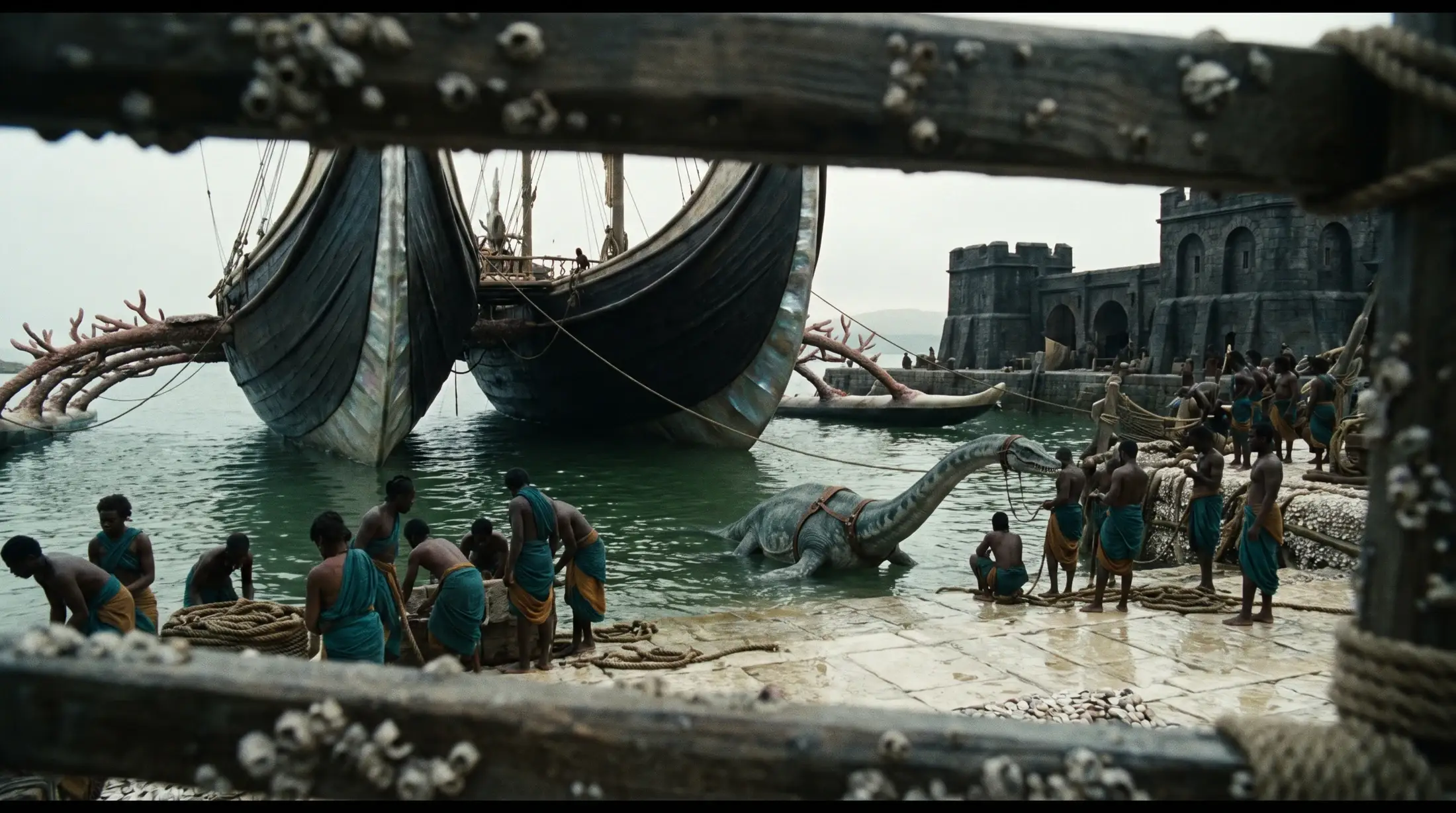
The Porte-Barges
The landing ship (“Barge Carrier”): it carries barges and five hundred to nine hundred soldiers depending on the class.
Carrying troops to the shore
The Porte-Barges prepares landings. It carries barges and, depending on the class, five hundred to nine hundred soldiers. It sails with plesiosaurs and has a medium defence; its crew numbers six hundred to one thousand.
It is part of what gives Volonia its ocean reach, even though the nation’s best assets remain tied to water, ports and their upkeep rather than to a long land conquest.
The barges and their launching
The Porte-Barges carries on its deck and in its sides a flotilla of landing barges: flat, broad hulls of very shallow draught, whose bows drop into a ramp once ashore. The smallest carry a section of infantry, the largest heavy equipment, rams or beasts. The hold, which can take more than a thousand tonnes, keeps the food, weapons and reserves of the embarked troops.
Launching is the decisive manoeuvre. Cargo booms and winches lower the barges along the sides, one by one, while the ship lies at anchor, in the lee of a headland if possible. The barges are then taken towards the beach by small plesiosaur teams or by their rowers, in successive waves. A well-served Porte-Barges can put its five hundred to nine hundred soldiers ashore in a few hours.
Who goes ashore
The embarked soldiers are not fleet sailors but contract companies, hired for the campaign. The Calystrëa companies provide the heavy infantry, in quay armour of sea leather and shield-crab plates; the Koraleth pikemen form the wall against great land beasts; the sea crossbowmen and anti-pterosaur net teams protect the beach and its sky. Deck sailors, recruited on the pontoons, occupy and fortify the ground taken.
Some Porte-Barges carry more. The largest can house one or two Lamiers de Velasar in a reinforced barge, the only great land beast Volonia has trained for war, along with the shark-headed landing rams mounted on wheels under a roof of wet hides. Their landing is slow and delicate; it only takes place once the beach is held.
The shore clause
The contracts of the landed companies state how far they will go. A shore clause sets the distance from the coast beyond which a company is no longer bound to march, or only at a higher rate. It reflects a fact every Volonian knows: their forces are made to hold a coast, open a port or destroy an objective, then re-embark, not to push inland where their great sea reptiles can no longer follow them.
Doctrine takes this into account. A Volonian landing is planned together with its re-embarkation: the Porte-Barges stay at anchor, barges are kept empty on the beach, and the Brise-Port covers the withdrawal. Volonia’s enemies know this too, and try to draw its companies far from the shore, where the barges can no longer bring them back.
The order of a landing
A landing follows an order the Admiralty repeats from campaign to campaign. The Baliseurs de Courants first sound the beach and its approaches; a Phare Mobile marks it by night; the Brise-Ports and Great Hulls silence the coast’s engines. The first barges carry the pikemen and crossbowmen, who hold the sand; the next, the heavy infantry and net teams; the last, the rams, beasts and supplies.
Frégates d’Écume cover the barges during the crossing, and foam riders patrol the shallows against enemy swimmers. Once the troops are ashore, the Porte-Barges moves in as close as its depth allows, to shorten the way back.
Carrying rather than landing
In peacetime, the Porte-Barges serve for heavy transport. Their barges make it possible to unload on coasts without a harbour: building materials for a relay island, food for an isolated garrison, relief after a storm has destroyed a quay. Some houses hire them for their island building works, others to carry guard troops to distant trading posts.
Their crews of six hundred to a thousand include many barge hands, carpenters and stevedores, and relatively few fighters, for the ship’s medium defence relies mainly on its escort. It is said in the fleet that the Porte-Barges is the most awaited and least loved of ships: everyone wants to see it arrive, no one wants to be aboard when it approaches a defended beach.