
Armies
Ports, basins and maritime rescue
A fleet is sustained by quays, basins, lines and bodies working in water.
Separate waters and uses
Ports organise service basins, ramps, quays and equipment spaces. Separating waters limits conflicts among circulation, work, rest and rescue. It also makes it possible to approach an animal or hull without putting an entire harbour at risk.
Marine harnessing is quay work
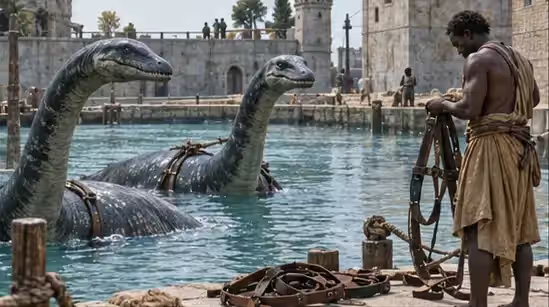
Towing or rescue depends on checked lines, protected fastenings and people able to read tension. Harnessing is a point of contact between hull, animal, water and the human body. Its maintenance conditions port use as much as a vessel’s condition.
Rescue belongs to infrastructure
The same installations serve transport, towing and rescue. Rescue rests on ramps, accessible basins, teams and recovery procedures. A port network must shift state without losing essential access.
A roadstead in several basins
A great Volonian port reads as a sequence of basins, each with its own use. At the entrance, the outer harbour receives ships waiting for a pilot, a tow or an inspection. Then come the trading basins, lined with quays and warehouses, then the traction basins, where the towing plesiosaurs rest and work in rotation, away from the traffic. The refit docks, closed by watertight gates, take in hulls under repair, and the war basins, deeper, shelter the Great Hulls and the guard Double-Fins.
Each basin has its entrances and its rules. No one goes in with just any beast or at just any tide, and painted posts, buoys and bells show what is allowed. The basins of the great predators, when a port keeps any, are isolated behind gratings and separate channels, far from the children’s basins and the bathing quays.
Rescue in a port
Ports keep rescue teams ready to leave at any hour. A distress bell, rung in a rhythm everyone knows, calls them out: fast boats, divers, foam riders and one or two rescue plesiosaurs, kept permanently harnessed near the ramps. The rescuers pull out people who have fallen into the water, tow a capsized boat and cut a tangled harness before it drags a beast or a man to the bottom.
Rescuing people is never billed: it is a rule of the League, which the houses fund through a share of the port dues. Goods, on the other hand, are paid for under salvage law. Most dockers, haulers and divers take out a quay micro-insurance against drowning, bites and falls, for a few coins a week, which pays compensation to the injured and a share to widows.
When the port goes to war
In war, a Volonian port changes its face within a few tides. Harbour chains are stretched at night and lowered by day for friendly ships; the traction basins become relays for the fleet’s teams, and the storehouses fill with fish rations, water, resin and spare parts. The rescue ramps receive the wounded brought back by the Hôpitaux des Marées, and the refit docks work without pause.
The districts next to the basins live this change at close quarters. Sailors’ families wait for the returns on the quays, taverns serve passing crews, and contract companies guard the warehouses. A port that supplies a gathered fleet well earns lasting revenue and reputation; a port that delays it pays for it in the contracts of the following peace.
The trades of the basin
Basin work supports trades rarely seen elsewhere. Sluice keepers regulate the waters and the watertight gates according to the tides; linesmen moor the hulls; quay harness makers check lines, fastenings and towing traces; feeders prepare and hand out the rations of the port beasts. Finally the basin masters decide the order of entries and departures, and their log is accepted as evidence before the Merchants’ Court in case of accident.
These trades are often handed down in families, and every great port has its lines of sluice keepers and harness makers. In the basins of Port Volon it is said that a sluice child can read a tide before he can read his own name.
Why the waters are kept apart
Keeping the basins apart is not just a matter of order. Plesiosaurs and other sea reptiles foul the water they live in, and a disease affecting one beast can spread through a whole roadstead if the waters mix. Basin masters therefore have the traction basins dredged regularly, their water renewed through sluices that open onto the tide, and isolate any sick beast in a basin of its own. The Quarantine of Vaesh can close an entire basin if it suspects contagion there; on such days the port’s teams work from the outer harbour, and all traffic slows down.