
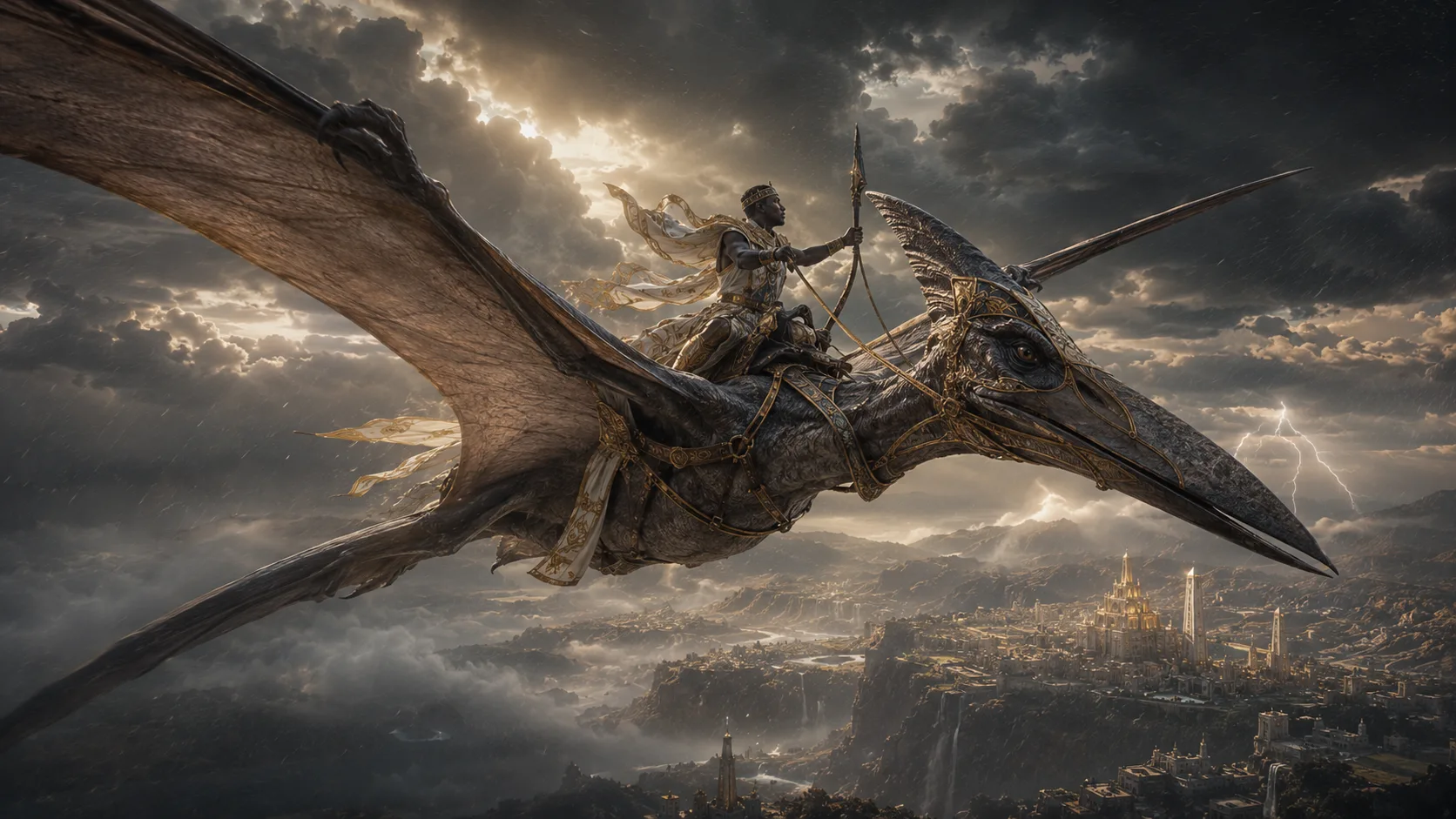
Pterosaurs
Flying reptiles, neither dinosaurs nor birds: the living air arm of Ishtir, of Volonia’s fleets and of Urnok’s relays.
Flying reptiles
Pterosaurs are flying reptiles, distinct both from dinosaurs and from swimming reptiles; they are neither birds nor dragons. Their flight depends on a network kept up from the ground: perches, resting places, care, relays, harnesses, protected routes. Inspecting membranes and resting are part of the daily work of those who handle them.
Ishtir: the Silver sky
Ishtir’s pteranodons and other pterosaurs provide observation, mail, signals, links and some military operations. The Silver rank brings together command, certification, ceratops and pterosaurs; the order of the Silver Winds organises aerial extraction, strikes and relays. The rarest are a public responsibility concentrated at Qer-Aton.
A Nacelle d’Argent is a gilded glider-cage that carries about thirty soldiers; four great pterosaurs tied to its corners lift and steer it. It sets off from a cliff, a tower or a ramp. This projection is precise but fragile: contrary winds, ballistae, the panic of a single carrier and a limited range can make it fail.
Volonia: shipboard pterosaurs
Volonia’s small marine pterosaurs relay signals, scout routes and spot shoals of fish. Ships fit them with perch-masts, platforms and recovery nets, and some vessels of the fleet carry them. Larger individuals serve for relays, light transport and aerial interception; the Hautes Îles and signal posts maintain some of the places they need.
Urnok: the Sky chain
In Urnok’s army, the Sky chain uses pterosaurs for observation, reconnaissance and relays. The separate Signals chain brings together flags, sounds, mirrors, codes and messengers.
Breeds and uses in the bestiary
In Ishtir, the solar pteranodon, or Hel-Aile, with a great crest and white-and-gold harness, serves for relays, watch and rites from cliffs and towers: only Ishtir trains and controls the great pteranodons. The Heliopte of the Zenith, messenger and watcher, traces its shadow across the sun during the Flight of the Zenith; the living beacons of the Îles du Soleil Levant fly around the towers and guide a sacred navigation.
Elsewhere, small pterosaurs do not challenge that monopoly. Volonia uses the sea Seno-Vel, which carries lanterns under its harness, for light-marking, reconnaissance and mail, and storm messengers that fly through the tempest. Arkhan and Volonia have their small, nervous trail pterosaurs for light messages. The pirates of the Broken Isles release black-winged pterosaurs at night, without lanterns, to spot their prey.
A body made for the air
A pterosaur flies with its arms. Its wing membrane, supple and living, stretches between an immensely elongated fourth finger and the hind leg, and a second, narrower panel runs in front of the arm; in flight the animal trims its sail by bending the wrist and spreading the legs. Its bones are hollow and thin as tubes, so that even large pterosaurs weigh far less than their wingspan suggests.
On the ground it walks on all fours, wings folded, resting on its wrists, and it is from all four limbs that it takes off: it vaults on its arms as on a pole, unfolds the membrane and takes to the air in a single movement. Many carry a crest on the head by which they recognise one another, and which trainers read like a face. Most live on fish, taken at the surface or in skimming flight.
Perches, nests and perch masters
Pterosaurs nest in colonies, on cliffs, islets and towers. Their soft-shelled eggs are buried in warm sand or in nesting mould, and the young, barely hatched, already fend for themselves: they fly far sooner than a young herbivore walks. Breeders therefore do not have to feed them for long, but must accustom them very early to people, to their master’s voice and to the perch to which they must always return.
The perch master watches over them. Every day he inspects the membranes for a tear, a patch of fungus or a sunburn; a small tear is stitched with collagen thread, a large one grounds the animal for weeks. He feeds them fresh fish, flies his animals in fine weather and keeps them sheltered in storms. The saddle-harness of a riding pterosaur, with a frame of hollow bone and tendon straps, costs some thirty Dracos, and in Ishtir the pilot never owns it: he is only certified to use it.
Short wings of canyons and reeds
The great pteranodon is not the only pterosaur that is ridden. In passes, canyons and marshes, people prefer a stockier, short-winged animal of some sixty kilos, which turns tightly between rock walls and lands on a ledge. In Arkhan, the riders of the dry sky fly it to hunt with the bow above the canyons and to run down fugitives; it is fast and agile, but cannot face the armoured pterosaurs of Ishtir. In N’Goro, an amphibious strain flies low over the channels and reed beds, giving the marsh a light air force quite unlike Ishtir’s heavy doctrine.
Korath, which distrusts the sky and has built its defences against it, uses these animals only for the post between its passes and for scouting the gaps. Its post pterosaurs are fed on a meal of fault insects, and it is said they recognise their own pass by the smell of sulphur.
Sénelles and sea lookouts
The smallest pterosaurs are the most numerous. The sénelle, a coastal pterosaur of about eight kilos, lives in flocks on masts and quays; every great Volonian hull carries fifteen to forty of them, which spot shoals of fish, signal fog and carry notes from one ship to another. In some harbours of the Empire, fishermen train them to fish on the wing and to carry signals from quay to quay.
The Northern Pirates have their own lookouts: small long-tailed sea pterosaurs of barely two kilos, kept at the masthead, which shriek at the sight of a sail. A lookout of this kind spots a ship several leagues off, long before the man on watch. Sailors of every nation feel for these little animals an affection the great ones do not inspire: they give them names, keep them the best scraps, and say that a ship whose sénelles fly off and do not come back will never make port.
Defending against the sky
A power without an air arm must learn to protect itself from one. The Empire raises along its coasts and roads, and around its camps, net masts paired with batteries of ballistae: the nets, stretched between tall masts, stop a diving animal, and the ballistae strike it as it climbs away. Korath’s engineers design their ballistae and cables with Ishtir’s pterosaurs in mind first of all, and Volonia arms its pterosaur carriers with ballistae against the enemy sky.
The simplest defences remain the most widespread: archers posted on high ground, roofs covered with nets, smoke that blinds the pilots, decoys laid on the ground. Pilots know it and fly high, out of range, until the moment of the dive. The whole art of fighting the sky lies in those few moments when the animal comes down and can be reached.
Part of this article covers events of season 1. Turn spoilers on in the menu to read it.