

Armies
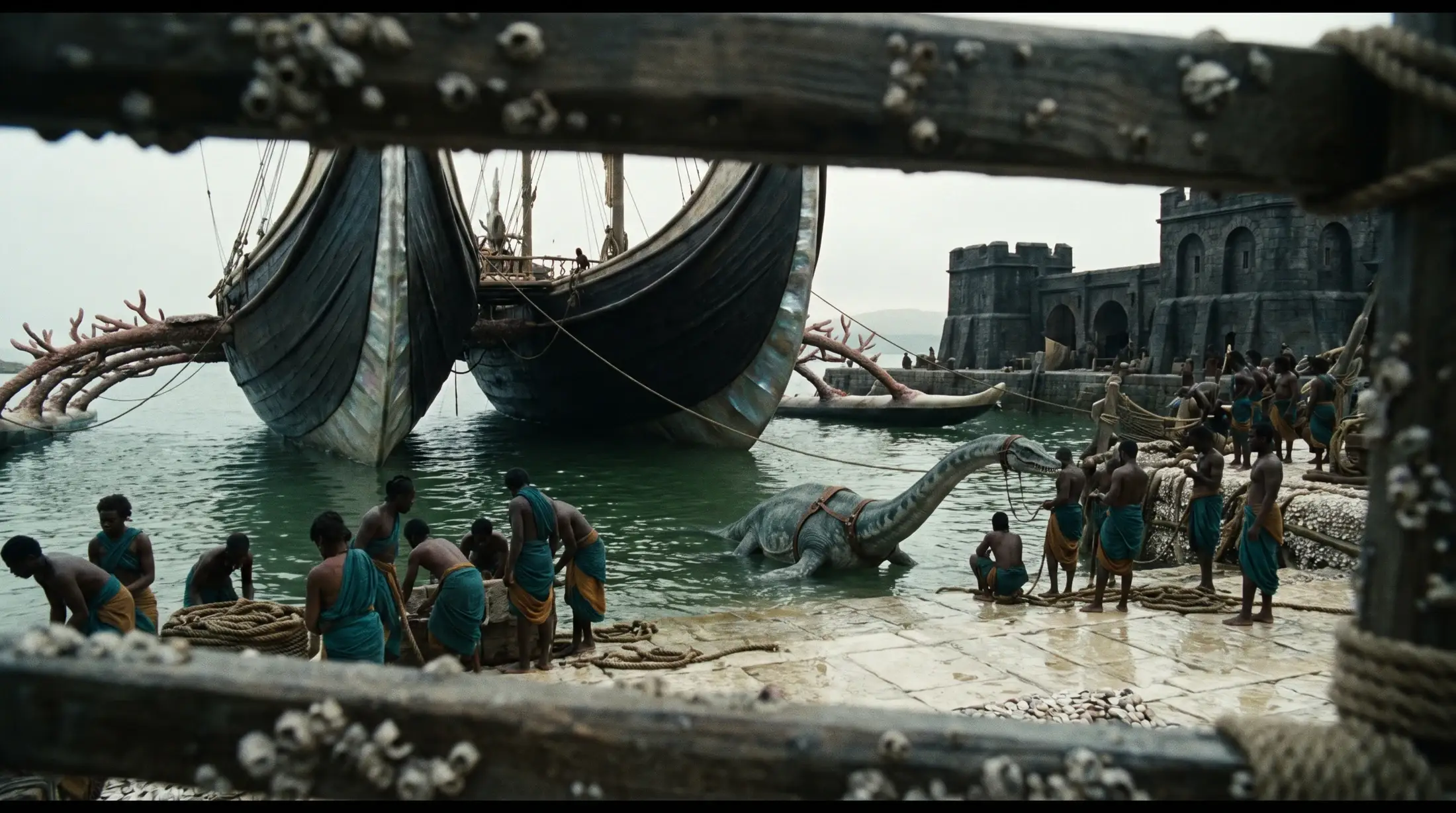
The Escorteur de Convoi
The trade-defence ship (“Convoy Escort”), armed with medium artillery, which protects convoys.
Defending trade
The Escorteur de Convoi protects trade. It accompanies convoys with medium artillery and sails with the help of plesiosaurs. Thirty-five to sixty metres long, it carries one hundred and eighty to four hundred people.
In a nation whose wealth was born of the fleet and of sea traffic, protecting cargo is a military mission in its own right, distinct from the close escort of the Frégate d’Écume and the long range of the Croiseur des Grandes Routes.
Forming a convoy
On exposed routes, Volonian merchants do not sail alone. Ships gather into convoys, in the Baie des Mille Mâts or another great anchorage, under the guidance of a route pilot and the protection of one or more Escorteurs de Convoi. The order of sailing is fixed before departure: the most valuable hulls in the centre, the slowest at the head so that the convoy sets its pace by them, the Escorteurs to windward and bringing up the rear.
The service is paid per ship and per day of escort. A house wishing to protect its cargoes hires Escorteurs or supplies its own; small shipowners club together to share the cost. The insurance chambers of Marévant encourage the practice: a cargo sailing under recognized escort pays a lower premium, and some routes can no longer be insured any other way.
Never leave the convoy
The Escorteur’s first rule is to stay. It does not chase a fleeing pirate, does not stray for an easy prize and does not leave the convoy unguarded to help a straggler: it signals, and others come. A captain who abandons his convoy for personal gain answers for every loss before the Merchants’ Court, and insurers may refuse to pay for cargoes lost during his absence.
Its medium artillery is made for this defence. It keeps raiders at a distance, smashes the oars of an approaching galley and covers the rear of the convoy, where attacks are most frequent. Its plesiosaurs let it run up and down the line of ships faster than the convoy itself moves, and place itself between the threat and the merchant hulls.
Night and fog
Convoys dread night and fog above all. Pirates like to attack at dusk, when the light blurs distances, or in the fog banks of the western routes. The Escorteur then has lanterns lit at an agreed height on every hull, counts the lights at regular intervals and rings its bell to keep the ships together. In thick fog the hulls advance by sound, each answering the bell of the one ahead.
A Phare Mobile often accompanies the great night convoys, and an experienced Escorteur knows its rhythms. It also knows that false lights exist: on certain coasts, wreckers light deceptive fires to lure ships onto the reefs. An Escorteur captain who sees a light he does not know first has the convoy close up, before even trying to find out where it comes from.
A trade of trust
The Escorteurs de Convoi are house ships more than Admiralty ships. The great merchant houses own them for their own routes; other houses have made them their speciality and sell their escorts to all comers. Their reputation is made in the insurers’ registers: a captain whose convoys arrive complete season after season finds his services in demand, and his name alone is enough to lower a premium.
In wartime, the Gathering of the Flags places the Escorteurs under the Admiralty like other ships, but it mostly leaves them to their task: trade must go on, and a fleet that wins a battle while the convoys are plundered has not won much. Sailors say the best Escorteur is the one whose convoy has nothing to tell on arrival.
Weeks at the pace of the slowest
Escort duty is mostly waiting. The hundred and eighty to four hundred men of an Escorteur spend weeks at the pace of the slowest ships, watching the horizon, counting the convoy’s sails every morning and rounding up stragglers. The officers keep a log in which every escorted ship has its line, with its condition and its delays; this log accompanies the declaration handed to the insurers on arrival, and the escort’s pay is settled on it.