

Armies
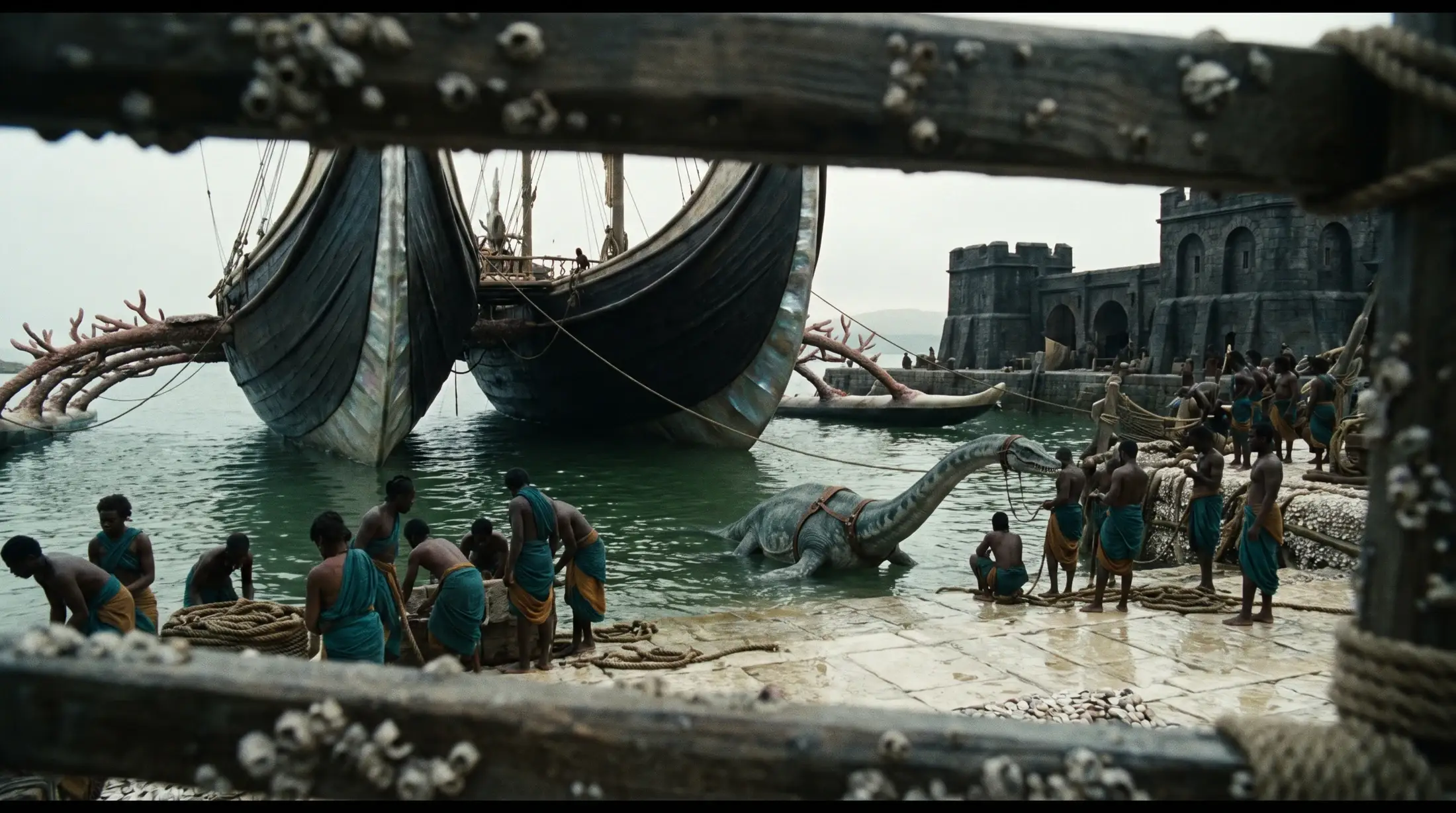
The Grenier du Large
The supply ship (“Offshore Granary”): water, food and fodder for the animals.
Feeding a fleet at sea
The Grenier du Large carries water, food and animal feed. It lets combat ships continue a campaign without carrying all their reserves themselves. It sails with a light defence and carries one hundred and fifty to three hundred and fifty people on a hull of fifty to ninety metres.
What the hold carries
A Grenier du Large is first and foremost a hold. Its broad, deep hull, divided by watertight bulkheads, carries up to a thousand tonnes of cargo. Fresh water fills the bottom, in barrels bedded in sand and jars lashed into baskets; above come the crews’ provisions — black-salted fish, ship’s biscuit, dried vegetables, ration rum — and the animals’ rations, which often take up the largest share of the space.
For it is the animals that eat the most. A draught plesiosaur consumes nearly ninety kilograms of fish a day, and a Great Hull of the Line harnesses eight to fourteen of them: the team of a single large ship alone needs almost a tonne of food daily. The Grenier therefore carries salted cast-off fish, fish meal and dried squid, as well as a few cages of small farmyard dinosaurs for the crews’ fresh meat. The provision clerks keep count of every barrel in Quay Notation, and that count decides the day the squadron must head home.
Resupplying at sea
Transfer is the Grenier’s most delicate manoeuvre. In a calm sea it comes alongside the ship to be served; the two hulls are held apart by rope fenders and brought closer or eased away by their plesiosaur teams. Barrels pass from one deck to the other in nets slung from cargo booms, and the animals’ rations are often lowered straight into the water, in baskets that the masters of traction hand out to the teams.
In heavy weather, it is better to wait for a sheltered anchorage or to use boats. The Admiralty indeed often chooses its rallying points according to transfers: a calm bay where several Greniers can serve an entire squadron within a tide is worth as much as a port to an admiral. A failed transfer is costly, for a broken net can send a team’s food for several days to the bottom.
A crew of storekeepers
The hundred and fifty to three hundred and fifty people aboard a Grenier du Large are not all sailors. There are coopers, salters, storekeepers, cooks, feeders responsible for preparing the animal rations, and fishermen who top up the stores on the way with trailing nets. The provision clerks, few in number, are among the most listened-to people aboard: they know better than the captain how many days the fleet can still hold out.
The ship’s defence remains light. A few ballistae, sea crossbowmen and net-throwers are enough against an isolated raid, but the Grenier relies above all on the fleet it feeds. Its crew knows this and hardly complains: on the quays it is said there is no ship where one eats better.
A prime target
For an enemy, sinking a Grenier du Large is worth almost as much as sinking a Great Hull. A squadron deprived of its stores must turn back or ration its animals, and underfed plesiosaurs pull for less time and fight worse. The pirates of the south-west and the island privateers therefore readily target supply ships, especially when they lag behind or are separated from their escort.
The Admiralty draws its rules from this. In formation, Greniers sail in the centre, surrounded by convoy escorts and Frégates d’Écume; they are never sent ahead of a fleet alone, and their route is kept as secret as that of the fighting ships. Houses that own them hire them out dearly at the time of a Gathering of the Flags: on the quays, a squadron is said to go as far as its Grenier.
In peacetime
In peacetime, the Greniers du Large do not stay in port. Fishing houses hire them to accompany their fleets to the Great Ocean, where they bring traction rations and leave laden with salted fish; others resupply the lighthouses, signal towers and relay archipelagos, which do not produce enough to feed their garrisons and pterosaurs. A supply round of the northern islands can keep a Grenier busy for a whole season.