
Institutions
The College of Pilots
The institution that holds Volonia’s knowledge of routes: currents, migrations and ocean windows.
The knowledge of routes
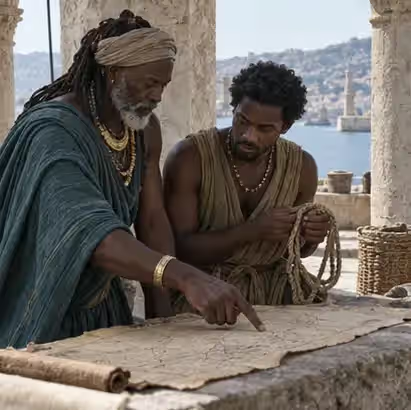
The College of Pilots gathers Volonia’s knowledge of navigation: routes, currents, migrations and ocean windows. A passage window gives a voyage a dimension of time. Knowing where to go is not enough to decide when to leave; season, current, cargo and towing animal change which route can be used.
This expertise completes the contract. When it must be decided how and when a voyage can take place, the pilots’ judgement counts as much as the availability of a ship or the expected value of a catch.
The key to the Great Ocean
Volonia is the only great power able to exploit the Great Ocean regularly. The Great Ocean pilot, a trade attached to the College, reads currents, migrations and open-sea windows; the register of trades links this knowledge to Volonia’s monopoly on deep fishing. Other nations reach the fish, oils, bones, pearls and materials of the open sea only by going through Volonia.
Training pilots
Pilots are trained on the Pilots’ Islands, home to the House of Pilots and the School of Routes, and aboard training ships, which teach pilots and officers navigation and command. The Register of Hulls and Routes then records the pilot among the details that allow a vessel to be committed to a route.
The watch pilots and the passes
The College does not live only in its study halls. Its watch pilots hold the passes of the great ports, which no foreign ship and no Great Hull enters without them. When the signal tower announces a sail, a pass pilot boat — a fast craft some fifteen metres long, rowed by a dozen men — goes out to meet the vessel and puts the pilot aboard. He takes charge as far as the anchorage and directs the berthing with the port’s teams of draught plesiosaurs.
The College also maintains the buoyage. Its painted, weighted buoys mark the channels, the shoals and the waiting areas; the Current Beacon ships, small vessels of twenty to forty metres, lay them, recover them after storms and measure the strength and direction of the currents on every outing. A buoy moved without the College’s order is a serious offence: it can send a whole convoy onto a reef.
Tables, charts and windows
Each season the College publishes what sailors expect of it. The tide tables of the great ports, computed with the observatories of Marévant, are copied and sold in every trading post. The coasting charts, which describe the coastal routes, shelters and watering places, are open to anyone who pays for a copy. The calendar of windows indicates, for each great route, the periods when current, wind and migrations make the passage favourable or dangerous.
Other documents never leave the College. The charts of the Great Ocean, the surveys of the deep banks and the migration routes of great wild reptiles are entrusted only to sworn pilots, who learn them and hand them back. The distinction is old and deliberate: the republic sells the safety of coasting to everyone, but keeps for itself the knowledge on which its high-sea monopoly rests.
Finally, pilots write a route report after every crossing. The College compares them from one season to the next; this is how it spots a sandbank that is advancing, a current that is shifting or a pass that is closing.
From the pass to the Great Ocean
The College ranks its pilots by the extent of what they are entitled to conduct. The pass pilot knows a single port and its approaches, which he works every day. The coasting pilot takes ships from one port of the League to another. The route pilot leads convoys along the great routes, towards Urnok, Arkhan, Korath or N’Goro. At the top, the pilot of the Great Ocean conducts the distant fishing fleets and the high-sea crossings.
One moves from one rank to the next only after a number of crossings attested in one’s logbook and an examination before senior pilots. Each rank carries a seal of the College, which the pilot sets on his reports and on the log of the ships he conducts. In case of loss, the Merchants’ Court reads that seal as a guarantee: a pilot who has conducted beyond his rank loses the College’s protection and answers alone for his decisions.
The pilot as a weapon
The College’s knowledge has a diplomatic reach that the League embraces. Its doctrine makes it a principle: rights of access, of call, of repair, of financing and of pilots can become geopolitical weapons. Granting or refusing a pilot means opening or closing a coast to a foreign fleet that knows neither the passes nor the windows.
A Volonian pilot does not conduct a foreign war fleet without the League’s consent. The rule protects the republic’s deepest doctrine: to prevent a power already dominant on land, Urnok first of all, from gaining complete freedom at sea. In a recognized war, the College places its pilots at the disposal of the Admiralty of the United Fleets; they are the ones who guide the gathered fleet through the approaches and choose, with the admiral, the hour to enter a pass.