
Creatures
Noasaurids
Small Arkhan theropods used for harassment, signals and spreading panic.
Harassment, signals and panic
Noasaurids are among the animals bred in Arkhan’s networks. They serve for harassment, signals and panic devices. Their role differs both from that of ridden raptors and from that of the great predators: they are small, light theropods, scaled and featherless.
Open herds and flutes
Open herds supply animals for several uses. Flesh, carcasses and offal are distributed according to the species, since humans and domesticated carnivores do not have the same needs. Sound signals and learned habits guide the groups; the flute removes neither hunger nor the animal’s reactions, and keepers must preserve distances and exits. The Sand Serpents khanate, Drazka’s, has made noasaurids, flutes and the geometry of panic its speciality.
War beneath the line
At the Three Waves, Orgaï opened Urnok’s centre through corridors: noasaurids slipped through infantry that seemed to give way, and an army set up to receive masses of several tonnes suddenly faced small, fast bodies. In Arkhan’s chain during that battle, the Apex unbalanced, artillery wounded, noasaurids cut the titans off from their screen and cavalry exploited.
A small pack body
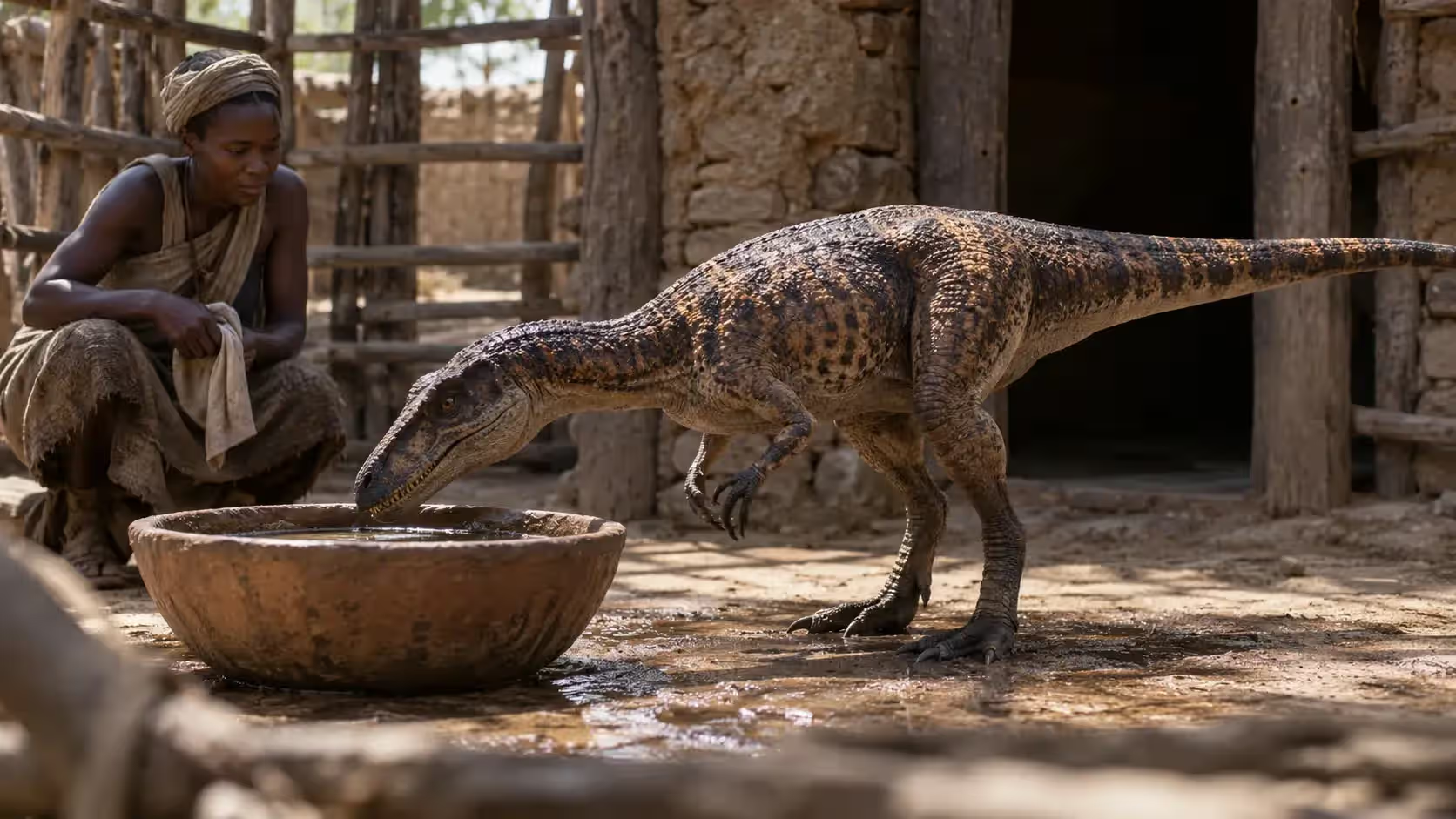
The noasaurid is a small theropod of some twenty kilos, one and a half to two metres long including the tail, long-legged, with a slender neck and a narrow head. Its front teeth point forward like a rake and serve to seize and tear rather than to slice; its hands are short and of little use. Its scales are fine, sand-brown or ochre, without a single feather. It is a nervous animal, quick over short distances, and it cries a great deal: a shrill, jerky call that carries far and that the Serpents de Sable have learned to use.
It lives fast. A noasaurid is adult in a year and a half, lays four to eight eggs after six weeks of incubation, and seldom lives more than ten years or so. It eats little, less than a kilo a day, of offal, carcass scraps, insects and small prey. That is what allows the Serpents de Sable to breed them by the thousand, where whole herds would be needed to feed a few Apex.
Raised to the sound of flutes
The Serpents de Sable breed noasaurids in great open enclosures, such as those of the Sablières Mordantes, among the meat herds whose leftovers they share. They are not trained one by one: they are trained as a pack, from hatching to adulthood, to the sound of the mass flute, a long bone flute that plays not music but orders. A pack learns to gather, to set off in a direction, to stop and to cry out on command; it does not learn to carry a rider, and no one rides them.
Their keepers live among them, hands rubbed with resin, and know the signs of a pack about to fight or flee. Noasaurids are rarely sold; they are hired out instead with their trainer, for four hundred to twelve hundred Dracos at Port de Sable, because a pack without its flute-player is worthless within a few weeks. The Volonian merchants who tried to keep some without a trainer learned this the hard way.
Beneath the pikes
In war the noasaurid does not fight head-on. It is released in packs on the flanks, in the tall grass, under the legs of men and beasts: it bites hamstrings, ankles and leg tendons, slips beneath the pikes the infantry holds to stop great masses, and is gone before anyone can strike it. A troop trained to receive the shock of beasts weighing several tonnes finds itself fighting small, quick bodies it sees only at the last moment, and its ranks come apart of their own accord.
Its cries serve as much as its teeth. Let loose around a camp at night, a crying pack prevents sleep and panics the mounts; sent in a precise direction, it shows the riders following it where the enemy is. Armies that face Arkhan have learned to guard against it: low shields, grass fires, close ranks, greaves of thick leather. None of these defences removes the panic, and panic is what the Serpents de Sable are after.
What people say of them
The old trails look down on noasaurids. They are not mounts, they have no lineage to recite, and their war of low bites passes for the trick of a poor khanate. Urnok’s soldiers fear them more than they admit: they call their cry “the laughter of the steppe”, and after a battle they talk among themselves of the small footsteps they heard in the grass.
Among the Serpents de Sable, who simply call them the Jaws, people do not like hearing these beasts called vermin. Drazka herself holds the insult to be a fault, and her people always take it up. They say the noasaurid is the most honest of war beasts: it costs almost nothing, asks for neither saddle nor glory, and does exactly what hunger does, which is to get through everywhere.