

Economy
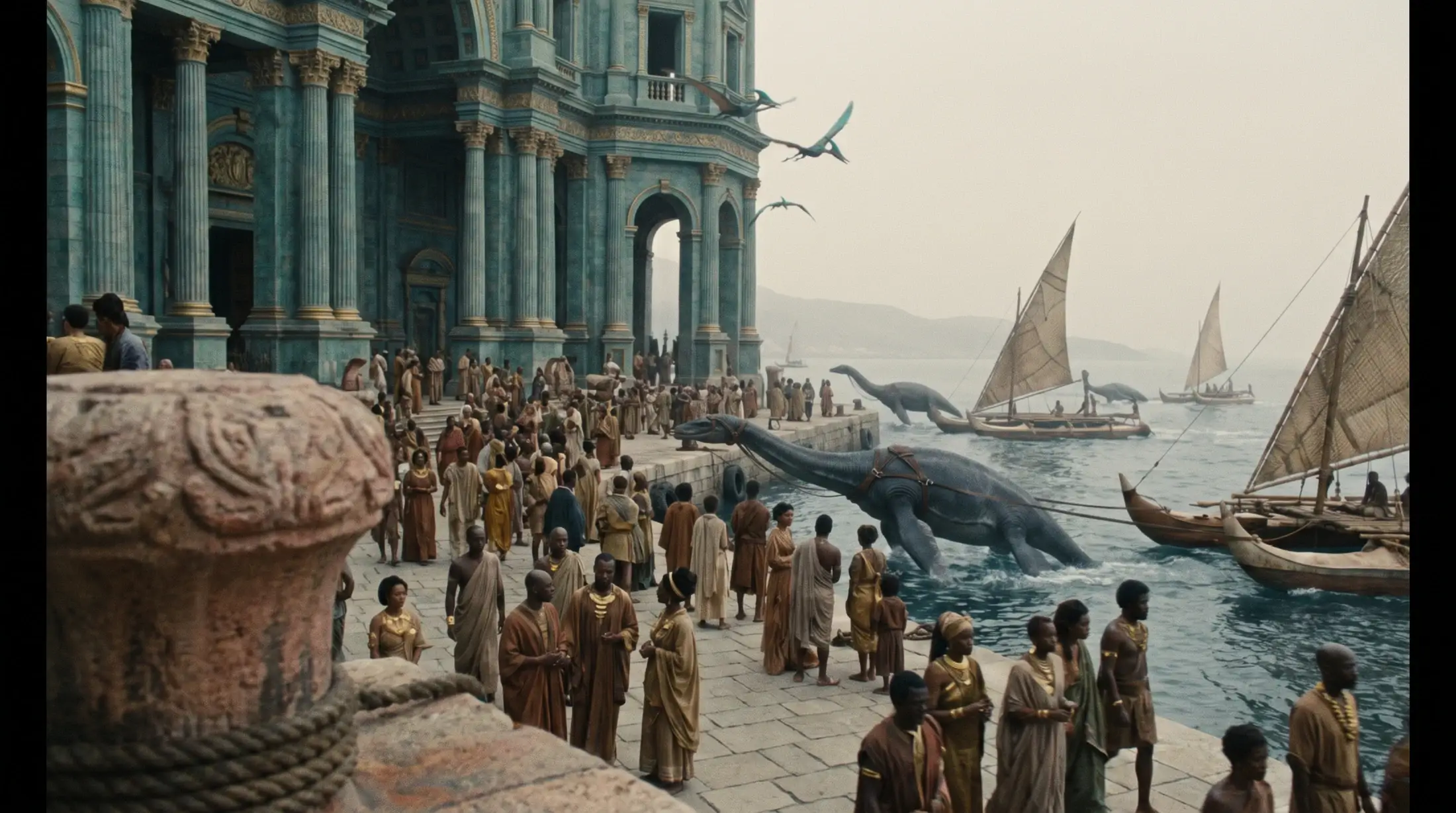
Volonia’s trades of risk
Claims brokers, road and harbour insurers, rare-creature gaugers, campaign estimators and maritime-clause jurists: in Volonia, monsters and crises become a price.
Turning monsters into prices
Volonian insurance rests on five terms: premium, seizure, reputation, proof and risk. Its consequence is well known: Volonia turns monsters into prices.
Dominating through the aftermath
The claims broker converts a loss, a reputation or a debt into a price: Volonia dominates first of all through the aftermath of crises. The road insurer turns a crisis into a premium; the harbour insurer prices the risks of living cargoes, breakage, shipwreck and sea predators.
The price of rare living creatures
The rare-creature gauger values beasts, captives and risks to set their price, without dying in the process: in Volonia, rare living creatures become first of all a value. The campaign estimator separates an expedition’s cost, the shares of the prize, the insurance and the predictive wager; he prices a war before it sets out.
Conquest without the word
The maritime-clause jurist turns an armed intervention into a lawful seizure. It is conquest without ever uttering the word.
The risk gauger
The risk gauger is the oldest of the risk trades. He calculates what a route, a season or a cargo may cost by combining three things: the loss tables, kept route by route for centuries; the reports of pilots and captains; and the signs, the colour of the sky, the flight of the pterosaurs, the nervousness of the plesiosaurs before a squall. The old gaugers also read omens, and many still do.
A quarrel runs through the trade. The recent schools, of which House Bellcor has made itself the champion, have kept the tables and dropped the omens, and boast that they pay more fairly. The old gaugers of Marévant answer that a pterosaur refusing to leave its mast sometimes knows more than a register. Prudent captains consult both.
Learning risk
These trades are learned in two ways. Most brokers and insurers start as clerks in a house, copying policies and tables, before earning the right to sign in the Sealed mode. The others go through the House of Errors at Marévant, the oldest school in Volonia, which studies catastrophic contracts, shipwrecks and false charts, and whose graduates always learn two trades, one of the office and one of the sea: an insurer also learns to dive or to steer there, a lawyer to gauge a cargo.
The trade is paid by commission: the claims broker takes a share of what he makes others pay or avoids paying, the campaign estimator a share of the shares he helped to sell. The great fortunes of risk are made in a few seasons of crisis, and unmade just as fast: a broker who misjudged a route loses his clients even before the end of the trial.
What people think of them
Sailors have little love for the people of risk, and they have words for them: they are called drowned-men’s accountants, because they arrive on the quays at the same time as the wreckage. On the day of a shipwreck, the claims brokers are there before the families, question the survivors in the Hand mode and draw up the list of what is lost. Sailors know, though, that it is they who will make the widows be paid, and that without a policy a vanished crew leaves nothing but debts.
Foreigners see in these trades a kind of scavenger, living off the deaths of others. Volonians answer that these scavengers have made their ports the only ones in the known world where a sailor’s widow can hope to be paid.
Risk at war
In war, the role of these trades grows. The campaign estimator prices an expedition before it leaves, and his figures often decide whether it sails: if the shares find no takers, the fleet stays in port. The maritime clause lawyer drafts the deeds that will turn an armed intervention into a lawful seizure, and the route insurer sets the price of every convoy that must cross a contested sea. Volonians say they lose fewer wars than others because they have already lost them on paper before starting them.