
Armies
The Cloche d’Abîme
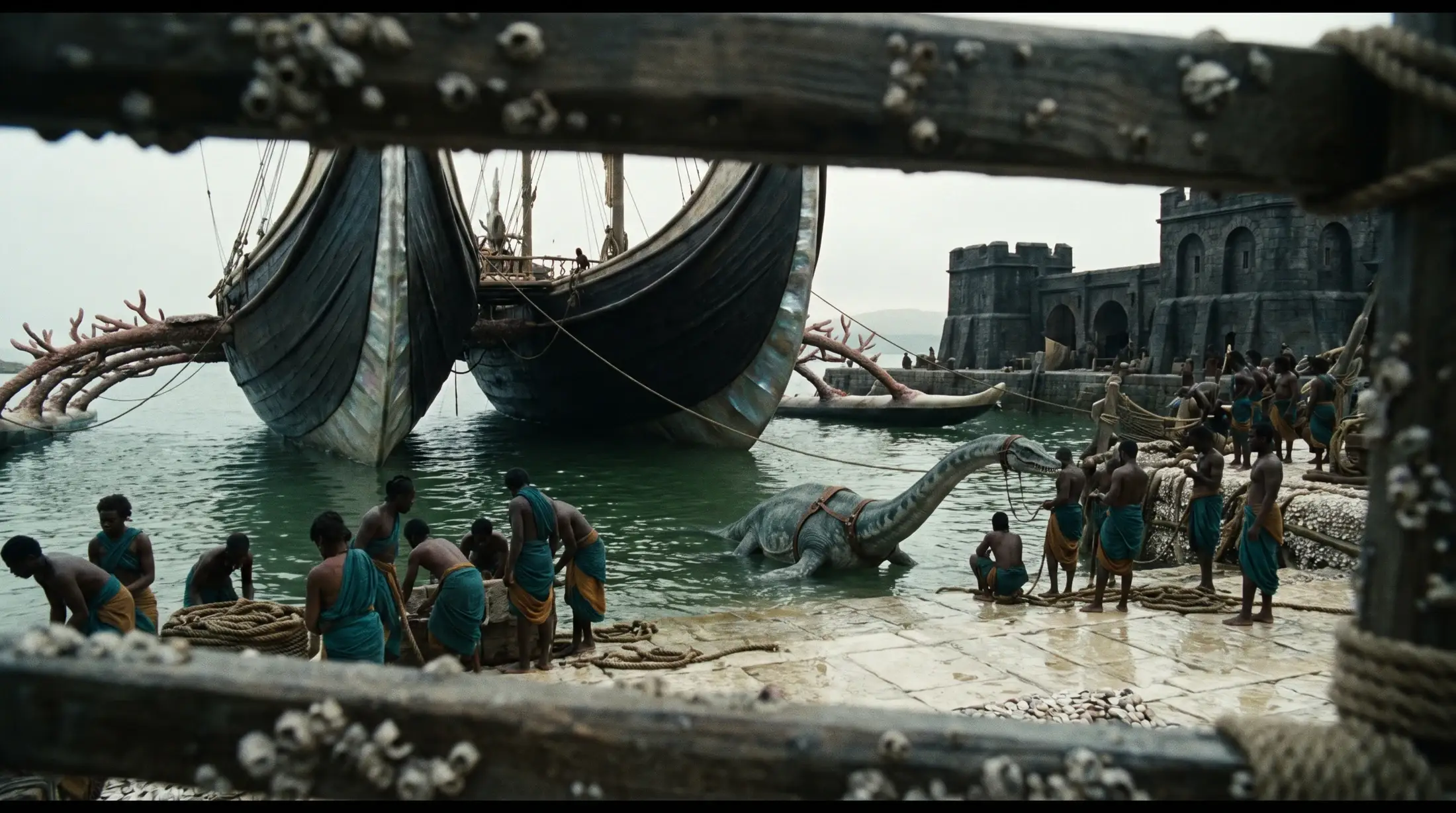
A small underwater-operations ship (“Abyss Bell”), towed by plesiosaurs, which carries divers, caissons, cutting tools and charges.
Working under the enemy hull
The Cloche d’Abîme is a small vessel of twenty to forty metres, towed by plesiosaurs. It carries divers, caissons, cutting tools and charges: its mission is work under water, up to sabotage.
It does not turn its divers into sea creatures: the Volonian swimmer works on held breath, with harness and bell, without any supernatural breathing; breathing bladders and bells provide limited air, caissons and underwater transfers, with constrained duration and depth.
A ship that hides under the water
The Cloche d’Abîme is a small, low, heavy vessel, designed to settle until it is no more than a hump awash. Its ballast compartments are flooded little by little until only a hatch and an air intake show; thus submerged, it is towed by night by its plesiosaurs, invisible a few lengths away. This is what earns it its reputation as an undersea ship, which it only half deserves: it does not sail under the water, it hides in it for the time of an approach.
Beneath its hull hangs the bell that gives it its name, a great bronze bell open at the bottom, in which air stays trapped. Close to their objective, the divers go down into it, catch their breath between dives and leave it to work. Air skins, filled at the surface and lowered with weights, renew the bell’s air during the operation.
Charges and cutting tools
The Cloche’s charges are not explosives. First come breaking hooks, heavy blocks of stone and lead fitted with hooks, which the divers fasten to an enemy ship’s rudder, anchor cables or harness traces: when she gets under way again, the weight tears the part away or sets the ship adrift. Then there are jars of sea fire, fixed at the waterline against a hull and lit at the last moment by a swimmer.
Cutting tools complete the set: saws to sever anchor cables and harbour chains, augers to bore a plank below the waterline, shears to cut nets and barriers. A successful night’s work can leave an enemy fleet drifting at dawn, with ships taking water without anyone having seen the attack.
The Cloche’s divers
The forty to a hundred and twenty people aboard are mostly divers, chosen from among the best swimmers of the republic. Many come from Girvane, where children learn to free-dive on the pearl banks. They work in pairs, joined by a line, with a detachable weight, a knife and tools tied to the wrist. Their time underwater is counted in breaths, and a dive master who stays in the bell tugs the line when it is time to come up.
They also use the products of N’Goro, filters and pastes against irritation and pressure, which the Citerne des Profondeurs brings them. Veterans know their price: headaches, tremors, the need to take more. The trade is among the most dangerous in the fleet and among the best paid. It is said in Girvane that a Cloche diver can recognize an enemy hull by touch, in the dark, from the way its planks are nailed alone.
Work in the shadows
In peacetime the Cloches d’Abîme do not lie idle. They raise sunken cargoes for the Récupérateurs d’Épaves, inspect the keels of Great Hulls without taking them out of the water, and maintain the foundations of quays and the entrances of undersea palaces. League ports use them to check, before a season of war, that their harbour chains and barriers have not been sawn through over the winter.
Their very existence is enough to worry people. In foreign ports, the presence of a Volonian ship riding low in the water doubles the guards on the anchor cables, and more than one captain sends his own men down beneath his hull before weighing anchor.
A night of approach
A Cloche operation is planned like a tide. The captain picks a moonless night and a current setting towards the target, so that the plesiosaurs need only guide the hull. The Cloche leaves at dusk, submerges at a distance and approaches at the slowest pace; the last league is often made adrift, the team held back, so as to raise no foam. The divers go down when the bell almost touches the target hull and must be done before the sky pales. The Cloche then slips away on the ebb, and only in the morning does anyone know whether the night succeeded.