

Religion and rites
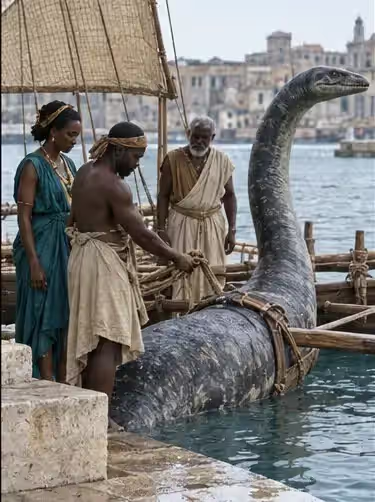
Volonia: Crossing and Return
The sea connects origins, travellers and the memory of the drowned.
Returning towards the beginning
The religious core holds that humans and dinosaurs come from the sea. Returning towards it brings them closer to their origins. Crossing, Return, Witness and Tide are concepts that give depth to sea travel. The cult’s name, clergy and major deities remain little known; these words do not make a pantheon.
Blessing those who leave
Blessings of swimmers and ships accompany a civilisation of circulation. The memory of the drowned recalls the human cost of passage. Blessing thus accompanies passage, crews and the memory of the drowned.
Faith and the body’s limits
Religious closeness to the sea does not remove the body’s limits. Volonians learn early to swim, dive and read currents, then use harnesses, bells, air bladders and caissons when the work demands it. No supernatural breathing exists: the depths remain dangerous and air limited.
Fortune and the current
Religious language likens wealth to a current and success to the ability to float. The image celebrates navigators’ skill and courage; it can also justify harshness towards those weighed down by debts or unable to find work. Yet the rites of the dead maintain obligations beyond success: a house answers for its drowned, its widows and its missing.
Blessing the passage
In Volonia religious festivals often take the form of legal acts. The Reckoning of the Tides blesses the season’s tide tables and insurance contracts; the Voilecou Procession leads ceremonial elasmosaurs by night between two rows of lanterns. Every departure also commits those who stay on the quay.
The Sacred Portolans
Volonia’s scriptures are maps: the Sacred Portolans are tide-charts made sacred. The Quay Notations, made of accounts and cursive, stand in for holy writ.
What the four rites involve
The Crossing is the rite of departure. No ship of the League leaves port without being blessed in a quayside chapel: the officiant sprinkles the bow with seawater, reads aloud the name of the hull and that of its captain, and each crew member touches the chapel’s threshold stone on the way aboard. The blessing of swimmers belongs to the same rite: at about five, a child takes a first bath in the sea in front of the district chapel, in a parent’s arms, before a witness.
The Return concerns the dead, but also the living who come home. The first thing a crew does on reaching port is to ring the chapel bell and declare there, in the Hand mode, who has come back and who has not. The Witness is less a rite than a religious duty: every birth, marriage, death and oath requires someone who saw, and refusing to testify to a drowning is considered a grave fault. The Tide, finally, governs sacred time. People marry on the rising tide, the dead are given to the sea on the ebb, and the season’s tide tables are blessed like relics at the Reckoning of the Tides.
The chapels and their officiants
The religion of the sea has neither a single head nor a state clergy. It lives in hundreds of harbour chapels, funded by the houses, the guilds, the neighbourhood associations or the crews themselves. Those of Marévant or Port Volon have white stone vaults, bronze bells given by the great houses and walls covered with names; those of the wreck-cities stand on a few stilts and own nothing more than a salvaged bell. All of them open onto the water, and all keep a register of departures, returns and the drowned.
Officiants marry and live among the quay people; many were sailors, pilots or sailors’ widows before taking up the charge. They bless hulls, read deeds, ring bells, keep the registers and look after the chapel’s copy of the Sacred Portolans. They live on the share each ceremony pays them and on the support of the house that protects their chapel. They are also entrusted with gastroliths: these plesiosaur stomach stones, polished by years of digestion and recovered from the bottom of the basins, are held to be stones the sea has chosen, and many sailors wear one as a talisman.
The sea gives, Fortune decides
One phrase sums up Volonian piety: the sea gives, Fortune decides. Fortune has no temple, and no sacrifices are offered to her. She is invoked at the moment of risk, when a captain signs a premium, when a diver goes down, when a bettor places a stake. The wisdom of the quays holds that she favours those who have prepared their hull, their charts and their guarantees, and a common house motto puts it in its own way: “The sea gives back what one knows how to take.”
This morality turns honest accounts into a religious matter. Paying one’s debts, declaring one’s gains and keeping one’s sealed word are pious acts; the great fraudster does not only betray the republic, he closes off his own return to the sea. The most esteemed alms are not given to the poor in general but paid into the fund for the families of the drowned that every chapel keeps: it is this fund sailors have in mind when they say they have “paid for their place”. A house that gives generously boasts of it, and the names of the great donors are read in the chapel on the day of the Reckoning of the Tides.
A faith of ports, open to strangers
Volonia does not impose its religion. Migrants keep their gods, their feasts and their dead; a quayside chapel willingly blesses the hull of a foreign captain who has paid for his place in the pass, and nobody asks him what he believes. Volonians look at other faiths with curiosity rather than hostility: Ishtir’s cult of the Sun strikes them as admirably severe but unliveable, Urnok’s veneration of the great beasts that carry the Empire seems strange in a people that swims so little, and the N’Goro rites, which give the dead back to the marshes, seem close to their own.
War has its place in the religion of the sea. On the day the Gathering of the Flags is pronounced, every chapel of the League rings together, and the gathered ships are blessed one after another before they join the Admiralty. When a campaign returns, the bells ring for each lost hull, whatever house fitted it out, and the names of the dead are read before the families assembled on the quays.