

Trades
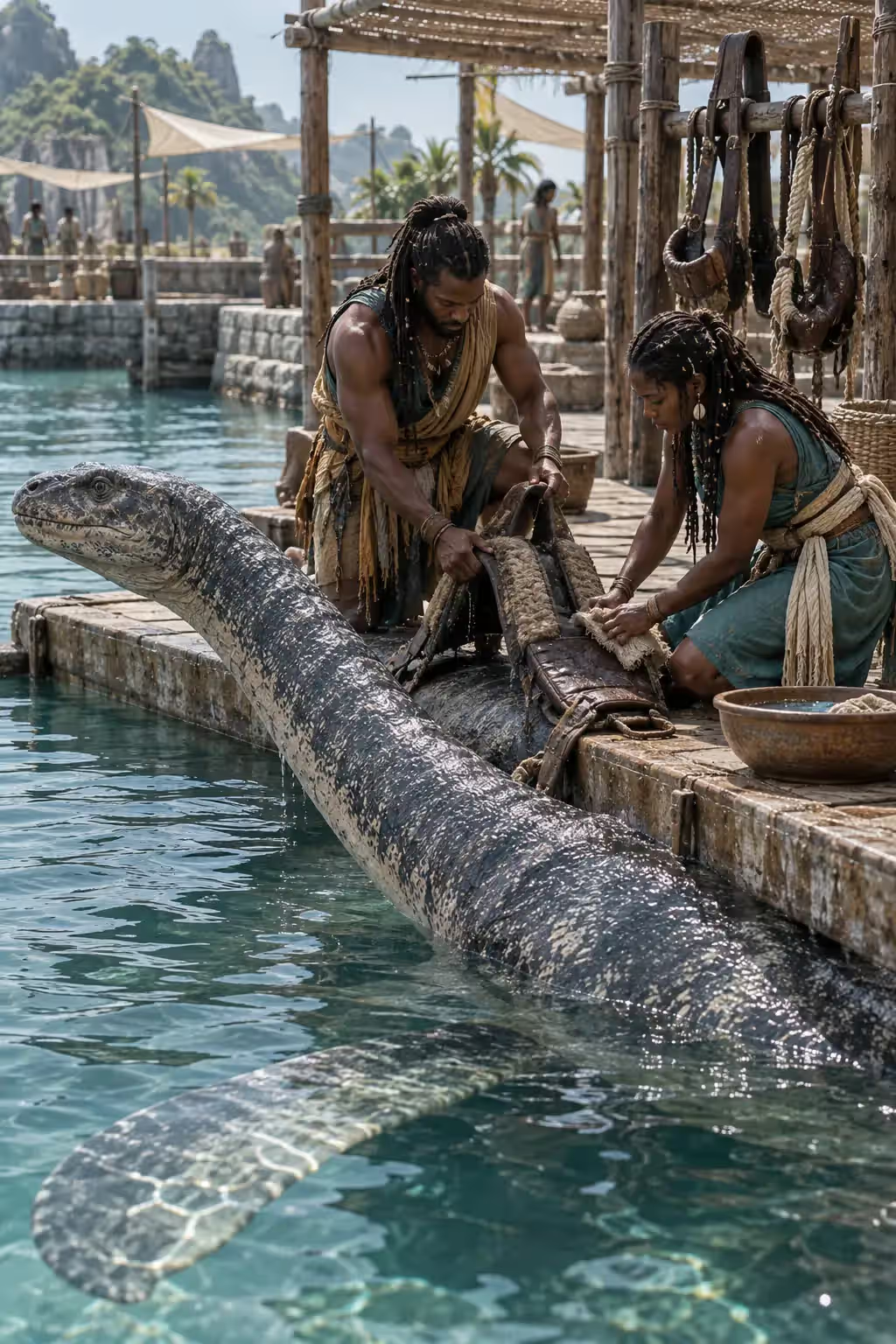
The plesiosaur traction master
The traction master coordinates the harnesses, rotations, rest and signals of plesiosaur teams: through him, the marine reptile becomes the engine of Volonia’s ships.
The reptile becomes an engine
The plesiosaur traction master coordinates the teams’ harnesses, rotations, rest and signals. Through him, the marine reptile becomes a ship’s engine. The plesiosaur is Volonia’s civilisational animal: towing, building sites, fishing, rescue, transport, the high seas, racing, firing platform, coastal war and links with the undersea cities. In Volonia they say it: the mosasaur protects the republic, the plesiosaur made it possible.
The largest Volonian ship reaches about a hundred and fifty metres; its flagship model can harness twelve to eighteen traction plesiosaurs.
At the service quay
In port, plesiosaurs stay in the water. Service quays separate the keepers’ movements; the waiting area makes it possible to observe the animal and remove its gear, which is rinsed and hung up. Marine harnesses are among Velasar’s products, along with floating cages and quays.
The rotating team
A plesiosaur does not tow a ship without respite. Each animal wears a two-point side harness, linked to the hull by traces of salted tendon, and the team works in rotation: some pull while the others swim freely alongside the hull or rest aboard a support ship. On a Great Hull that harnesses eight to fourteen animals, the traction master decides at every watch who pulls, who rests and who must be taken off.
He decides by watching. The breath of a tiring plesiosaur grows shorter, its flippers beat unevenly, its head sinks below the surface. The master passes on his orders by bronze whistles, by the swimming drums that set the cadence, by flags for distant teams and by coded tugs on the traces. He knows each animal by its name, its character and its habits, and knows which can last a night of towing and which cannot.
Becoming a traction master
One becomes a traction master after a long career. Basin children begin by feeding the animals and rinsing the harnesses; they become keepers, then harness-makers, then seconds of a team, and receive the title of master only after several campaigns and an examination before older masters. Many learned at the marine stud of the Doubles-Carènes, where plesiosaurs are born alive, in the water, and learn the harness from their first seasons, beside their mother.
On board, the traction master is the captain’s equal in his own domain. Sailors put it this way: the captain commands the hull, the master commands what pulls it. He draws a large share of the pay, and a house that wants to keep a good master offers him campaign shares. His authority nonetheless rests on his reputation: an animal dead of exhaustion under his orders follows him for a long time, and the Merchants’ Court may ask him to answer for it.
Traction in battle
In battle, traction is the enemy’s first target. Enemy harpooners aim at the teams to immobilise a ship before boarding it, and a pliosaur can swoop on a team beneath the hull. The master must then manoeuvre his animals out of range, bring the team in close to the hull, or decide to cast it off: by cutting the traces, he gives the plesiosaurs back to the sea, where they can flee, rather than let them sink with a lost ship.
A gathered fleet has a traction master on the Admiralty’s staff, who shares out the teams between ships and decides when a squadron must rest before battle. Animals cast off at sea often come back by themselves to the ships of their fleet, drawn by the whistles they know; masters love to tell of these returns, which count among the finest moments of their trade.
Caring for a team
The traction master also answers for the health of his animals. He watches over the rations, nearly ninety kilos of fish a day for each traction plesiosaur, over the wounds the harness opens at the shoulders, the parasites that settle under the flippers, and the fine teeth the animals lose and renew. After each campaign, the team spends several weeks in the resting basin; a master who cuts this rest short to gain a season often pays for it with an animal lost the following season.