

Culture
The Nacre Nights
Volonia’s society nights: banquets on the water, pearls and games of sebi, where wealth becomes spectacle and spectacle becomes information.
Tables on the barges
The Nacre Nights (Nuits de Nacre) set their tables on barges along illuminated canals. Black pearls, masks and nacre tokens sliding across the sebi table are all on display; a maritime fortune can change hands in a single game. Lobster dinners and games of sebi belong to the evenings of the wealthy.
Spectacle as information
There Volonia turns its war wealth into spectacle, and its spectacle into information. Patricians of the great houses, captains, courtesans and foreign princes who have come to lose with elegance mingle; the merchant patriarch Aurel Vornëa holds his salon there. Every conversation is a disguised risk premium.
When the Nights come
The Nights of Nacre are held in the season of returns, when the Great Ocean fleets and the pearl convoys come back to port and the houses have fresh money to show. They last several nights, first along the canals of Séloris, then at Port Volon. House Vornëa opens first; the other great houses then moor their own barges, and the place of each in the guests’ arc tells the whole port where it stands this season.
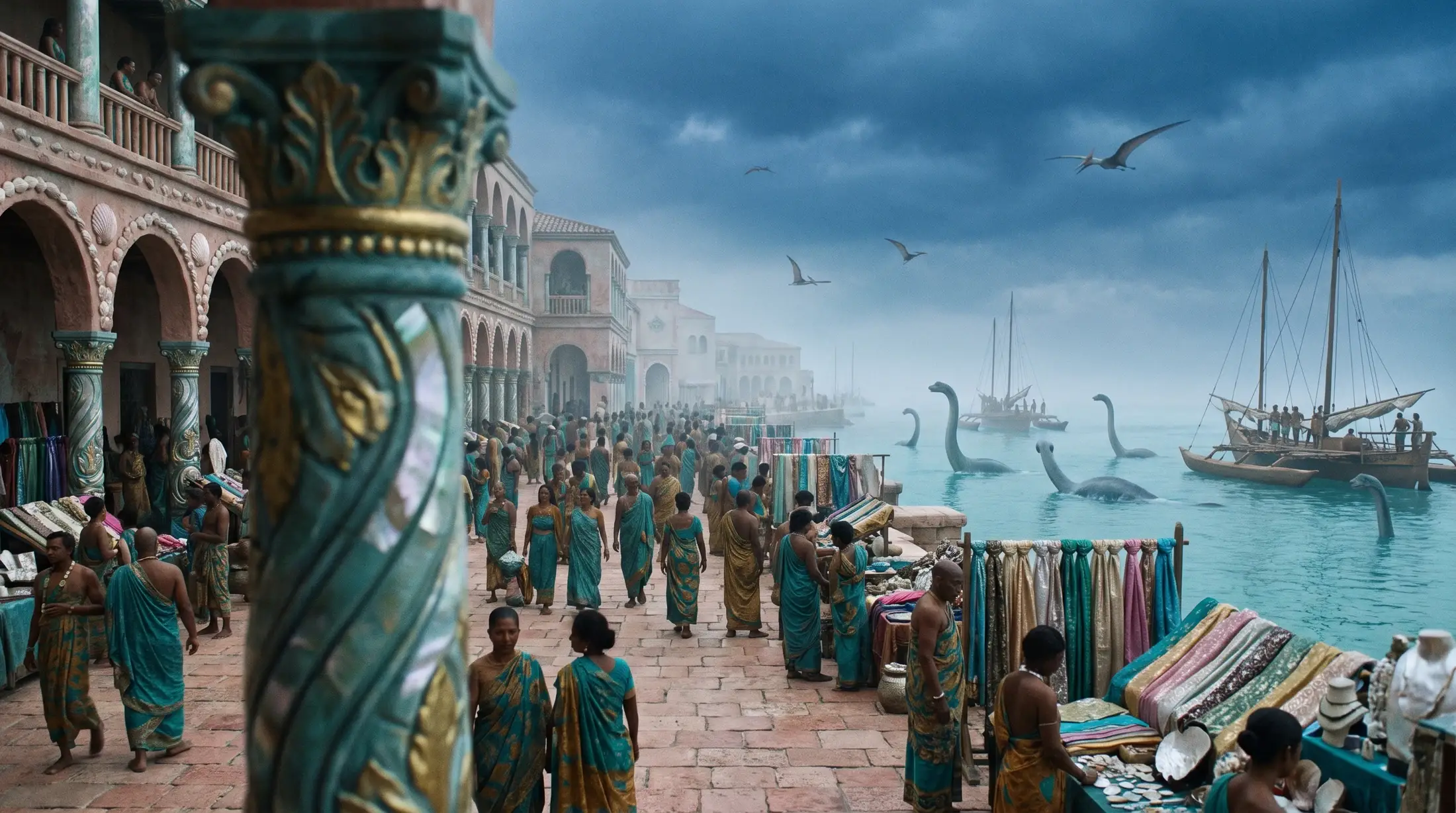
The barges arrive at nightfall, guided by voilecous whose long necks carry lanterns hung from a halter of nacre and little bells. On each barge there are tables, musicians, servers and guards; on the bridges and quays, the people watch the lights go by. The districts hold their own feast at the same time: rum, fried fish and music on the terraces, dancing on the pontoons. This feast below is called the night of shells, and many of those who serve on the barges join it after midnight, their pockets full of the evening’s tips.
Sebi
Sebi is played with engraved nacre tokens, sold in lots of a hundred. Each player stakes, then announces a hand, and the whole art of the game lies in how one announces. An announcement made in Mist may be false: that is bluffing, and it is allowed. An announcement made in the Hand mode commits the player to what they have seen of their own tokens. An announcement made in the Sealed mode cannot be withdrawn: if it proves false, the player pays double the table. The best players know when to move from one mode to another, and sebi champions are harbour celebrities.
Gaming debts are settled in tokens, which the host house exchanges for Dracos at its counter the very next day. Custom requires a sebi debt to be cleared before the following tide; whoever lets it drag loses their place at the table for the season. Scribes keep the account of each table, for winnings, even those won by lantern light, pay the Fifteenth.
The night auctions
Each Night ends with an auction. Necklaces and parures are knocked down there, century-old rums, sometimes a racing hull or the right to dive on a bank for a season, and above all crown pearls: only one comes out per season and per bank, registered and insured before it is shown. The pearl merchants of Girvane, who sorted at the quay what they sell here, often run the sale. Bidders raise a small lantern to outbid, and the organiser’s commission is taken at dessert.
These sales inform as much as they enrich. Whoever bids reveals they have money, whoever abstains lets a difficult season be guessed, and the brokers present draw their conclusions. The next day, at the Great Counting House, some premiums have already moved. Security on these nights is entrusted to contract companies: guards on the barges, boats on the canals and, it is said, divers under the hulls, so that no necklace ends up on the bottom.
Behind the Nights
A Night of Nacre takes hundreds of hands. Oarsmen and haulers move the barges, cooks and servers work in floating kitchens moored apart, musicians and dancers are hired by the night, and keepers watch over the voilecous, which the noise and lights tire. Fire is the great fear of these feasts: every barge carries buckets of sand, no lantern hangs above the drapes, and a barge that drops a lamp into its sails is excluded from the following Nights.
Foreign guests judge these nights according to their own country. The nobles of Urnok come willingly and lose with elegance. Envoys from Ishtir, used to feasts that have their own week and their own rule, are mostly surprised that here the feast has no fixed calendar: it begins when the money comes in.