

Institutions
Quarantine: deciding what may touch land
A sanitary threshold organises waiting, inspection and responsibility before contact with a port or basin.
Distance is a practice
Quarantine maintains a distance between an arrival and the bodies, basins or animals that might suffer its consequences. It requires a place to wait, people authorised to observe and a stated decision. It does not promise absence of risk; it makes risk visible before it is shared.
A departure must be explainable
Inspection, waiting and resumption of travel produce a chain of responsibility. Cargo, a living creature or a crew do not become safe by declaration. People authorising a movement must be able to state which condition was observed and what remained uncertain at departure.
The waiting roadstead
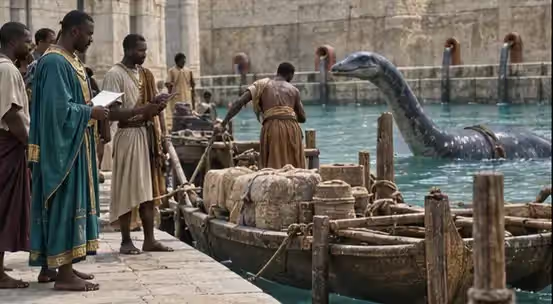
A ship that must pass a sanitary threshold does not go straight to the quay. Its pilot takes it to a waiting roadstead, away from the service basins, the live tanks and the markets. A particular flag goes up the mast to signal its condition to other ships and to the shore. Nobody goes ashore, and nothing comes aboard except through a designated boat whose crew knows the gestures of separation: people talk at a distance, pass objects across on the end of a pole, and wash whatever comes back.
Draught animals go through the same wait. The plesiosaurs are unharnessed and led to a separate basin, where they can rest without meeting the harbour teams. Signal pterosaurs stay on their shipboard perches. A fleet arriving with full animal teams thus turns a roadstead into a floating enclosure, and the keepers’ first task is often to water and feed the animals before inspecting the humans.
Three things to observe
Inspection covers three sets of things. The crew first: fevers, wounds, deaths during the crossing, the state of rations and water, which the logbook and witnesses must make it possible to trace. Then the living cargo: appetite, thirst, the condition of skin and scales, behaviour in the cage, signs of struggle or exhaustion. Finally the goods: smell, rot, the state of containers and seals, declared origin and the ports touched on the way.
No universal delay governs the wait. Its length depends on what has been seen, on the route followed and on what is known of the ports of call. By quayside custom it is counted in tides: one tide for a slight doubt, several for a sick animal, more when a crew has committed men to the sea during the voyage. Every extension must be justified in writing, because it costs someone.
What can happen to a cargo
At the end of the wait, the decision takes a familiar form. The cargo may be admitted without condition; admitted under condition, to a reserved quay, a limited market or a buyer who answers for it; held longer; sent back, with orders to put to sea again; or destroyed, burnt on a threshold beach or sunk beyond the bar. Destruction remains rare and is always recorded, with its reasons and the names of those who ordered it.
Each outcome has its economics. The owner and the insurer carry the costs of waiting, the animals’ feed, care and cleaning; Volonian contracts include quarantine-loss clauses, and claims brokers argue over their scope before the Merchants’ Court. A decision taken too quickly can contaminate a port; one taken too slowly can ruin a house. The threshold lives between those two faults.
The very great at the threshold
The threshold does not concern goods alone. The Vaesh quarantine officer also authorises or blocks the movement and mobilisation of the very great, those huge sea reptiles of which a single one is enough to change the safety of a channel. A very great beast returning from a distant escort or from combat goes through its own observation basin before rejoining its quarters. Its size exempts it from nothing: on the contrary, it makes every mistake more costly.
The quays have their own vocabulary for these waits. A ship “in the salt” is awaiting inspection; a cargo that has been “lifted” has been admitted; an animal “in the basin” remains under observation. The most dreaded word is “go back”: it means the whole voyage will have to be made again elsewhere, at a loss. Crews who hear it know they will not set foot ashore, and that their pay will now depend on the clauses signed before departure.