
Creatures
Pterosaurs of Ishtir
Flight depends on a network of relays, supplies and rest.
The Silver aerial chain
Large pterosaurs, great war beasts, are closely associated with Ishtir’s animal trades and Silver responsibilities. This rank describes productive and strategic capital governed by contracts, licences and insurance; it is not simply a measure of animal size.
Air depends on the ground
Relays, cliffs, supplies and rest make the aerial network possible. Empirical knowledge of currents belongs to this geography. Facilities must accommodate animal needs as well as the movement of those who equip and care for them.
Carrying together
A Silver gondola combines four large pterosaurs with a transport apparatus. It demonstrates cooperation between several bodies and their equipment rather than a lone rider. Attachment points and harnesses belong to this material chain.
Clutches and secret eyries
Ishtir breeds its pterosaurs on the cliffs. The females of the war line live in breeding eyries whose location only the Silver Winds’ breeders know, and their routes change from one season to the next: a stolen war egg would deprive the country of an animal and give one to the enemy. The more numerous signal pterosaurs are bred more openly, in the relays and the Tours du Zénith.
A female lays one to three eggs in a hollow of sun-warmed sand on a ledge sheltered from the wind. The breeders count them, mark them with a stroke of ochre and watch over them until they hatch, about three months later. Signal pterosaurs may leave the country, under licence and with bronze rings, for Urnok’s relays; war pteranodons, never.
Training a sky animal
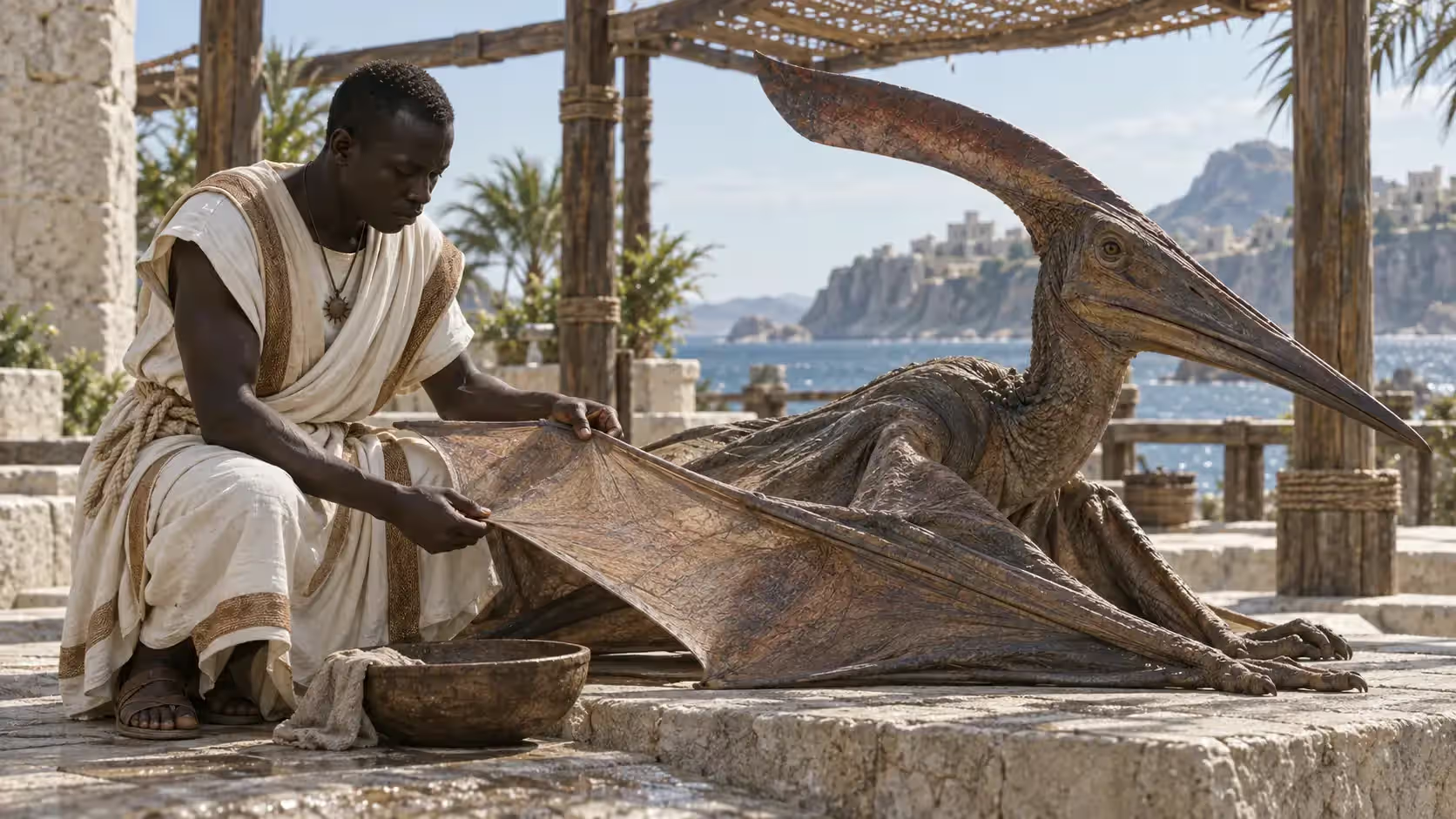
Training begins before the first flight. Young pterosaurs first learn to accept hands, then a linen practice harness, then a saddle weighted with sand, without ever leaving the ledge. They grow used to bronze whistles, each note of which calls for a movement: unfold, fold, come, wait. A signal pterosaur is ready for service in less than a year; a war pteranodon takes two years of work.
The first flights are made on a lunge line above a slope of sand, then freely around the tower, then between two relays. Only then does the pilot come. A sky animal accepts not a person but a crew, and care is taken that its carers, harness-makers and pilot keep the same gestures, the same dress and, as far as possible, the same smell. A pilot who changes animals starts part of his own apprenticeship over again.
Pilots and gear
Silver Winds pilots are chosen for lightness. The flying certification sets a weight that may not be exceeded, gear included, and many mail pilots are slight women or men who have made their weight a profession. They fly lying flat on the saddle, tied on by two lines, and barely sit up for signals.
Their dress is made for cold and light. At altitude it is cold even under Ishtir’s sun: pilots wear a tunic of lined linen, leggings and gloves of ceratops leather, and a close-fitting cap. Against glare they set over their eyes a visor of horn pierced with two narrow slits, which cuts the light of sky and sea. The rest hangs from the belt: strap knife, bronze whistle, small mirror, water flask and dried fish for the animal.
What brings a pterosaur down
A pterosaur is fragile, and those who ride one know it better than anyone. The first enemy is the weather: late-afternoon storms, valley fogs, winds that turn beneath the ledges. The second is weapons made for the sky. Korath has made a speciality of ballistae and of cables strung between two heights, and its engineers design their fortifications with Ishtiri wings in mind; a thrown net, a rain of bolts or a rope invisible against the sun is enough to break a membrane.
Last come fatigue and hunger. A pterosaur that flies too far from its perches can no longer find food, and a weakened animal lands badly. That is why the Silver Winds count their flights in hours as much as in leagues, and why their captains spend so much time on their lists.
The everyday sky
Most of Ishtir’s flights have nothing warlike about them. Signal pterosaurs carry mail and give the time; others fly over the herds of the Plains to count heads or spot a stray, watch for forest fires above the Bois Sacré, show the fishermen of the Isles where the shoals are and search the sea for boats lost after a storm. The cartographers of the Silver Mirrors use them to survey rivers and coasts, which can only be seen properly from above.
This daily presence has shaped the country. Herders on the Plains have arm signals for calling a courier, children recognise silhouettes before they can read, and part of the day is set by the passing of wings. Foreigners notice that Ishtiris look up more often than other peoples; the Ishtiris answer that there is more to see above them.