

Armies
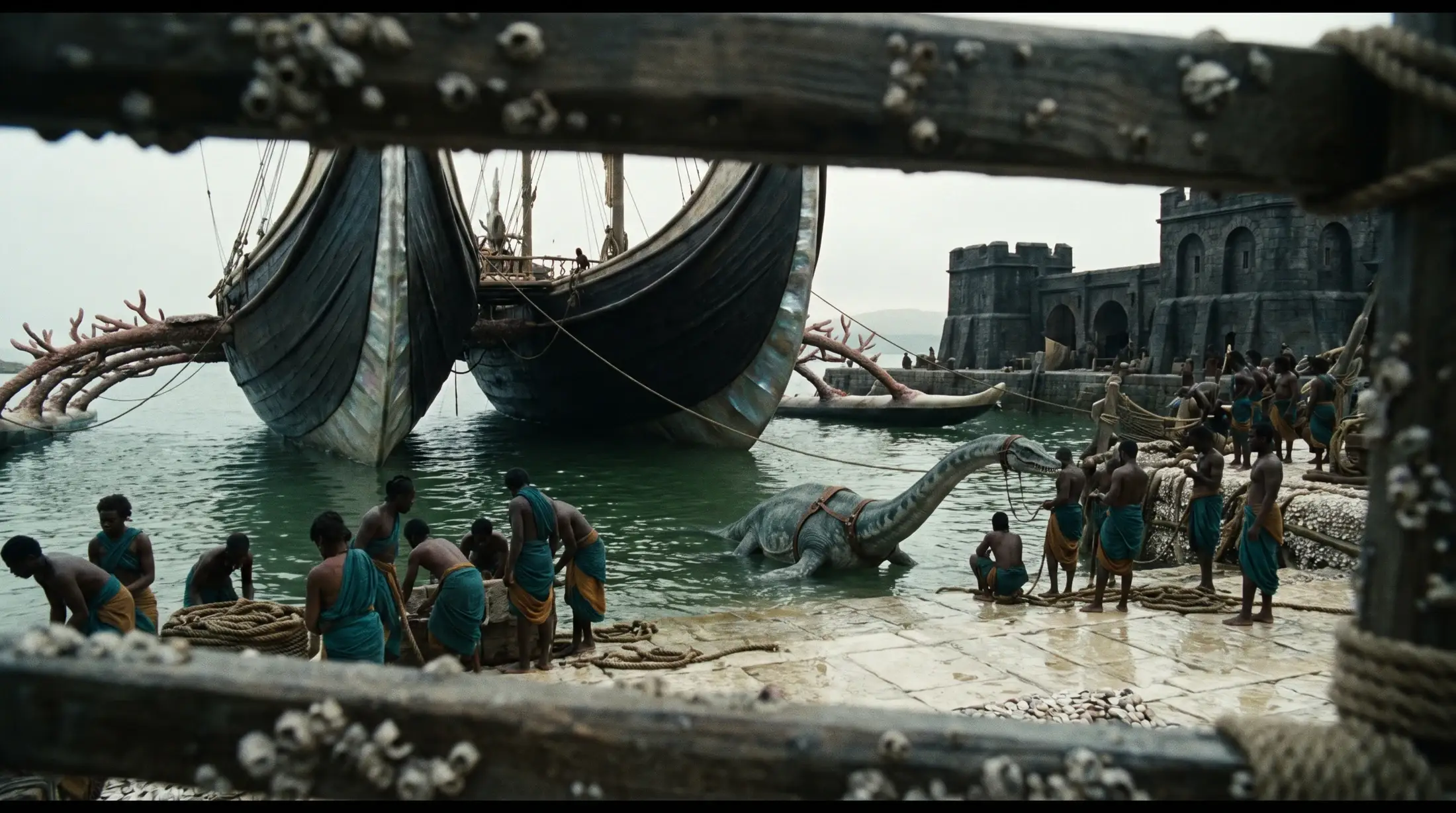
The fighters of the living fleet
Foam riders on fast ichthyosaurs, gunners posted on plesiosaur platforms, Korathi recoil engineers: Volonia’s fleet fights with beasts.
The foam rider
The foam rider is the fleet’s fast scout, Volonia’s equivalent of a naval fighter. He rides a small beast: fast mounted ichthyosaurs serve for scouting, messages, pursuit and rescue, and the rider fights from them with lance, bow or harpoon.
The platform gunner
Heavy plesiosaurs carry two platforms close to the trunk. The platform gunner serves archers or light ballistae there: the warship becomes a living one. Volonia’s fleet thus fights in three dimensions — the sky, the surface and the depths.
The Korathi recoil engineer
The Korathi recoil engineer adapts ballistae, tension and damping to Volonia’s great hulls. It is a technology imported from Korath, and paid for dearly; it derives from the Shared Recoil patent.
Becoming a foam rider
One becomes a foam rider young. Recruits are chosen in adolescence from among the best swimmers of the ports, and spend several years learning to live with their beast before riding it on a mission. The rider sits astride behind the ichthyosaur’s head, strapped into a light harness, and must learn to hold his breath when the animal dives, to lie flat against it to cut through the waves and to steer it by pressure of knees and hands.
The mounts are mostly Icthylames, scouting ichthyosaurs used for reconnaissance and fast mail, and, for night patrols, Œils-de-Nuit, large-eyed ophthalmosaurs that see in the dark. A rider keeps the same beast for years; it is said the two end up breathing together. Their weapons stay light: a lance, a short bow or a harpoon, and a knife to cut a line.
Fighting from a Double-Fin
The platform gunner fights from a living animal. Double-Fins, the heavy versions of the plesiosaur, carry two cradles strapped near the trunk, holding, depending on the fitting, a few archers or the crew of a light ballista. A driver seated at the base of the neck steers the beast; the gunners must shoot from a platform that rises and falls with every stroke and sometimes half dips under when the animal speeds up.
The trade demands a strong stomach and complete trust in the driver. Gunners are tied to the cradle by a line, keep their bolts in watertight quivers and learn to shoot at the top of each swimming stroke, when the platform stops for an instant. A well-served Double-Fin guards the flanks of a line, chases light craft and harries enemy riders; badly served, it wastes its bolts in the foam.
The recoil engineer and his licence
The Korathi recoil engineer works aboard under a double tie. He is hired by the house that fits out the ship, but remains bound to Korath, whose licences cover the mechanisms he maintains. His trade is a constant struggle against the sea: damp slackens the torsion ropes, salt eats into the iron parts, the shocks of firing knock the dampers out of true. Every morning he sets the tension of the ballistae, replaces worn parts and teaches the crews not to damage what they handle.
Volonian houses know what this dependence costs them. In war, Korath can suspend its licences, parts and engineers, and a fleet deprived of its specialists sees its engines slowly lose their accuracy. Velasar therefore trains Volonian apprentices alongside the engineers settled in its quarters, without ever managing to do without them. Aboard, the engineer is treated with wary respect: he alone can say, before battle, how many more shots the line will be able to fire.
The other trades of the living fleet
Around these fighters work other trades of the living. Masters of traction allot the plesiosaur teams and decide when they rest; the Porte-Aile tend and release the pterosaurs of the Nids d’Alizé; feeders prepare the rations; fleet veterinarians treat wounded beasts; combat divers work beneath enemy hulls. None of these trades can be improvised, and most are learned in the breeding grounds, aviaries and basins of Velasar and the Silver Wind.
Their prestige depends on the beasts they serve. A famous foam rider or a master of traction whose teams always arrive fresh at contact is as well known on the quays as the jockeys of the sea racecourses. Their pay follows: houses compete for these specialists between wars, and a Gathering of the Flags that begins sees their contracts rise within days.
One battle, three trades
In battle, the three trades of the living fleet work together while hardly seeing one another. The foam riders go out first, locate the enemy beasts below the surface and come back to report their position to the ships. The Double-Fins then take up station on the flanks of the line, where the riders reported the threat, and their gunners open fire on whatever approaches. Meanwhile the recoil engineers move from piece to piece on the Great Hulls, re-tensioning a rope here, changing a wedge there, so that the ballistae hold out to the end. An admiral who knows how to make these three trades work together often wins before the hulls touch.