

Armies
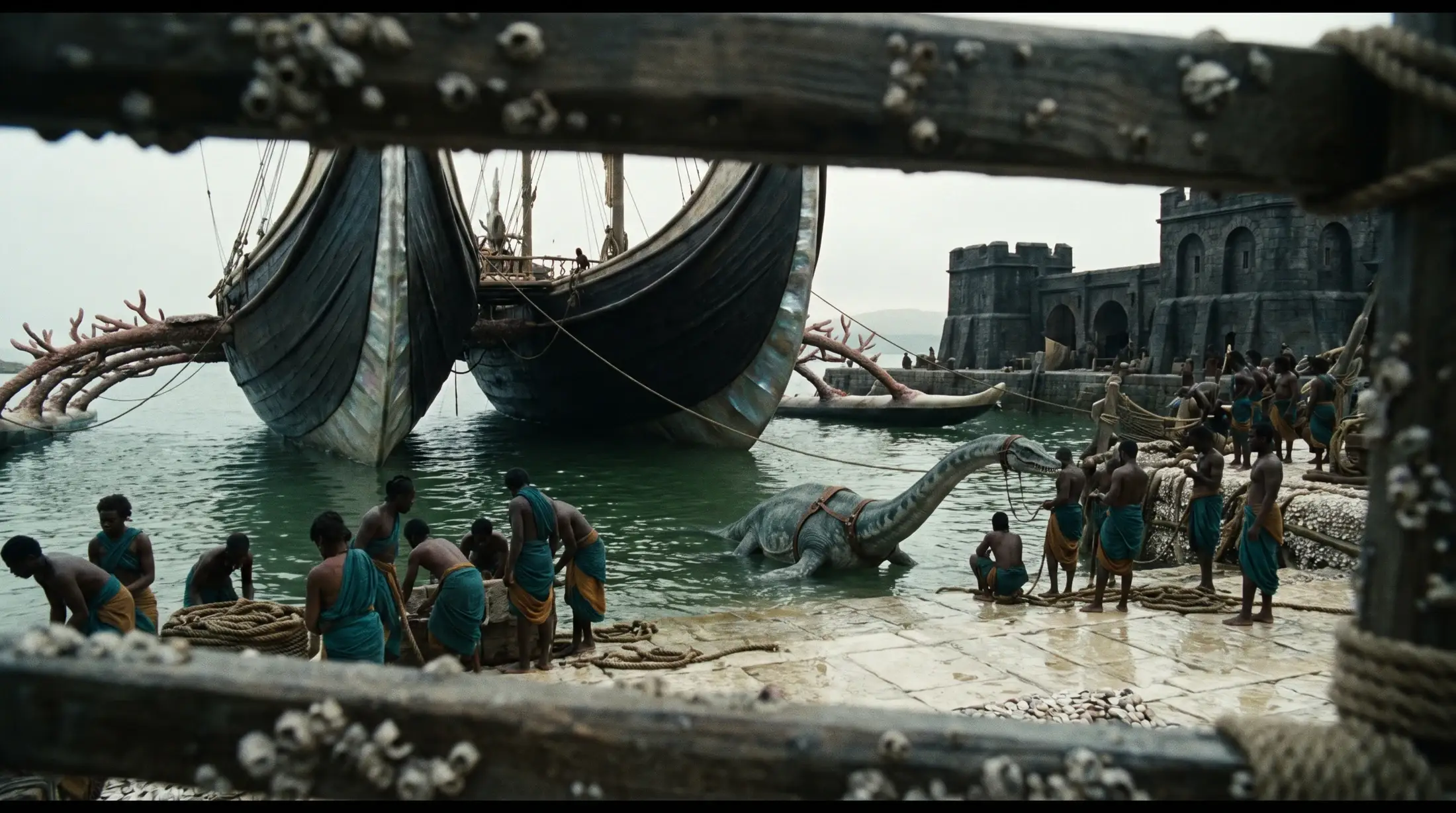
The Chasseur de Pirates
A fast interception ship (“Pirate Hunter”), armed with light ballistae and grappling hooks, built for pursuit and boarding.
Speed and boarding
The Chasseur de Pirates seeks speed. Sails, oars and two to four plesiosaurs let it catch a lighter ship; its light ballistae and grappling hooks serve to stop it and then board it. It measures thirty-five to fifty-five metres and carries one hundred and eighty to three hundred and fifty people.
Pirates are one of the reasons why the Volonian fleet is over-armed: they too have real navies.
What the hunter hunts
The Chasseur de Pirates was designed for the south-western front, where raids, unchartered privateers and grey ports threaten the convoys every season. Its prey is fast and low in the water: the black-lacquered raiding galleys of the Dents Noires, which slip out of the mangroves at dusk; the mist-sailed coursers of the archipelagos; the double canoes lying in wait in the passes. Each flag of the archipelagos has its own way: the Voile-Tranchée takes cargoes, the Pavillon-Rouge lives on ransoms, the Récif-Faux leads ships astray with false buoys.
Against such opponents, the Chasseur relies on speed and on knowledge of the waters. Its pilots know the passes through the reefs, the coves where a raider can hide and the tide hours when a shallow opens or closes. It does not need to be stronger than a pirate: it must reach him before he gains shelter.
The pursuit
A hunt often begins with a signal. A convoy under attack, a watchtower or a scouting pterosaur reports a raider, and the Chasseur leaves its anchorage. Its two to four plesiosaurs, chosen for speed rather than endurance, are harnessed short; sails and oars add their share. Over a short distance, a well-harnessed Chasseur overtakes almost every ship of the south-west.
Yet the captain must spare his beasts. Too long a chase exhausts the teams, and a Chasseur whose plesiosaurs are spent has only its oars to get home, in waters where the pirate may have friends. Experienced captains therefore cut across the route rather than follow the wake: they make for the pass through which the prey must flee, and wait for it there. Chasseurs often hunt in pairs, one driving, the other closing.
Disable, board, judge
Within range, the light ballistae aim at the pirate’s sails, oars and draught beasts, to slow him without sinking him: a sunken ship cannot be judged. The boarding grapnels, four-pronged iron hooks on tarred lines, then make him fast to the Chasseur, and the boarding company crosses over. The fighting is short and violent; the Chasseur’s sailors are trained to fight on a moving deck, with cutlass, boathook and short crossbow.
What follows belongs to the law. The captured ship, its cargo and its crew are brought back to port, and the Merchants’ Court judges the prize: return of stolen goods to their owners or insurers, the Chasseur crew’s share, the fate of the prisoners. Ransoms are standardized, and a pirate can sometimes be bought back by his own people. The insurance chambers also pay a bounty to the crew that has made a route safe.
What a hunter does not face
The Chasseur de Pirates is not made for every water. It avoids the northern coasts, where the Pirates du Nord form a sovereign civilization and where their three black mosasaurs make any chase deadly: against the Double Circle, fire-bearing riders on the surface and a black monster beneath the hull, a fifty-metre ship does not last. Nor does it venture alone into mangroves and shallow channels, where its hull strikes bottom and ambushes come from both banks.
For those waters the fleet relies on other ships: Harponneurs against beasts, Frégates d’Écume for the shallows, whole squadrons when a lair must be stormed. The Chasseur remains the ship of patrol and pursuit, the busiest in the fleet in peacetime. On the quays of the south-west it is said that the pirates know every Chasseur by name, and change course on learning which one has put out.