

Armies
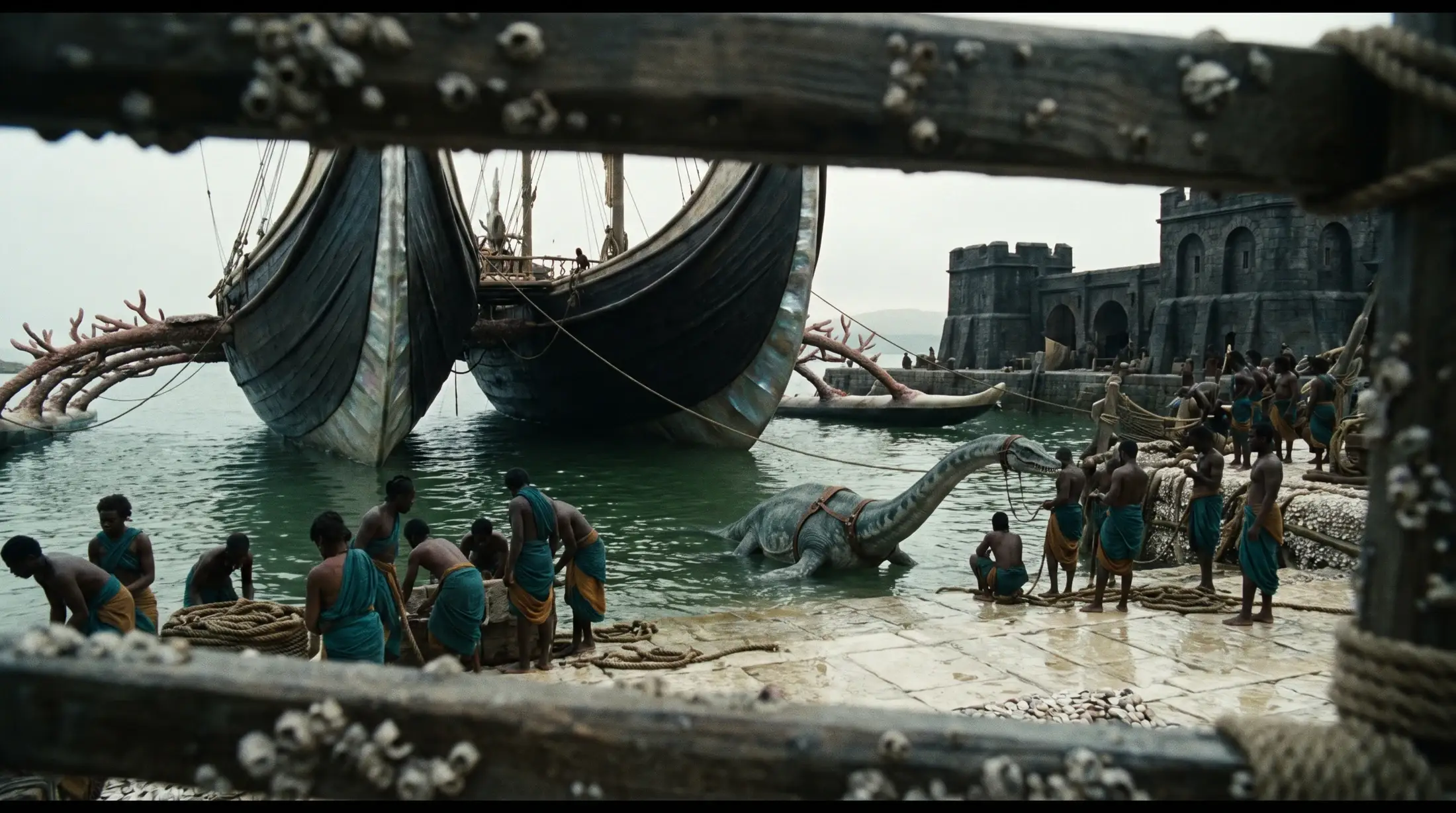
The Récupérateur d’Épaves
The salvage ship (“Wreck Recoverer”), which searches for survivors, prizes and hulls still worth saving.
What the sea can give back
The Récupérateur d’Épaves recovers survivors, prizes and hulls still worth saving. Its harpoons are tools more than weapons. It moves with plesiosaurs and under sail, and carries one hundred and fifty to three hundred people.
It is one of the ships that give the Volonian fleet its endurance: being able to recover its losses is one of Volonia’s advantages over enemy fleets.
Winches, harpoons and beasts
The Récupérateur d’Épaves is built to lift. Its deck carries winches, davits and one or two reinforced cargo booms; its hold, large enough for a few hundred tonnes, receives what the sea has given back. Its harpoons are not weapons: thrown from light ballistae or by hand, they hook a drifting wreck, a piece of hull, a barrel or a dead animal, which is then hauled aboard.
Its plesiosaurs do the heaviest work. Harnessed to cables, they pull stranded hulls off the reefs and tow those still afloat to port. To raise what has sunk, the crew uses divers, a bell and flotation skins inflated at the bottom, beneath the object to be lifted. A well-equipped Récupérateur can refloat a boat within a tide and bring a disabled Great Hull home in a few days.
What the sea gives back, and to whom
Salvage obeys a precise law. People come first of all: survivors are picked up and cared for without being charged anything, and bodies are returned to their families so that the rites can be performed before a witness. For goods, the custom of the League grants the salvager about eighteen per cent of the value of what he brings back; the owner or his insurer pays that share to recover the property.
The owner has a period in which to claim, counted in tides and entered in the declaration the Récupérateur’s captain files at the port. After that period, unclaimed goods are sold at auction, and the proceeds are shared between the crew, the Récupérateur’s owner and the port’s fund. Disputes — over the value of a cargo, the state of a hull, the share due — go before the Merchants’ Court, which judges dozens of them every season.
After the battle
In war, the Récupérateurs follow the fleet at a distance and go into action as soon as the fighting moves away. Their first task is to pick up the men, Volonian or enemy; enemy survivors are handed over to the Admiralty, the wounded entrusted to the Hôpitaux des Marées. They then recover everything that can be used: hull timber, masts, sails, harpoons, projectiles, torn-off war engines, even the carcasses of the beasts, from which hide, tendons, teeth and oil are taken.
Finally they tow the damaged hulls to the Ateliers des Coques or to the nearest port. It is this work that gives the Volonian fleet its endurance: a hull the enemy believes lost can return to sea a few seasons later, and a battle won is doubled by a harvest of materials that the opponent has left on the bottom.
The salvage folk
The hundred and fifty to three hundred people aboard a Récupérateur form a crew apart: divers, masters of traction, carpenters, riggers, keepers and appraisers who value on the spot what is brought up. Many come from the wreck-cities or from the districts of Girvane, where salvage is a family trade, and have known the gestures of diving and stripping since childhood.
Their reputation cuts both ways. Sailors often owe them their lives, and the sight of a salvage hull on the horizon after a shipwreck is a relief. But they are also nicknamed the scavengers of the sea, because they earn all the more when others have lost, and merchants distrust their valuations. Récupérateur captains generally reply that they sink no one, and that they are often the only ones who come back for the others.
In the ports
Outside wartime, Récupérateurs work for insurers, houses and ports. They clear channels choked with wrecks after storms, raise lost anchors and chains, and bring up cargoes long sunk in the western fogs. The League pays them a fee to keep the passes clear: a wreck left in a channel can cause a second one.