

Families and social ties
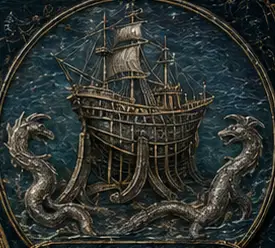
House Velasar
The great naval house-trust, Velasar dominates Great Hulls, arsenals, ocean fishing and plesiosaur breeding, and ranks among the five largest private companies in the known world.
The naval house-trust
Velasar is Volonia’s great naval house-trust. It brings together Great Hulls, arsenals, ocean fishing, industrial plesiosaur breeding and foreign orders. The country’s leading private naval power, it ranks among the five largest private companies in the known world.
The family, the city and the arsenals are almost inseparable. Velasar is an arsenal city specialised in building Great Hulls, fleet equipment and the care of draught animals; the family leadership, the shipyards and the town form a single whole.
A legacy from Orlantis and Korath
Velasar has at least 2,500 years of tradition. Its power comes from the naval traditions and timber of Orlantis: wood, resins and rope from the duchy feed its shipyards. It also employs Korathi engineers, whose metals, reinforcements and mechanisms are applied to ships and their equipment.
Like all Volonian naval production, the house thus depends on parts, materials and techniques obtained by contract, which leaves its suppliers power over the cost and availability of its means.
The plesiosaur at the shipyard
The towing plesiosaur, the house’s emblem, recalls that the Volonian fleet was born from an animal before it became a matter of finance. At the shipyard it tows and assists the great constructions; its channels are kept apart from human routes. Velasar breeds them on an industrial scale.
Bone shipwrights and Orlantis timber
The house joins two lineages through a contract marriage: Velasar, the old bone shipwrights, and Doryan, the importers of Orlantis timber. A fleet is built only by marrying know-how and supply: Harun Velasar, master of the bone stem, married Oria Doryan. Their daughter Velia Doryan-Velasar now runs the shipyards; her younger brother, Karel Velasar, has gone to the northern yards.
In Volonia, people say, one does not seize a house: one marries it.
The arsenal city at work
Velasar does not sound like the other ports. Fashion quarters and theatres give way there to dry docks, building pits and basins wide enough for a Great Hull. The Double Keels and the Cages of Velasar are among its named places. Shipyard plesiosaurs serve as floating cranes: harnessed in teams, they move blocks, tension cables, set frames in place and help to raise domes, under the direction of the traction masters.
The city’s architecture is massive, more metallic than that of the luxury ports, and keeps the mark of Orlantis in its timberwork and roofs. A ring-bastion, with a deep basin, separate channels and high refuges, protects part of the arsenal. The animals’ channels do not cross the people’s: a carpenter who steps into a harness lane at the wrong moment is not being clumsy, he is committing a yard offence.
What Velasar builds
Velasar’s yards mainly build the Great Hulls, up to the flagship model of about one hundred and fifty metres, and the line classes that form the front rank of the fleets. They also make the equipment that keeps a fleet alive: sea harnesses, floating cages, hitching gear, floating quays. The Great Hull builder designs articulated hulls, multiple keels and watertight compartments there.
Part of the output goes abroad, to order. Velasar sells hulls, repairs and know-how to clients who lack its yards, and this is one reason it ranks among the five largest private enterprises of the known world. The Kron-Mer, a pliosaur with a massive head and short jaws, guards the Doryan arsenals like a living hull-breaking ram: a yard that builds for the world must also deter the world from coming in.
Bone carpenters
The Velasar are bone carpenters first of all: theirs is the tradition of the bone stem, the prow cut from the bone of a great sea reptile and joined to the timber of Orlantis. An apprentice of the house starts far from the keels. He spends his first years at the Cages, cleaning, rinsing harnesses, learning the tension of a cable and the mood of a team; then he moves on to wood, then to bone, and sets his mark on a stem only after repairing dozens of hulls built by others.
The house insists on this path because a finished hull remains dependent on the workshops for its whole life: whoever built it must know how to take it apart again. In Velasar they say a good carpenter is judged at the third repair, not at the launch; launches make festivals, repairs make fleets.