
Creatures
The Vur-vaa
The great raptors of the Cavaliers du Crâne, climbing mounts whose claw is a sacred material.
The great raptors of the Cavaliers du Crâne
The Vur-vaa are great raptors of the Utahraptor type, tied to the skills of the Cavaliers du Crâne, an old saddle lineage some two thousand six hundred years old that also judges rising clans. Their mobility serves for crossing rough ground and approaching walls. A route stays usable only if its holds and exits match what the mount can do. Asymmetric saddles and claw equipment help the crossing; every piece is checked before and after a difficult passage.
Claw and tendon
A Vur-vaa’s claw is a prestigious material. It can be traded, but the trade does not cancel the sacred return clause attached to it: the merchants of Sand Port must take it into account, and bone certification at Qor-Zaï ties the material, its recognition and the law together.
The tendon of an elite Vur-vaa bears about nine thousand newtons per square centimetre of section, more than twice an ordinary tendon cable, which bears about four thousand. It is used for critical straps and cavalry bows.
The body of a Vur-vaa
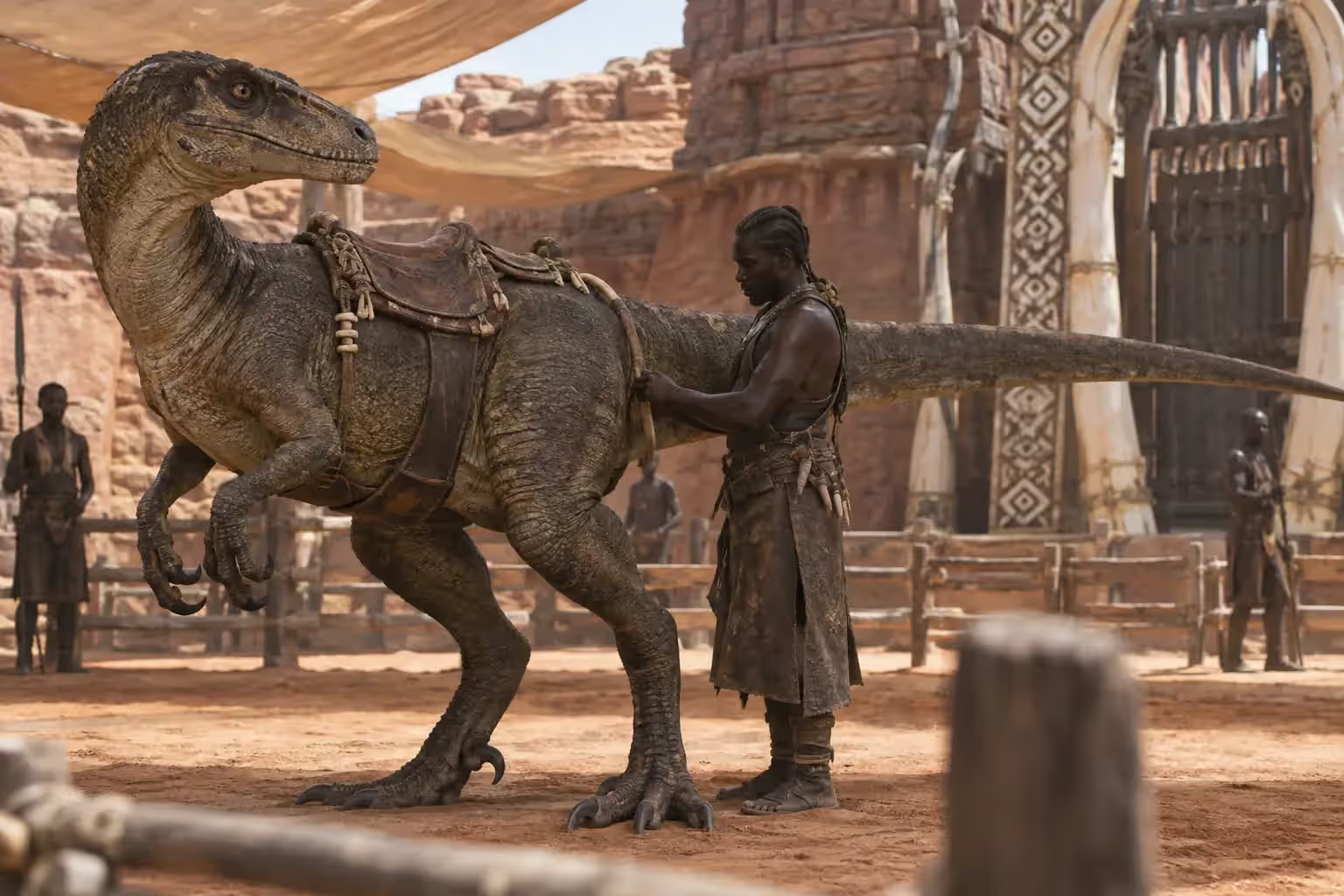
The Vur-vaa is the largest of the ridden raptors. An adult measures six to seven metres from snout to tail tip and weighs in the order of five hundred kilos; its hip reaches a man’s shoulder, and a rider in the saddle can see over the low roofs of a village. Its body is long, its chest deep, its tail stiff and muscular, serving as a counterweight in turns and as a prop on walls. Its scales are fine on the flanks, thicker on the back and legs, a slate grey often lit with an ember sheen, and the best lineages keep these colours into old age.
Its weapon is the sickle claw on the second toe of each foot, as long as a child’s forearm, which the beast raises as it walks so as not to blunt it and brings down in the pounce. Its hands, armed with three claws, seize and hold; its jaws, shorter than a carnosaur’s, bite to finish. The Vur-vaa sees well, hears better still and can follow a trail several days old. It becomes adult at about four years old and seldom lives beyond twenty or so.
Lineages and uses
The Vur-vaa is not a single beast but a species Arkhan has worked on for centuries. The most famous lineage, the Griffe-Lune, belongs to the Cavaliers du Crâne, who recite its genealogy on their cords and never sell their finest animals. Other lineages exist in the other khanates, less prestigious, recognisable by colour, size and temper. Above all, the beasts are distinguished by their training: wall Vur-vaa, trained to climb; line Vur-vaa, trained to run in formation; saddle Vur-vaa, for long stages; endurance Vur-vaa, for marches without water; chief’s Vur-vaa, tall and conspicuous, made to carry a commander; armoured Vur-vaa, which wear bone armour.
At the top stand the colossal Vur-vaa of the Cavaliers du Crâne, exceptional beasts seldom ridden, which the khanate keeps as shock guardians and symbols of lineage. Each kind of training has its masters and its schools, the most famous of which, the Vur-vaa School at the Fort of Rathok, teaches verticality. A beast rarely changes its use during its life: a wall Vur-vaa does not become a line beast, and breeders say a Vur-vaa is what its first month of training made of it.
Born at Vurvak
The great lineages are born in the nests and breeding yards of Vurvak, on the lands of the Cavaliers du Crâne, and in a few hatcheries such as Itor’s. A female lays three to six eggs of nearly six kilos each, which the Keepers of the Lineages bury in warmed sand and watch over for almost three months. These eggs fall under clan control: they are exchanged between clans, never with foreigners, and stealing the egg of a lineage Vur-vaa opens a vendetta. The hatchling is imprinted from its first hour by the woman or man who will raise it.
A young Vur-vaa grows fast and eats a great deal. It learns first to hunt with its clutch-mates, on live prey, then to come back to the voice, then to carry a blanket and an empty saddle. It carries a rider only in its third year, and enters a use only after a trial period during which the Keeper watches who accepts whom. An adult Vur-vaa eats about seven kilos of meat a day, more during training, and its food weighs heavily in a clan’s budget.
Under the saddle
A Vur-vaa is ridden on a saddle with a bone tree, often asymmetric among the Cavaliers du Crâne, where it is mounted on the left to keep the rider’s weight on one side when the beast runs along a wall. The saddle rests on a lining of leather or vûrskel; the straps are of Vur-vaa sinew, the strongest in the Confederation. For climbing, the claws are sheathed in hardened bone or metal and a hook is fixed to the tail. The rider mounts from the flank, with the beast lying down, and keeps his seat with his knees more than with the reins.
A lineage beast is almost never sold on its own. At Port de Sable a Griffe-Lune Vur-vaa fetches seven thousand five hundred to nine thousand five hundred Dracos, with a trainer engaged by contract to go with it, and under a claw clause: if the beast dies far from its own people, its claw goes back to the Cavaliers du Crâne. An asymmetric saddle alone is worth four hundred and fifty to nine hundred Dracos, more than many whole mounts from other nations.
The sickle pounce
In war the Vur-vaa hunts whatever is isolated. Its signature attack is the pounce: the beast springs from several paces away, comes down on its prey with all its weight, pins it to the ground under its sickle claw and holds it while the jaws finish the work. A wing of Vur-vaa let loose on a scattered troop, on scouts, on engine crews or on a chief separated from his guard does great damage. Against a tight front of pikes, on the other hand, the beast is fragile, and riders know not to launch it head-on against a line that holds.
Its true speciality is verticality. Trained and equipped, a Vur-vaa crosses walls, cliffs and ramparts that no other mount can pass, and the Cavaliers du Crâne have made a doctrine of it: a rampart is only an animal lying down. Enemy builders answer with smoothed facings, overhanging cornices and ditches at the foot of the walls; the Empire of Urnok maintains units armed with nets, hooks and lances to bring raptors down. The old riders say every new wall is a question put to the saddlers.
Part of this article covers events of season 1. Turn spoilers on in the menu to read it.