

Economy
Arkhan : la chaîne après la piste
Élevage, récupération et ateliers composent une même économie sans réduire les animaux à un stock.
Un vivant ne produit pas une seule chose
Sur les pistes, élevage ouvert, peaux, os, tendons et dents alimentent plusieurs métiers. Cela explique pourquoi un atelier d’arc, une tannerie et un chantier de cadre dépendent du même territoire, sans rendre chaque animal interchangeable.
Récupérer demande des métiers
Une matière doit être séparée, préparée, séchée, liée ou réservée avant de devenir cuir, sangle, outil ou pièce de bâtiment : chaque étape a son métier.
La matière dépend du soin
La filière suppose bêtes, eau, personnes, pistes, outils et temps. Tout se tient : une rupture de route ou de conduite atteint les ateliers même si une matière existe déjà.
The first hours
A carcass spoils fast on the steppe. As soon as a beast is slaughtered or found dead, the team in charge bleeds it, opens it and guts it, then removes the hide before the heat can damage it. Tendons are cut the same day: a tendon left overnight in a warm carcass is worth little. The meat goes in strips onto the drying cords, the offal to the packs, the fat is set aside.
The bones are left for last. They are freed, left a few days in the sun and sand, where insects finish cleaning them, then sorted by shape and size. A medium-sized beast thus keeps half a dozen people busy for a day; a very-great one, dozens for weeks. In both cases, the mortuary teams go through before the smallest piece leaves for a workshop.
The yard of an Apex
The death of a very-great beast is an economic event as much as a ritual one. The Apex carcass yards, such as those of the Sharvor massif, of Les Veines among the Stone Teeth or of Gorresh among the Fils de la Faim, bring together dozens of skinners, bone-workers who know how to cut great bones without splitting them, and priests who say the chants owed to the beast. If the Apex belonged to a kept lineage, nothing begins without the consent of its lineage mother.
Such a yard lasts for weeks. The colossus’s hide becomes the skin of the Horde’s drums; its tendons, smoked and oiled, give the black sinew of champions’ weapons; its long bones, once treated, become columns, thrones or the cores of Ashkhandi; a tyrant tooth that remained intact goes to the Bone Tribunal, which will state its value. The craftsmen say that a broken tooth of a very-great beast is not waste but three months of orders, and they quarrel over the very splinters.
The bone gleaners
Herds and hunting are not enough to feed the kilns. Teams of gleaners therefore roam the steppe and the old basin of the Sea of Bones to collect the bones of dead beasts, sometimes as they have for generations. They advance in a line, with pack beasts, waterskins and ropes, wash and sort what they find, and bring back to the kilns of the Longs-Os common long bones, vertebrae, a little petrified bone and a few fossil teeth.
A mortuary team always goes with the gleaners, for the steppe also holds human dead, lost travellers or the fallen of old battles. Recent battlefields are gleaned the same way, with even greater care: they are deposits of teeth, claws, plates and broken armour, but also places where human remains mingle with the material. Gleaning is considered a poor trade; it is often the first work of the shareless.
Fat, blood, glands and bladders
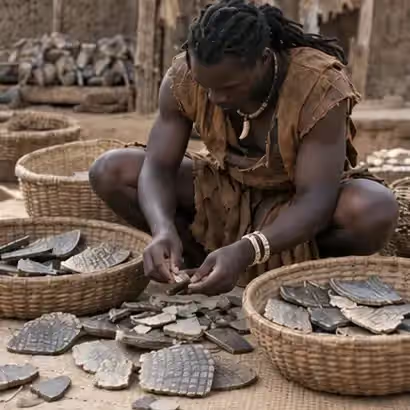
After the flesh, hide, tendons and bones, there is still enough left to keep several trades at work. Rendered fat gives lamp oil, soap and the base of balms. Offcuts of hide and bone, boiled for a long time, give the workshops’ bone glue. Blood, collected fresh and salted, serves as fertiliser for the oasis gardens. The bony scutes from the backs of carnotaurs become the platelets of light armour and shields.
Trainers take the scent glands of raptors to make lures and repellents. Bladders and stomachs, scraped and greased, become floats and waterskin liners, which the Peaux de Marée use along the coasts. Cleaned skulls serve as pack standards, parade helmets or raid masks. Whatever finds no use ends in the lime kiln: an Arkhan carcass leaves almost nothing behind.