
Culture
Hides, bindings and bone pieces
Arkhan dress assembles animal materials, each with its own constraints.
Dress made of several materials
The clothing repertoire combines dinosaur leather, tendon cords and bone pieces: osteoderm plates, breast pieces and collars. Red dust and war paint accompany this dress. These assemblies make different materials visible on one body; a flexible surface, a fastening and a plate do not perform the same function.
Observe gestures and materials · 4 images
Un homme au gilet de cuir brut et au pagne de peaux cousues, un collier de dents au cou, une lance d'os à la main, devant des huttes de peaux tendues.
Un ancien aux cheveux gris porte une cape de peau et un plastron de plaques d'os lacées, une massue d'os à la main, devant des tentes fumantes.
Un raider massif au nez cassé et ensanglanté porte un gilet de cuir cousu, fermé par des chevilles d'os ; ballots et feu flous derrière lui.
Un homme d’Arkhan ajuste un collier de dents sur son manteau de peau ocre.
Durability depends on treatment
Leather varies with tanning, thickness and moisture. Tendon works in tension but is vulnerable to rot and fatigue; bone pieces require suitable orientation and treatment. Wearing these materials therefore involves distinct skills. Dress and equipment bear the work needed to keep flexibility, strength and fastenings useful.
Animal bone and the human boundary
Since time immemorial, Arkhan craft has forbidden human bone, including that of enemies, captives or condemned people. Human remains are separated from recovered animal materials. A worn bone plate therefore does not imply that human bodies are workshop resources. This distinction accompanies the ordinary use of animal materials in armour and objects.
Everyday dress
Everyday dress is made for the saddle and for the sun. Men and women wear a loincloth or a short skirt of supple leather, a sleeveless tunic or a simple breastplate, bracers and leggings against the brush, and low boots or sandals laced with sinew. A veil of ochre cloth covers the head and the lower face when the wind rises; it can be seen from afar on the dune archers.
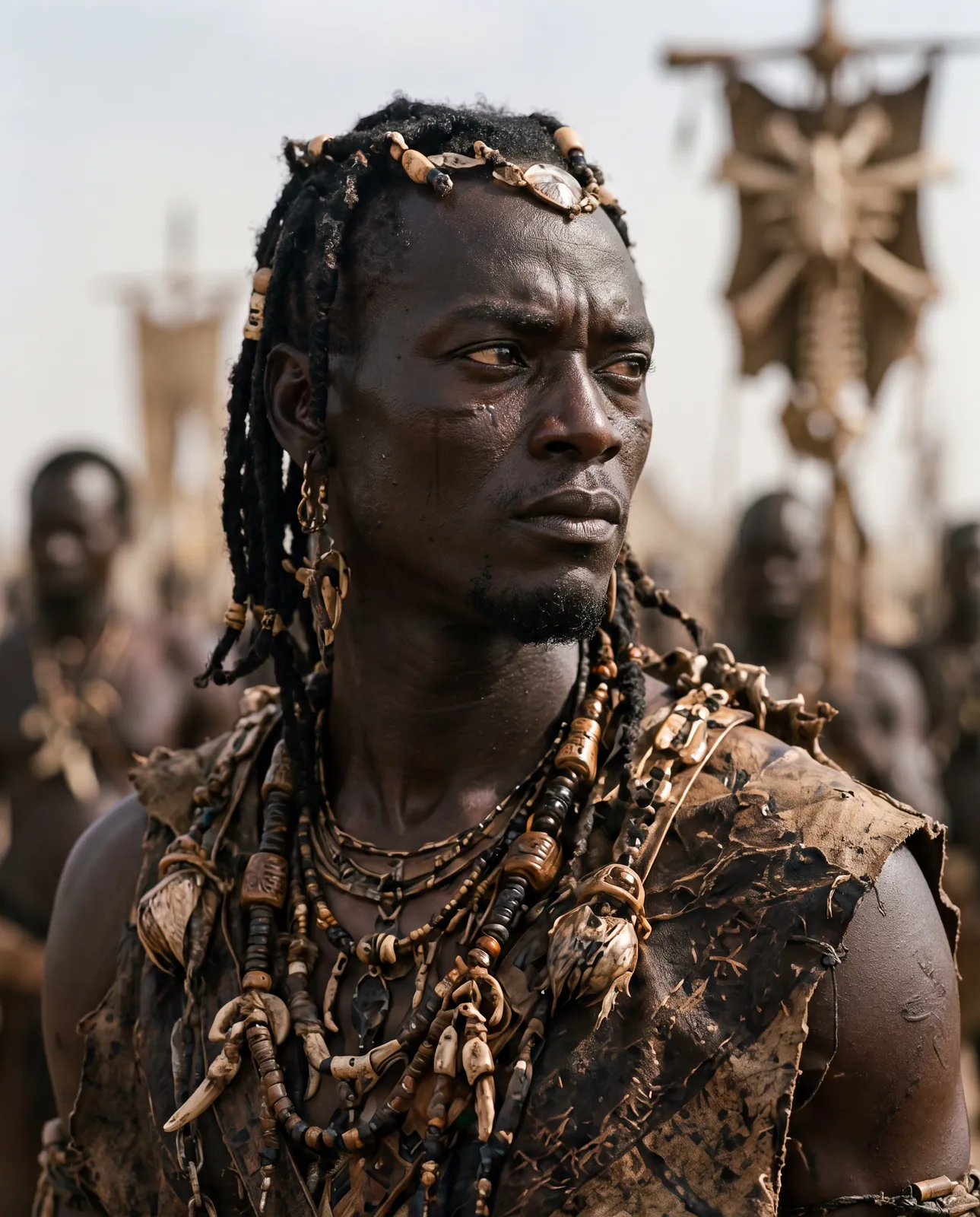
Cloth comes from the looms of Qor-Zaï and the great cities, leather from everywhere. Fine fabrics, which are imported, remain expensive and are kept for feasts and for khans’ families. Hair is worn braided or in long knotted locks, often decorated with beads of bone or teeth, and its arrangement changes with age more than with rank. On very dark skin, weathered by the sun, the dust of the trail soon draws a second colour.
Red dust and white paint
The red dust is not only that of the steppe. Arkhans readily rub it on their arms and faces, mixed with fat, against the sun, insects and wind; it is the ordinary colour of a camp. Clan pigments are added in bands on the forearms, the shoulders or the necks of the mounts, so that riders can recognise one another from afar in the dust.
White paint, on the other hand, is war paint. It is made with bone lime and fat, applied in strokes to the face and chest on the eve of a raid, and never worn outside war; painting oneself with it without reason is taken as a provocation. For raids, some warriors add a mask cut from half a raptor skull painted with ochre, which protects almost nothing and mostly serves to frighten.
Capes and furs
Steppe nights are cold, and elders and khans alike wear thick capes. Their fur is not a fleece: it comes from the dry-sky pterosaurs, which the Wind Walkers breed for scouting and hunting, and whose bodies are covered with a short, dense coat of fine fibres. Tanned with this coat, their hide makes a light, warm cape, which is edged with raptor leather and fastened at the shoulder with a claw.
These capes are expensive and are handed down. Humbler folk make do with doubled raid hides, rough and mismatched, or with greased leather coats that cut the wind. Night bands and trainers prefer the vûrskel of Vüren, the velvet that muffles sound and smell, to approach a pack or a camp without being scented.
What an outfit says
An Arkhan outfit can be read. A necklace of raptor teeth sorted by size tells the hunts of its wearer, one tooth per hunt. A hafted Falaa claw worn at the belt marks a captain. Khans wear rings of steppe jade; khanums, a fire-crystal jewel set on the forehead.
Formal armour adds its own signs: cut bone lamellae for the nobility of the saddle, bone splinters sewn onto blackened leather for the trail hunters, plates of very-great bone for the court. Captives wear no clan pigment, and a clanless man goes with a bare arm. All these pieces, teeth, claws, lamellae and plates, come from beasts: a human ornament would be as unthinkable as a weapon of human bone.