

Trades
Maintaining Arkhan’s living animals
Care, equipment and materials form distinct trades around the Horde’s animals.
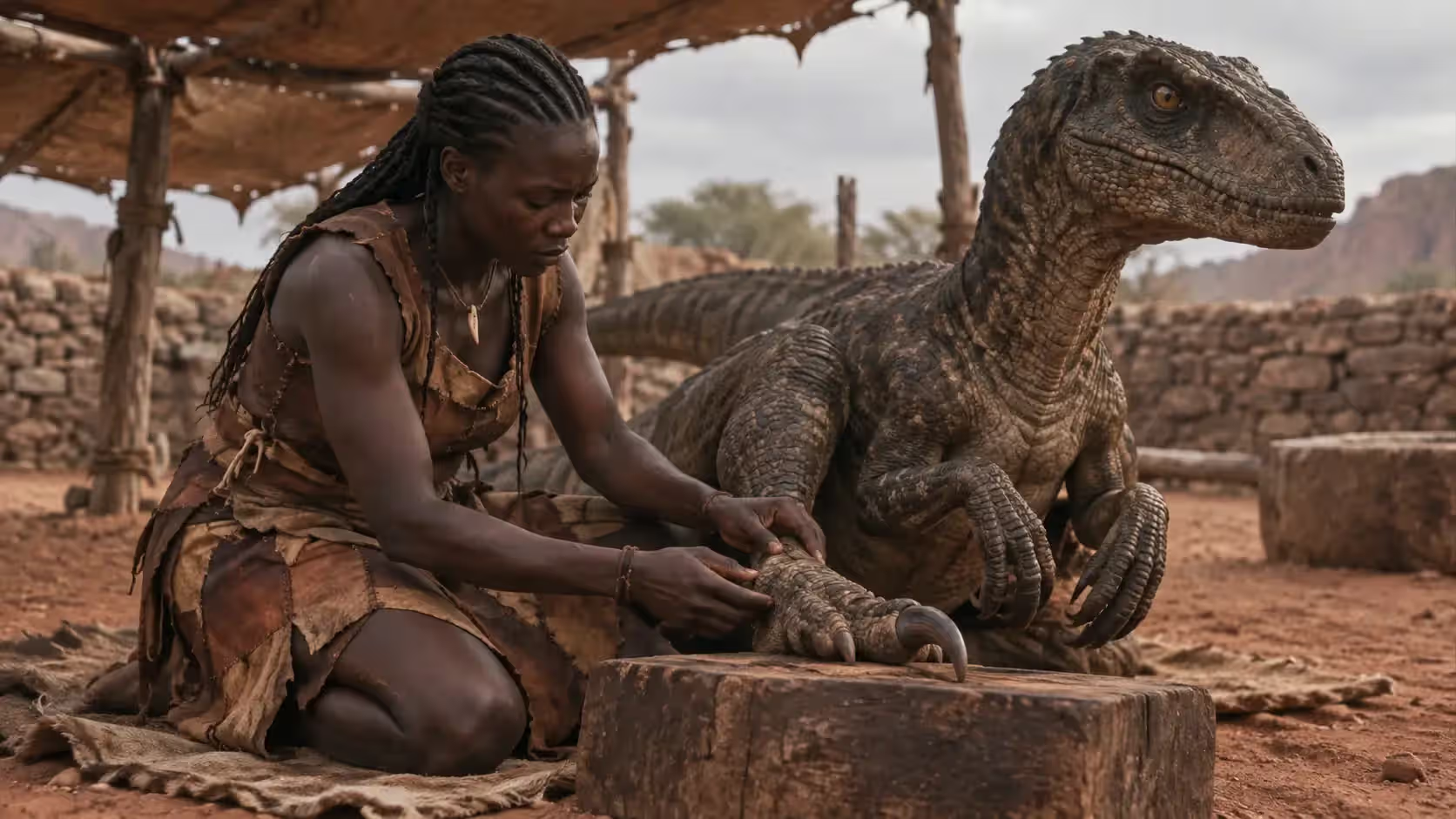
The body before capability
A jaw, tooth, skin, tendon or joint creates material needs before any use. Care work begins by assessing a condition and preventing an injury from spreading. For Apex animals, the oral care practised by Veska Sarr offers a precise example.
Equipping the outside does not heal the inside
Arkhan’s composites combine bone, leather, tendon, resins, textiles and reinforcement. Preparing them requires skills different from caring for a living body: select material, assemble it, test its hold and preserve mobility. Armour repair can support movement; it does not replace diagnosis or surgery.
The chain does not become a caste
Care, workshop, driving and command are distinct skills. Their coordination makes it possible to accompany animals, maintain equipment and organise movements.
The morning round
Every morning, before the camp loads up, someone makes the round of the beasts. He first watches each one walk, from a distance, to see whether it is sparing a leg; then he comes closer, looks at the eye, the nostrils and the breathing, and slides two fingers under the jaw to feel the warmth and the pulse. He checks the claws, the pads worn by stone, the base of the tail, and looks at the droppings left in the enclosure during the night.
Raptors shed their skin in patches, and a bad shed, which leaves dry shreds around the toes or the eyes, ends up causing injury; the round spots them and removes them by hand, with oil. What is seen is not written down: the carer tells the beast’s master, and whatever must be remembered is knotted on the beasts’ cord. In a good camp, no mount leaves without having been touched by a hand that knows.
Ordinary ailments
The trail wears the beasts down in predictable ways. Claws split on rock, pads crack on salt and hot stone, sand gets into the eyes and under the scales of the armpits. Ticks and mites from the enclosures settle in the folds of the skin, and spoiled meat can lay up a whole pack. A mount exhausted by heat stops, mouth open, and moves on only with shade and water.
Bites are the most frequent ailment. In a pack that is crowded, hungry or frightened, the beasts bite one another or bite those who hold them: these are the stress bites, which some carers have made their speciality. The wound is cleaned, sewn with fine sinew and covered with an anti-rot ointment from N’Goro, and hands and enclosure are rubbed with calming resin, a steppe resin whose smell soothes predators.
Mouth surgeons, carers and bonesetters
Beyond everyday care, Arkhan has true specialists. The mouth surgeons, of whom Veska Sarr is the most famous, operate on the mouths of the Apex. The bite carers, such as Hara des Crocs-Calmes, work closest to the pack raptors. The claw-cutters look after the claws of the Vur-vaa. The bonesetters put dislocated toes and tails back in place, and use a raptor claw hafted on bone as a scalpel.
These trades are learned from a master, often in the veterinary pits of the great arena of Qor-Zaï, where wounded beasts go down after the games. Women are numerous there, and the Arkhan cavalry knows it: an army of predators needs as many hands to care for them as to ride them. The khans pay these specialists in beasts, meat and shares, and compete for them before every campaign.
When a beast grows old
A worn-out mount does not end in the slaughter yard. Killing a saddle beast without need is surrounded by prohibitions, and an old mount still has its uses: it is kept for breeding if its lineage deserves it, set to guard an enclosure or a tent, or entrusted to the breeders, who use it to correct the young. Old females, calmer and steadier, are sometimes worth more than a war beast in a breeding camp.
When a beast suffers without hope, it is its rider who finishes it, or the one who cares for it, never a stranger. Its material then follows the rule of its lineage: an ordinary beast goes to the workshops, a lineage mount awaits the keepers’ decision. Many riders keep a tooth or a claw of their former mount, set as a pendant or fixed to the harness of the next.