
Creatures
Raptors of Arkhan
Fast trails, packs and training in a mobile civilisation.
Mobility that shapes society
Raptors are a major part of Arkhan’s fauna alongside carnosaurs and noasaurids. Their use accompanies a civilisation that places authority in trails, memory and reputation. An animal emblem is not equivalent to zoological exclusivity.
Two speeds in the town
A raptor district can distinguish a fast animal trail from a slow human path. Holds, cushioning hides, turning landings and sandy fall zones support movement. These facilities remain local; an entire capital does not become a jumping course.
Observe gestures and materials · 2 images
Place pavée autour d'un bassin cerclé d'os : la foule circule tandis qu'au premier plan deux raptors sellés sont menés en laisse.
Des cavaliers sur raptors empruntent une voie surélevée au-dessus d’un marché de Qor-Zaï.
Training with a way out
Pack areas and training yards combine feeding places, resting niches, scents and clan marks. Keepers know the shortcuts. A straight emergency exit and panic breaks remain necessary: managing a pack also requires planning for refusal and alarm.
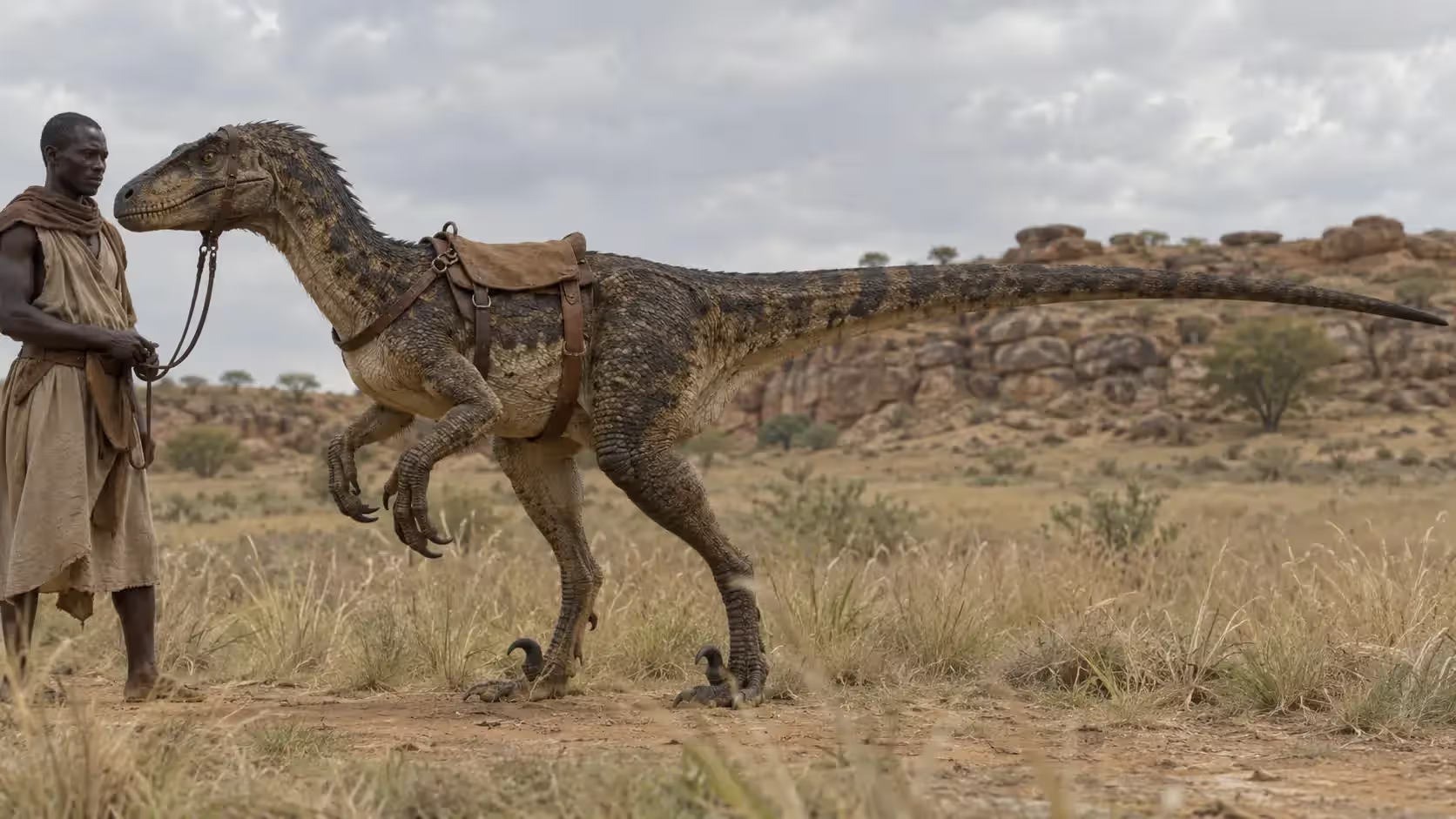
À la halte, un gardien inspecte le tapis de selle d’un raptor à écailles, un autre vérifie une sangle cousue main.
A beast in every camp
In Arkhan the raptor is not reserved for warriors. Every camp has all kinds: raid and racing mounts, guard raptors lying at tent entrances, hunting beasts, young ones in training, old breeding females. A rider usually owns one or two mounts, and a family at least one guard raptor that knows the smell of each of its members and raises the alarm at night. In the shell-cities, the raptor quarters house the enclosures of the household’s beasts, and the relays keep some for couriers.
Children grow up among the beasts. They learn to announce themselves before passing behind a raptor, never to run in an enclosure, to hold out a hand palm open, and they ride their first young Vrii before the age of ten, under the eye of a parent or a breeder. An Arkhan who does not know how to approach a raptor is taken for a foreigner, whatever his birth.
A pack’s day
A camp pack’s day begins before dawn. The carers make the round of the beasts, watch each one walk, check claws, pads and breathing; the mounts that will leave during the day are saddled first, the others stay in the enclosure. Most raptors eat once a day, in the evening, in a fixed order respected by riders and beasts alike: the mount that has worked first, dominant beasts before the others, the young last under the watch of an old female. Before a raid, war beasts fast for a day or two.
Between marches the pack trains. Young riders hold camp races, trainers go over voice and whistle orders, wall beasts climb the nearest banks. At night the raptors sleep pressed against one another in the enclosures, heads facing outward; one or two watchers stay awake, because a pack that panics in the dark can smash a stockade before anyone has lit a torch.
What a raptor costs
A ridden raptor costs first of all to feed: a week’s meat ration is worth some twenty Dracos, far more than for a draught herbivore, and a camp that keeps a hundred mounts must maintain meat herds, stores of dried meat and agreements with the breeding clans. A common saddle is worth twenty-five to seventy-five Dracos, a raptor hide thirty-five to a hundred and sixty depending on its condition; a lineage Vur-vaa fetches prices only khans and foreign powers can pay.
Raptors change hands a great deal. Breeding clans such as the Serpents de Sable sell trained beasts every year to the other khanates and, through Port de Sable, to the Volonians; the Empire of Urnok imports them under watch, with licences and lineage rights. The best beasts are not sold: they are given, lent or passed on by saddle testament, and a family’s wealth is measured by the number of mounts it can lend without running short.
Seen from elsewhere
To other nations, Arkhan’s raptors are the very image of the Confederation. Urnok’s soldiers call them “the running teeth”, maintain anti-raptor forts along their march and form units armed with nets, hooks and lances to bring them down; their officers teach that a line which scatters before raptors is lost. The Korathi, who despise Arkhan, nonetheless buy its raptor sinew for their ballistae. The Ishtiri see in these packs the opposite of their sacred, horned front.
The Volonians alone look at them with neither fear nor contempt, as a costly commodity. They buy them at Port de Sable, insure them, resell them, and have learned, often the hard way, that a raptor without an Arkhan trainer becomes within a few seasons a danger to whoever owns it. Arkhans, for their part, are amused by these views: they say a foreigner judges a raptor by its teeth, and an Arkhan by the way it comes back.