
Religion and rites
Korath: Sacred Geometry
Mountain, Magma and Form connect morality to the practice of material work.
Containing force
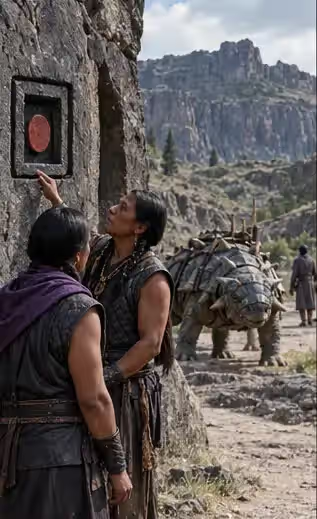
The Mountain owns matter, Magma owns force, humanity owns Form. The red disc within the black square represents contained power. Patience, Precision, Resilience and Moment structure this morality. The artisan’s worth also lies in declaring the gap between the plan and the part actually produced.
Cooling and repairing
The Cooling Time postpones judgment of a major decision still hot with anger or enthusiasm. The Trial of the Crack asks young people to understand and repair a damaged object. Entry into adulthood combines tool, watch and glass. These rites recognise limits, timing and a return to control alongside invention.
Form, humanity’s only share
For Korath the Mountain owns matter and Magma owns force; humanity owns only Form. Precise work does not claim to create rock or energy: it understands their properties and establishes forms that hold. The cult thus gives craftsmanship a sacred value. The square, the favourite form, suggests stability, measure, module, wall, terrace, grid and resistance; the maxim sums it up: “The circle rolls; the square remains.”
Declaring the gap
Perfection belongs to the plan; dignity belongs to whoever declares the gap. A recognised defect can be corrected or passed on to users; a hidden defect exposes them to a promise they cannot check. The major fault is therefore false precision, worse than an honest mistake. This ethic feeds counterproofs, revised patents and the memory of accidents.
Rites of passage
Sacred geometers take part in birth, marriage and funerals. Marriage traces a square with four hands; the tiny deviation of the gesture is kept, a trace of a shared construction. The Trial of the Crack asks young people to understand and repair a damaged object, not merely to invent. The First Glass links tool, watch and glass to entry into adulthood: work, timing and the ability to come back after drunkenness.
The Cooling Time forbids judging a major decision while it is still hot with anger or enthusiasm. On the eve of battle, soldiers wait until a heated stone can be touched with a bare hand: matter, not the clock, gives the signal to set out.
The forge festivals
Two festivals bind the cult to the forges: the Basalt Oath, when the year’s metal contracts are carved into stone, and the Black Kindling, the season’s first lighting of the black forges.
The Basalt Oaths
Korath carves its faith in stone. The Basalt Oaths carry the faith of the engraved oath, on the principle that “stone comes before blood”. At the festival of the Basalt Oath, the year’s metal contracts are carved into the rock.
A religion without revelation
The Mountain and the Magma do not speak. They have no face, no will and no commandments, and nobody in Korath claims to receive their orders. Nothing is asked of them: people do not pray for a pour to succeed, they check the crucible. Sacred geometry is a way of standing before matter and force, of recognising what they are and answering them with a sound form. It announces no survival in the rock and promises no wonder.
The most common religious gesture is therefore a declaration. Many households own a mirror of polished obsidian ringed with bronze, in which people look at themselves before admitting a gap: a mistake in a calculation, a promise poorly kept, an unjust anger. The words are addressed to the living people concerned, not to the stone. Foreigners often take this rite for a confession; Korathi describe it rather as checking a piece before delivering it.
The sacred geometers
Korath has no clergy ruling over souls, but it has its officiants. The sacred geometers measure foundations, rites and gaps. They can be seen drawing the square of a marriage or of a death, checking the first stone of a hall for true, blessing a pour by declaring the flaws of the ore. Their kit is a craftsman’s: compass, square, plumb line, bronze rule.
One becomes a sacred geometer after a career in the workshops, rarely before forty, and nearly always after working in the Side of Form or the Side of Measure. Their authority does not reach beyond the rite: they do not judge patents, do not sit in the Chamber and command nothing. A family may dispute their measurement, and the geometer must then redo the drawing in front of it. This humility of the trade explains their standing: they are respected because they accept being checked.
The sacred at home
Korath does not raise great temples. Its sacred places are places of work: the sanctuaries of the Rifts where the dead are returned, the square well of the Great Chamber, the black forges at the time of the Kindling. In homes, religion comes down to a few objects. Above the door, a plaque of black onyx inlaid with a disc of garnets repeats the national symbol. Near the hearth people keep the childhood patents, often framed on the kitchen wall, and the tools of dead parents.
These objects protect against nothing. They remind whoever comes through the door that the home is a form held up by the living, and that it has to be held up every day. Poor families replace the onyx with a painted square of basalt and the garnet disc with a round of red clay; nobody sees any difference in worth.
The four virtues in daily life
Patience, Precision, Resilience and Moment are not a preacher’s abstractions. Children learn them through gestures. Patience means waiting for a piece to cool before judging it, as the Cooling Time teaches. Precision means announcing one’s margin before someone discovers it. Resilience means repairing rather than replacing, as the Trial of the Crack demands. Moment, the most Korathi of the four, means acting at the right instant, neither before nor after.
In everyday life these virtues are used above all to judge. A colleague is reproached for lacking Moment when he interrupts a manoeuvre, Precision when he rounds off a figure, Resilience when he throws away a tool that could be mended. Workshops sometimes display the four words above the benches, inside a square with one virtue on each side; the centre is left empty, kept for the Form being made.
Facing other beliefs
Elsewhere, the sacred often has the shape of a beast. Urnok honours the great living animals that carry the Empire, Arkhan follows the Way of the Raptor, Ishtir serves the Sun and its great fliers. Korath has no colossus: the Black Mountain holds for it the place the very large beasts hold for others, that of mass, memory, defence and sovereignty. Korathi draw a quiet pride from this. They revere a massif that does not die, does not eat and cannot be sold.
The difference breeds misunderstandings. The Ishtiri see sacred geometry as an engineers’ religion without a sky; the Korathi see the solar cult as a faith that refuses to measure what it worships, and the contempt runs both ways. Yet Korath seeks to convert nobody: foreign students attend the rites without being bound by them, and all that is expected of them is that they declare their mistakes like everyone else.