

Families and social ties
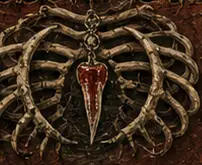
The Fils de la Faim
A recent clan from the poor steppes, recognised for about 240 years, despised by the old trails and grown into a new social power.
A clan of the poor steppes
The Fils de la Faim are a recent clan, born of the poor steppes and recognised as a clan for only about 240 years. Their territory is the Hunting Plains. They live by raiding, captives and packs; their workshops supply leather, hides and dried meat. Their short history earns them the contempt of the old trails.
Their recognition as a political actor turned a poor clan into a new social power, able to replace an ancient lineage.
Bands and sub-khans
The clan is organised into raiding bands. Kharûm commands one, which bears his name: a war leader and sub-khan, he is not the clan’s khan. A former captive integrated as a child, he is a son of the Hunger in the literal sense. Vaëkhan, his lieutenant, counts heads one by one where Kharûm thinks in packs. The clan’s takings go to auction at Port de Sable.
Vaëkhan, le lieutenant rival.
Vaëkhan, le lieutenant rival.
A clanless man attached
Sher’Khan is attached on paper to the Fils de la Faim without belonging to them. Clanless, he went through the trials of integration alone, with no trail to receive him, and counted himself among the living. He therefore owes no trail debt, which makes him impossible for his clan to humiliate.
Places and place names
The khanate’s lands include several named places: La Faim, Lit Asséché, Os-de-Disette, Tente-du-Ventre-Creux, Maraude-Aride and Puits-du-Renoncement.
Tergha Main-Sèche
Above the bands, the clan’s khan is Tergha Main-Sèche, keeper of a doctrine that makes hunger a law. His byname says it: the dry hand never feeds twice the one who failed once. Before refusing a ration he wipes his right hand on his thigh, and that gesture is enough to condemn a man to hunger. He owns what he has made: as trail-father of Kharûm, whom he had reborn into the clan, he can unmake him. Against a clanless man like Sher’Khan, who owes him no trail debt, his usual hold does not bite.
Camps without monuments
The Fils de la Faim (Sons of Hunger) live in semi-mobile camps on the Hunting Plains, made of bone, leather, dust and low cages, where noasaurids live too. These camps have no monuments: everything rests on dismountable methods, hide, sinew, fibre, modules and anchors, and on repair. The chiefs’ tents are recognised by the height of their lance racks rather than by their walls.
The clan rides a raptor that resembles it, the Draak-vaa, a roof raptor that leaps onto rooftops and serves, under a short saddle, for raids and pursuits. Its crude rams, drawn by starving beasts, are only for smashing a gate while the riders have already gone over elsewhere. The camps’ workshops produce the leather, raiding hides and dried meat that go to the Confederation’s markets and to Port de Sable.
The red-mouthed tyrants
The clan’s Apex are red-mouthed tyrants, the least stable in the Confederation, fed on raid meat and seized carcasses. The clan’s stock remains more precarious than that of the old lineages, and these beasts belong to the clan, above the band chiefs: Kharûm, a sub-khan, owns none of his own, and that limit is part of what others hold against him.
The red mouths weigh on the clan’s reputation. They speak at once of its power and its poverty: a rich clan feeds its Apex from controlled hunts, a poor clan feeds them on what it takes. Trainers from the old trails often refuse to work near them, and in the markets people say one should never buy a Fils de la Faim sinew without asking what the beast had lived on.
The clan of the shareless
The clan recruits where the old trails do not look. In the poor steppes, the shareless young, with neither herd nor booty and so without a name in many eyes, are the fuel of raids, and the Fils de la Faim offer them what no one else gives them: a share. Captives made sons are numerous among them, and war chiefs such as Kharûm are former captives taken in as children.
Accounts differ on what earned the clan its recognition, some two hundred and forty years ago. Some speak of a famine during which its bands fed older trails with their takings; others of a service rendered to a Horde. All agree on what followed: recognition turned a poor clan into a new social power, and the old trails have never forgiven it. For this clan, the creed of hunger as law is neither a formula nor an image.
Part of this article covers events of season 1. Turn spoilers on in the menu to read it.
Gallery1 image
Kharûm, a war leader with a broken nose.