
Places and landscapes
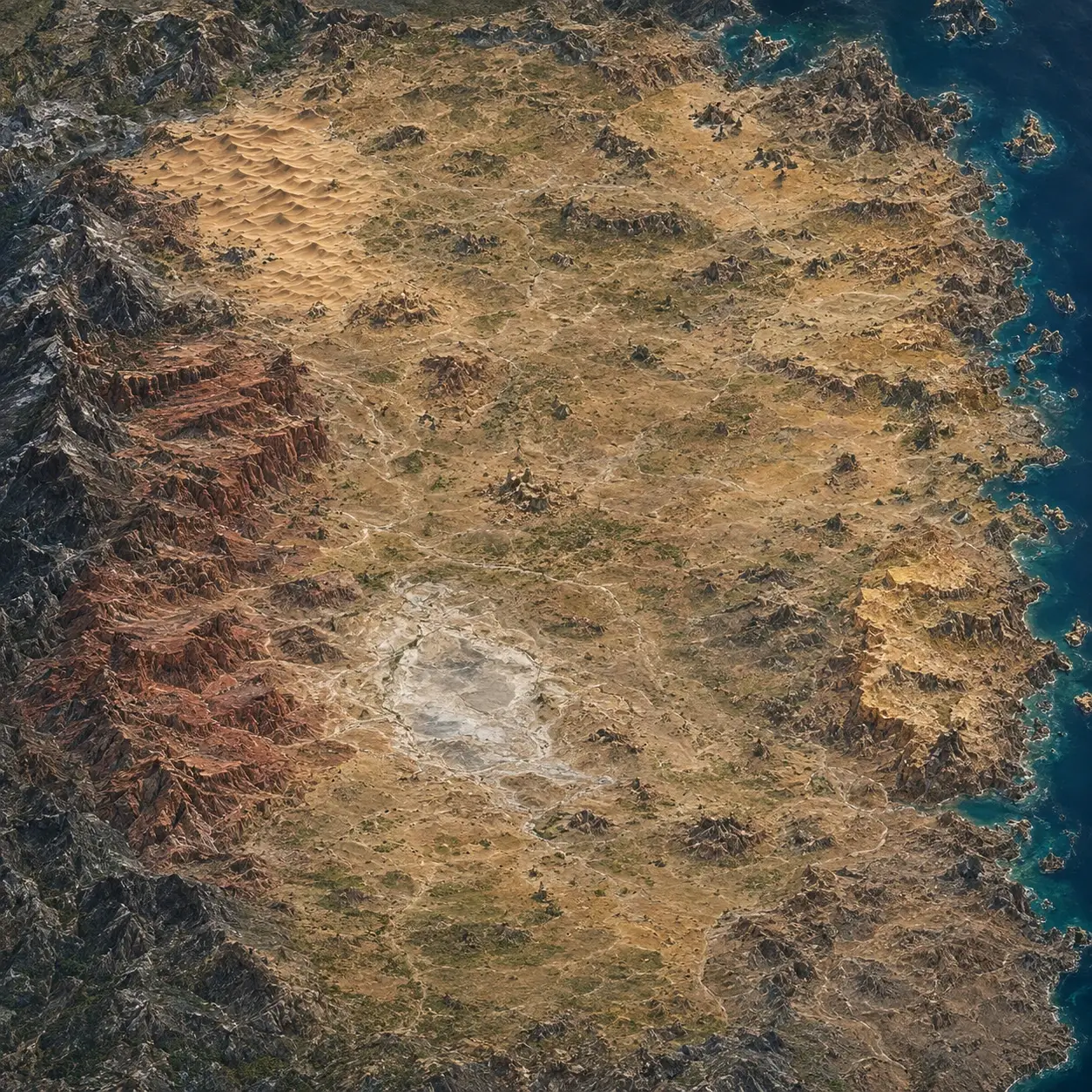
The steppes, deserts and canyons of Arkhan
Arkhan lies in the east of the known world: steppes, deserts, badlands, canyons, plateaus and coasts, between the Korath massif and the inland sea of Tethys. It is the largest of the six powers.
A land of landscapes, not borders
Arkhan lies in the east of the known world. Its territories combine steppes, deserts, badlands, canyons, stony plateaus, dry beds and coasts. The Korath massif closes it to the west; the inland sea of Tethys opens its trade to the east.
Wells, caravan relays, corrals, hatcheries and camps count for more than continuous borders: a passage is worth the water, rest and usable way out it offers. Between two powers there is usually no border but weeks of emptiness; a clear limit exists only where two civilisations truly touch, as Qor Zaï impérial and Arkhan, or Korath and Arkhan, do.
The largest of the six powers
Arkhan has about thirteen million people over eight to ten million claimed square kilometres, roughly one and a half inhabitants per square kilometre. These areas are claimed rather than inhabited. It is the largest of the six powers, and its strength comes from this immensity of track.
A Horde on a dry track covers twenty-five to forty leagues a day, while an Urnok army with its great beasts makes three or four. The numbers in Arkhan songs belong to another register: “ten thousand leagues of track” is not to be converted.
The names of the land
Arkhan divides into several large areas with imprecise limits. The Canyons Rouges form a brick-red massif along the Korath border; the Badlands de Khor are another red massif, on the western border slopes. In the north, a band of plain stretches between the Dunes Hurlantes and the sea. The Mer d’Os asséchée is a former basin south-west of Qor-Zaï arkhan. The Plateau de Pierre Jaune and Arabidis lie there too.
These names designate landforms, not khanates: clan influence is read on a different layer from physical geography. The Canyons Rouges can shelter a defensive quarter with narrow passages or a dark natural refuge; they do not, for all that, found an urban style of their own.
Thirteen trail countries
The Confederation’s atlas distinguishes thirteen great trail countries. In the north the Plain of the Broken Sun stretches as a band between the Howling Dunes and the sea. Further inland lie the Grey Lands and the Yellow Causses, then the Plains of the Cutting Wind, which give their name to one of the great trails, and the heights of the Teeth of the Sun.
In the west, facing Korath, the Red Canyons and the Khor Badlands form the red glacis of the border; the Hunting Plains, at the foot of that massif, carry the densest wildlife of the known world, and the Devouring Sands shelter no lasting settlement. The dried-up Sea of Bones, the Yellow Stone Plateau and the Wastes of Arabidis complete the map. These countries are reliefs and trail basins; the clans draw no borders across them.
Dry seasons, trail seasons
The country lives to the rhythm of a long dry season and short, violent rains. When they come, the dry beds become wadis again for a few weeks, the ponds fill, the short grass greens and the herds spread out. Then everything draws in again around the wells, the salt lakes and the cisterns. A trail passable in the wet season may be dead three months later; trail people speak of an “empty trail” for a season without raid or herd.
Vegetation follows the water. The steppes carry short grass and salt scrub that the meat beasts eat; the oases shelter orchards, fields and ginkgos; in the south, Arkhan’s only great forest lines up its araucarias. Dust storms, frequent at the end of the dry season, erase tracks and can hide an entire column.
The monsters of the map
Arkhan’s free lands have their famous monsters, wild Apex known by name that no trainer approaches. In the Red Canyons lives Three-Irons, a great tyrannosaurid that still carries three ballista bolts lodged in its body, none of which killed it; khans swear “by the three irons”, and it is said that whoever brought it down would become a khan, so that nobody has the right to try without the Supreme Khan’s leave.
On the trails of the Hunger, an abnormally large dromaeosaurid follows caravans at a distance for days and takes only the stragglers; it is called the Accountant, and “paying the Accountant” means lagging on the road. In the Howling Dunes a white carnotaur, Night-White, hunts by night like a ghost; when it comes down towards the wells, say the Sand Serpents, water is about to run short.