

Institutions
Migrations and urban continuity in Arkhan
Group movements in Arkhan require distinguishing what travels, what remains tied to a place and what must be maintained for newcomers.
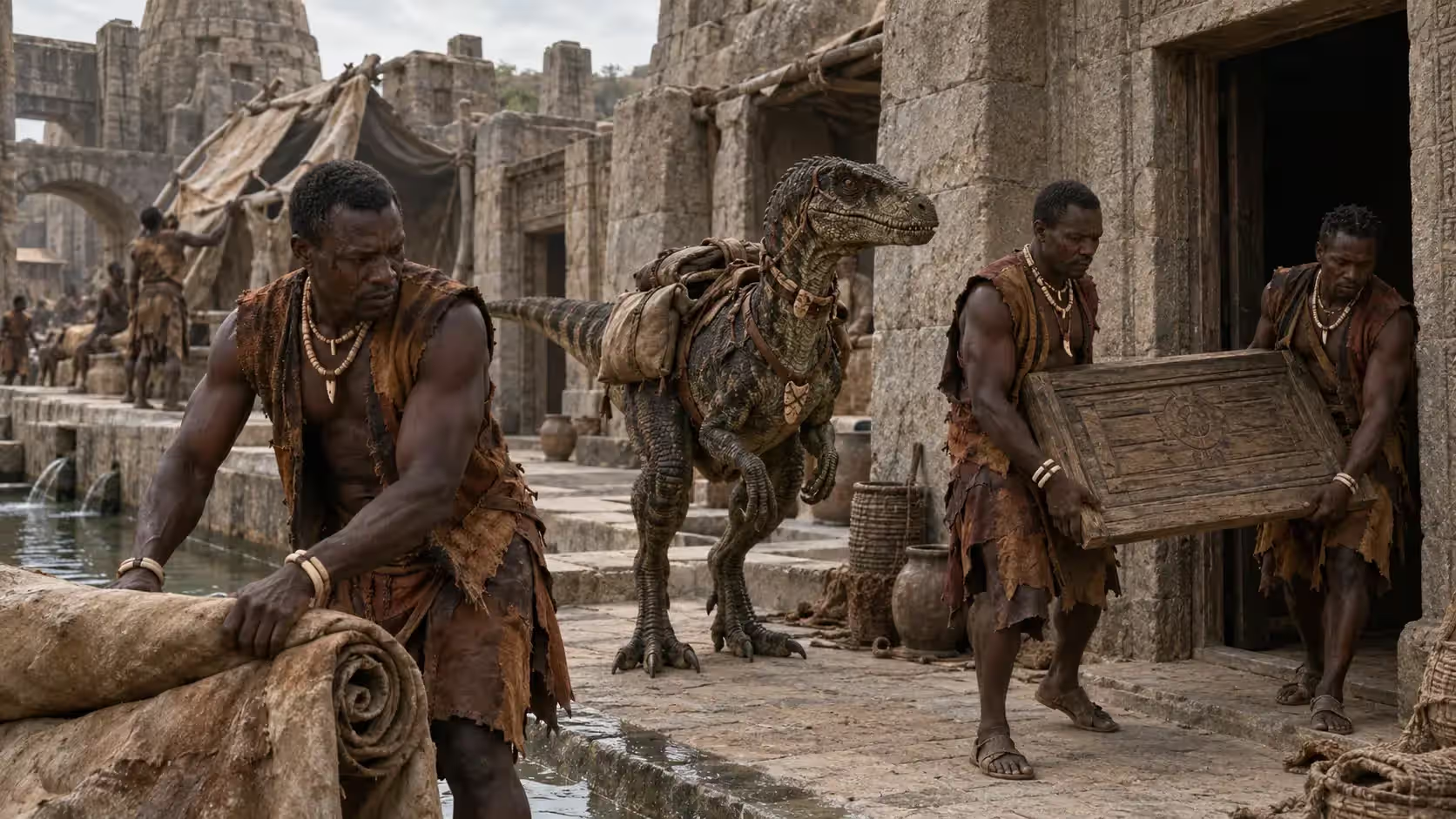
Departure distinguishes kinds of property
A city does not empty like a single inventory. Transportable objects, removable installations and elements tied to land or basins do not have the same departure conditions. This separation makes movement possible without pretending everything can be taken or abandoned without consequence.
People retain memory of places
People responsible for upkeep retain knowledge of basins, walls, enclosures and installations when groups change cities. This memory makes resumption of the place possible: it shows what can still be used, what needs repair and what presents a risk.
Receiving people requires restoring a place
Cleaning, water, enclosures and access must be checked before a new arrival. Receiving people and animals is therefore a matter of sanitation, space and local labour, not a vague image of free movement.
A calendar held by the centre
The Great Shedding comes round roughly every seven years, but its exact date belongs to no khan. The centre controls the calendar: it is from Qor-Zaï that the season of departure, the order of the columns and the day of the last horn are fixed. This control is part of the Supreme Khan’s authority, and he himself goes out onto the trails during the Shedding to attend the handovers.
The news travels long in advance through relays, war-singers and messengers. A family therefore knows a season or two ahead when it will have to leave and for which city; workshops begin to run down their stocks, breeders to gather their beasts, foreign merchants to renegotiate their contracts. The few scholars who study the institution say the calendar is the Shedding’s true weapon: whoever fixes the date also decides who will be ready.
The column on the move
A Shedding column is not a caravan. It carries a whole people: families, herds, raptors, dismountable workshops, roofing membranes, banners, portable altars, and the clan’s entire army. It stretches over leagues. Scouts and packs march at the head, then the herds, kept away from the families so that the scent does not turn the raptors; then come the families and the workshops’ loads, while the riders bring up the rear or cover the flanks.
It moves slowly. A Horde on a dry trail covers twenty-five to forty leagues a day; a Shedding column, with its children, its still-able elderly and its herds, does far less, five to eight on good days, and the journey from one city to another often takes weeks. Every stage depends on water, and the water masters set the order in which columns drink when several share the same well.
When two peoples cross
The peoples do not follow one another in file: they exchange their cities, and their columns cross on the trails. These crossings are awaited moments. News is traded there of the cities being left and those being sought, debts are settled, unions concluded; families separated by an earlier Shedding meet again for a night around the same wells.
The Shedding stories keep the memory of these encounters, down to the former lovers who work out the year when their migrations will pass within twenty kilometres of each other. Crossings have their frictions too: two peoples who have followed each other in the same city often blame each other for the state they left it in, and the water masters separate the camps when the reproaches grow too heated.
Foreigners and the Shedding
For foreigners the Shedding is first of all a practical puzzle. A single city changes identity according to the people living in it, so that diplomats must specify which Vulkar they mean: the present one, or the one arriving in two years. Volonian houses offer “Shedding relocation” contracts whose clauses exclude more or less everything that can happen on the way.
For Arkhan’s enemies the Shedding is a moment not to be touched. Since the battle of the Seven Dusts, when a foreign kingdom thought it was attacking civilians and found that a clan’s entire army was marching with them, no one attacks during the Great Shedding. Neighbours close their passes and wait for the movement to end. This protection applies to the recognised cycle, with its columns and handovers; it makes the Arkhan calendar a diplomatic matter as much as a domestic one.