
Creatures
Filtre, Nala Vey’s baryonyx
The channel baryonyx of the herbalist Nala Vey: an amphibious mount that smells contaminated water.
Medicine and territory
Filtre is a light spinosaurid, a damp-green channel baryonyx: the amphibious mount of Nala Vey, herbalist and envoy of N’Goro, who also practises at the Croc Fendu in Urnok. It smells contaminated water. Nala refuses to separate medicine from territory.
A channel baryonyx
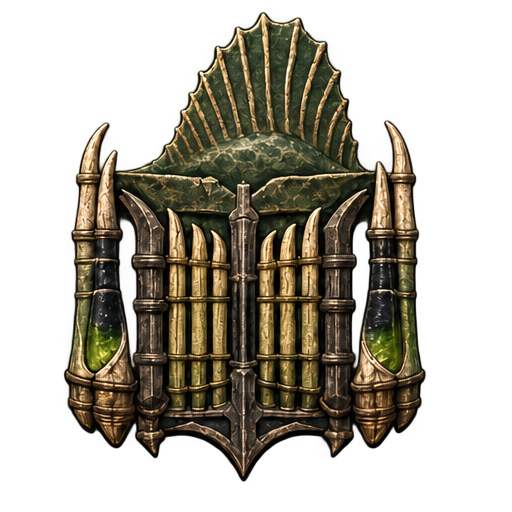
Filtre belongs to the line of channel baryonyx, the light spinosaurids N’Goro raises on its coasts and around its lakes. He is far smaller than a great Siirmuu: eight to ten metres long, under two tonnes, a narrow, elongated snout set with many fine teeth, and on the thumb of each hand a great sickle claw he uses to spear fish. His skin is a damp green, darker on the back and paler under the throat, and turns almost black when he comes out of the water. His low dorsal crest has nothing of the great sail of the Siirmuu.
Baryonyx are calm animals and good trackers, steadier than the great theropods of firm ground. In N’Goro they are used for fishing, for guarding quays and rivers, for hunting the raptors that venture into the marshes, and for hauling flat ferries across the estuaries, where their mere presence drives off the beasts lurking under the quays.
How a baryonyx learns to smell water
Every baryonyx has a keen sense of smell, but not every one becomes a water-sniffer. Those meant for the work are raised from hatching near the herbalists’ quays, where they are given food and drink only in read waters; the animal thus learns the smell of a sound water. It is then shown, in small doses, doubtful waters that the Sap-Keepers have recognised as such, and rewarded each time it turns away from them. After a few years it refuses of its own accord any water that lacks the smell it knows.
The training is long, and many animals fail: some refuse every foreign water, which makes them useless on a journey, others end up getting used to bad ones. The most reliable stay with the same person all their lives, because a water-sniffer works better with someone whose gestures it knows. Filtre is one of these: he takes his food only from the hand of Nala Vey or her team.
What a water-sniffer needs
A channel baryonyx needs constant care. He eats several dozen kilos of fish a day, which must be caught or bought from safe waters; his teeth fall out and grow back all his life; his skin cracks if he stays out of the water too long, and must then be rubbed with fish oil and fine mud. The parasites that lodge between his scales are removed with bone tweezers, and his eyes, which spores irritate, are watched closely.
Those who approach him also know to respect him. Filtre’s claw can open a man like a fish, and even an animal used to its team may strike when afraid. The helpers always come at him from the front, talking, and never step between him and the water. To ride, his rider settles into a low saddle of hide and chitin strapped in front of the crest and lets the beast choose its pace: one does not guide a water-sniffer, one follows it.
A mount worth a Sap-Keeper
In the Foam Marches and on the coast of Yveth, Filtre enjoys a reputation greater than that of many humans. Boatmen who see him refuse a water take note of it, the fisher-trainers of the House of Nala-Vey use him to test the basins of their quays, and the herbalists of the Vey clan cite him to their apprentices: a remedy begins before the preparation, at the moment the water is chosen. Of someone who sniffs out a trick it is said that he “has Filtre’s nose”.
The mount also says something about its rider. As the representative of a bloc of great spinosaurids, Nala Vey could be carried by a great Siirmuu; she travels on a humbler animal whose chief virtue is saying no to a bad water. Those who know her see in this her way of reminding people that medicine and territory are not to be separated.