

Culture
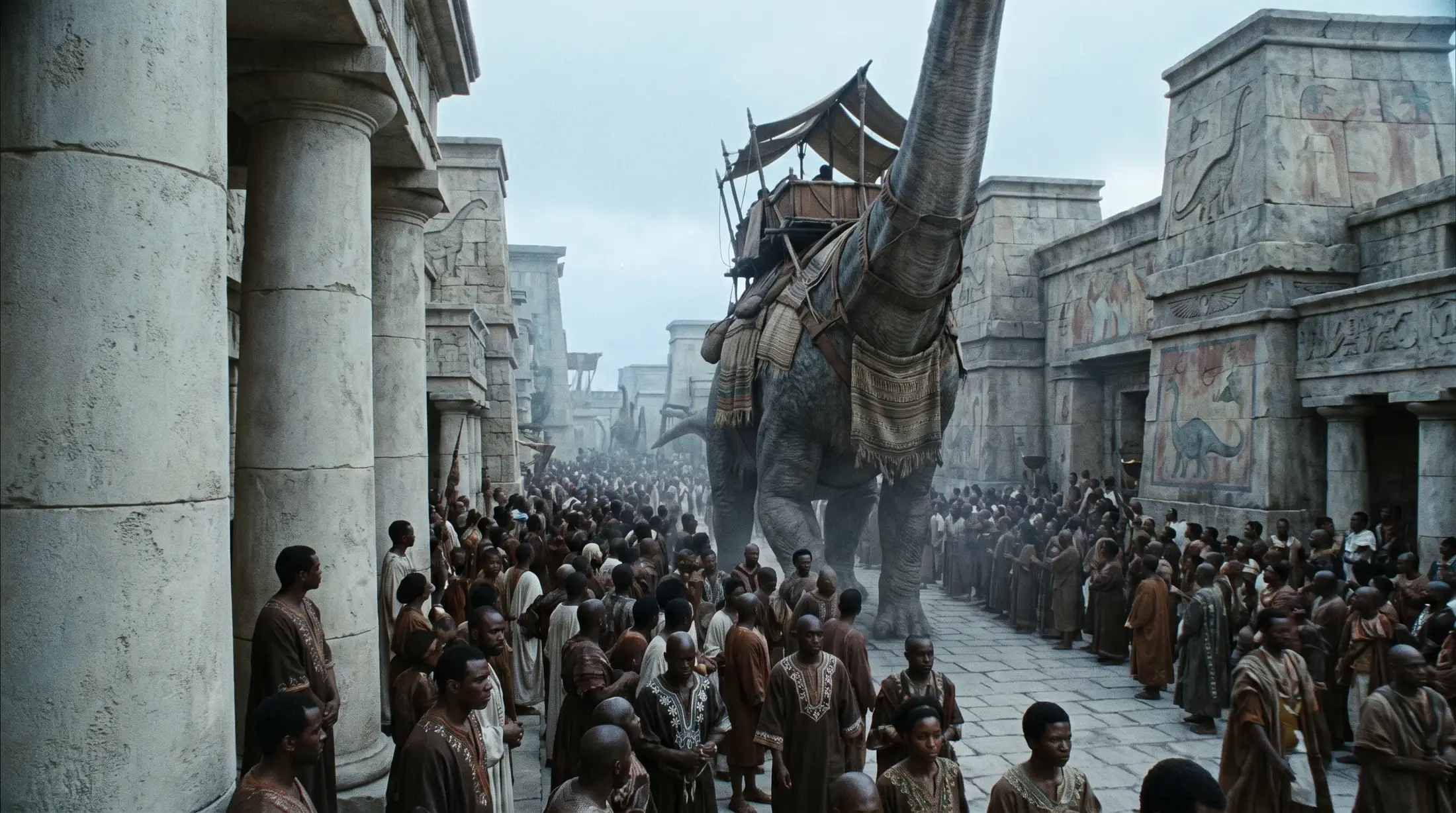
Urnâk, the language of Urnok
The Empire’s language records as much as it speaks: a well-formed sentence names a person responsible, a charge and a degree of certainty.
To speak is to record
In Urnâk, to speak is to record. A well-formed sentence always names a person responsible, a charge and a degree of certainty. Requisition is a grammatical form there before it is an administrative act: logistics is not jargon but the natural speech of Urnok.
Sounds and stress
Urnâk has five vowels, a, e, i, o and u, and their long forms, â, ê, î, ô and û. Its consonants are p, b, t, d, k, g and q; m and n; r and l; s, z, š and h; v and f; and finally y. Stress falls on the penultimate syllable. Doubling a vowel marks unity: a single piece, a single beast.
Who answers for what
Four cases organise responsibility. The -ka case names the one who answers for a thing; the -mu case, the charge, what weighs or is owed; the -ri case, what is safe, guaranteed or pledged; the -sha case, what remains risky, unguaranteed. Ur-sha, the dangerous road, carries this last marker.
The language also marks proof. The suffix -vek signals what is recorded or certified in the register; two further markers, -nur and -sai, complete this evidential system. The plural is formed in -en, and the collective in -um names the herd, the levy or the corvée.
Affixes build the vocabulary: -og expresses the colossal, as in silo-og, the colossal granary; -tar names the agent or the trade.
Words of the register
Everyday vocabulary keeps the trace of the activities that hold the Empire together. Pâng means the empire, môr the province, sêl the law and dren the citizen; urnâk names the centre, the capital. Ekal is the scale and ekal-or the gold scale. Darg is debt, zûn interest, mâr the due date.
Ur is the road, kav the convoy, šun the ration and šun-gra the great herbivore. Ekl means the egg and ekl-og the giant egg; dres means to train an animal; vek, certified.
Forming a name
The language supplies name patterns. A town joins a terrain and a function: Silo-og, Gren-urn, Col-ket. A person joins a value and a function, as in Qev-Šektar. A title is made by adding -ka to a noun: Môr-ka, the one who answers for the province, is the provincial governor.
These patterns coexist with the older names of the Houses, the Lines and the duchies, which keep their own sound traditions.
Ordering, forbidding, asking
Three particles place a sentence on the scale of authority. Ta introduces a direct order, na a prohibition, ke a request. A convoy driver who tells his team “ta kav” starts the convoy; a guard who shouts “na ur” closes the road; a merchant who writes “ke šun” asks for a ration. These particles stand at the head of the sentence, and switching particles mid-conversation is a signal everyone understands: a superior who moves from ta to ke is asking a favour, an equal who moves from ke to ta is taking command.
Two suffixes shade the meaning of words. The suffix -ik marks the small, the light or the familiar; -dur marks what is kept up, lasting, maintained. An ur-dur is a maintained road, one that can be relied on; a silo-ik is a small village granary. Children learn -ik before any other suffix, and adults use it to soften an order.
Words for animals and war
The vocabulary for animals is short and precise. Brax means brachiosaur, triq ceratopsian, rapt war dromaeosaurid, pter pterosaur; šun-gra means the great herbivore, the one that depends on a great ration. Leg is the legion and qasar the emperor’s title. Words combine freely: a brax-og is a colossal brachiosaur, a leg-um the levy of a legion, and a rapt-sha a raptor pack whose whereabouts are not yet known.
Urnok soldiers have turned these compounds into campaign slang. Enemy animals are counted in šun, like rations to be covered; an order “ur-vek” means the road has been checked and certified, and “ur-sha” that one must advance with pikes lowered.
Road-Cant
On every road and every quay of the known world, convoy drivers speak an unwritten trade language, Road-Cant. Its skeleton comes from Urnâk, its habits of proof from Volonia: everything in it is said to be guaranteed or not guaranteed. A few words form its core: sha, danger; vek, what is certified; mar, the due date; šun, the ration; nid, the depot. They are combined without grammar: nid-vek, a certified depot; šun-mar, a ration due at term; sha-sha, run.
Switching from one’s own language to Road-Cant in the middle of a conversation is a recognised gesture. It means one is stepping onto neutral ground, where one talks business and not honour. Arkhan, Korathi or Volonian merchants who know not a word of Urnâk can all say nid-vek.
The duchies’ accents
The Urnâk of the capital is taken as the norm, ample and measured, with its always-hard C. The duchies have coloured it. An Orlantine is recognised by the way he sings his vowels, inherited from the language from which Volonia’s descends; a man of Bralnor by his dry consonants; someone from Qor Zaï by the trail words he mixes into his sentences, picked up through contact with Arkhan. In Velmor the court keeps old turns of phrase that the capital finds archaic and Velmor finds royal.
Want has its words too. Someone without work is a “hand off the ration”, a worker without a fixed place a “ramp seasonal”: in Urnâk one exists when the register feeds one, and the language speaks the shame of not appearing in it without ever putting a number on it.