
Places and landscapes
Vüren: a contact metropolis
Commerce and mobility give a public function to a great city of the Arkhan–Korath marches.
The name of a contact march
Vüren belongs to the place names of the Arkhan–Korath border marches. The Arkhan layer of its name preserves the memory of a contact zone. Korath’s proximity places these marches between continental tracks and mountain exits: their names carry that meeting without turning the two civilisations into a single territory.
Vüren
Dans l’amphithéâtre de pierre, les passages courbes relient bassins, cours marchandes et arches d’os sous les membranes violettes.
A city of trade and movement
Vüren is among Arkhan’s great metropolises and has a migratory and commercial function. This combination brings together the movement of people and goods. The city’s value lies in its ability to receive movement: workshops, populations and exchanges form an urban wealth that the sheer volume of its walls cannot explain.
Two metropolises, two axes
Connections between Korath and Arkhan distinguish one axis towards Vüren and another towards Vulkar. The Obsidian Rift corridor belongs to this reading of continental contacts. For a traveller, a destination name therefore identifies a branch of the network: changing metropolis requires choosing another connection rather than treating the same track as interchangeable.
A city in an amphitheatre
Vüren is built in a stone amphitheatre, an oval hollow closed by low cliffs. A ring of great planted bones marks its edge: this is the Skelqar, the sacred limit of the city, which is crossed only through the gates. These are curved works, lined with thick hangings, and each opens onto a listening court where one stops before entering. The streets turn and climb in spirals; one never sees far ahead.
Above the districts rise listening towers: great stretched membranes catch the vibrations of the air and the ground, so that the watchers hear a pack or a column coming long before they see it. The districts have names that tell their use: the Market of Calm, where trade is done, the Nûr-Tel Basins, waters of rest and rites, the Gardens of Ash, planted with incense and resin trees, the Guiding Pens, where mounts are trained gently, and the houses pressed against the cliffs.
Velvet and bone
Vüren is nicknamed the city of Velvet and Bone. The velvet is that of the vûrskel workshops, a thick, close-woven cloth that muffles sound and holds back smells. Raptors hunt by ear and by scent; a city hung with vûrskel does not excite its own inhabitants’ beasts and gives nothing away to those of others. The gates are lined with it, the listening courts are carpeted with it, and rich houses cover their floors with it.
The workshops also make travel and war goods from it: silent cloaks for scouts, lures carrying the smell of prey, so-called scents of non-presence that erase a man’s own, and oath ribbons knotted when agreements are made. Volonia and Korath buy them. Arkhans from other trails mock them a little, and wear them when they must approach a pack without waking it.
The great market of the south-west
Vüren’s trade depends on its position. The city is the closest to the passages towards Korath and to the Hunting Plains, where wildlife is denser than anywhere else in the known world. It sells the bones, teeth and claws of the hunt, the solar amber and steppe jade gathered in the nearby pits, the dried meat and short fodder that Korath does not produce, and the calibrated tendons on which its ballistae depend.
In the other direction come Korath’s iron, steel, rivets and chains. At the border forges, armourers marry them to bone: bone-cored iron-shod lances, iron-ringed bone axes, riveted bone armour. These hybrid weapons are sold in Vüren’s market, where money-changers convert everything into Dracos, and where a mortuary team checks every consignment of materials before it enters a workshop.
Bone remembers
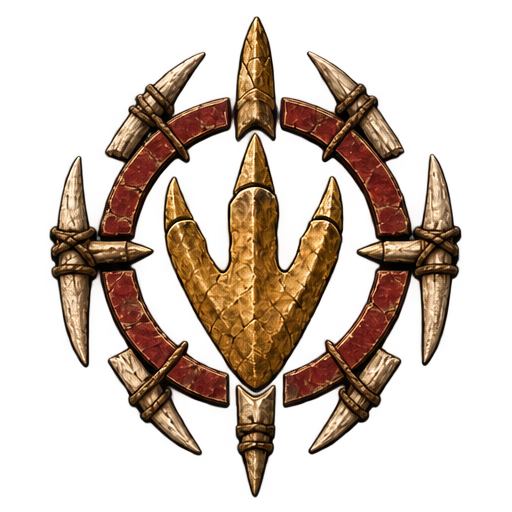
Vüren’s arms are a crowned vertebra, and its motto fits in three words: “Bone remembers”. It does not refer to a people, since peoples pass, but to the city itself, its works and those who keep them. Vüren’s Anchored like to remind newcomers that the city has seen more khans go by than any song can recite.
The other cities of Arkhan see Vüren as a counterweight to the hordes: a city of merchants, artisans and passages, where people would rather close a deal than win a battle. The reproach is an old one. The people of Vüren answer that hordes, too, need someone to sell them lances.
Part of this article covers events of season 1. Turn spoilers on in the menu to read it.