
Places and landscapes
Gates, ossuaries and khans’ halls: the bone monuments of Arkhan
Arkhan’s great thresholds, from the great gate of Qor-Zaï to the courtyards where bones are certified, use fossil bone and Ancestor cement. They serve to sort, weigh and acknowledge spoils more than to impress with spikes.
Thresholds for sorting spoils
The great gate of Qor-Zaï, an ossuary threshold, the Butin-Kar hall or a bone certification courtyard can carry a grammar of the jaw, built of fossil bone and Ancestor cement. Weighing tables, notched bones, spoils tokens, witness benches and trophy hooks make up their furnishings: the monument frames the sorting and acknowledgement of spoils. The very large living carnivores stay out of the daily flow.
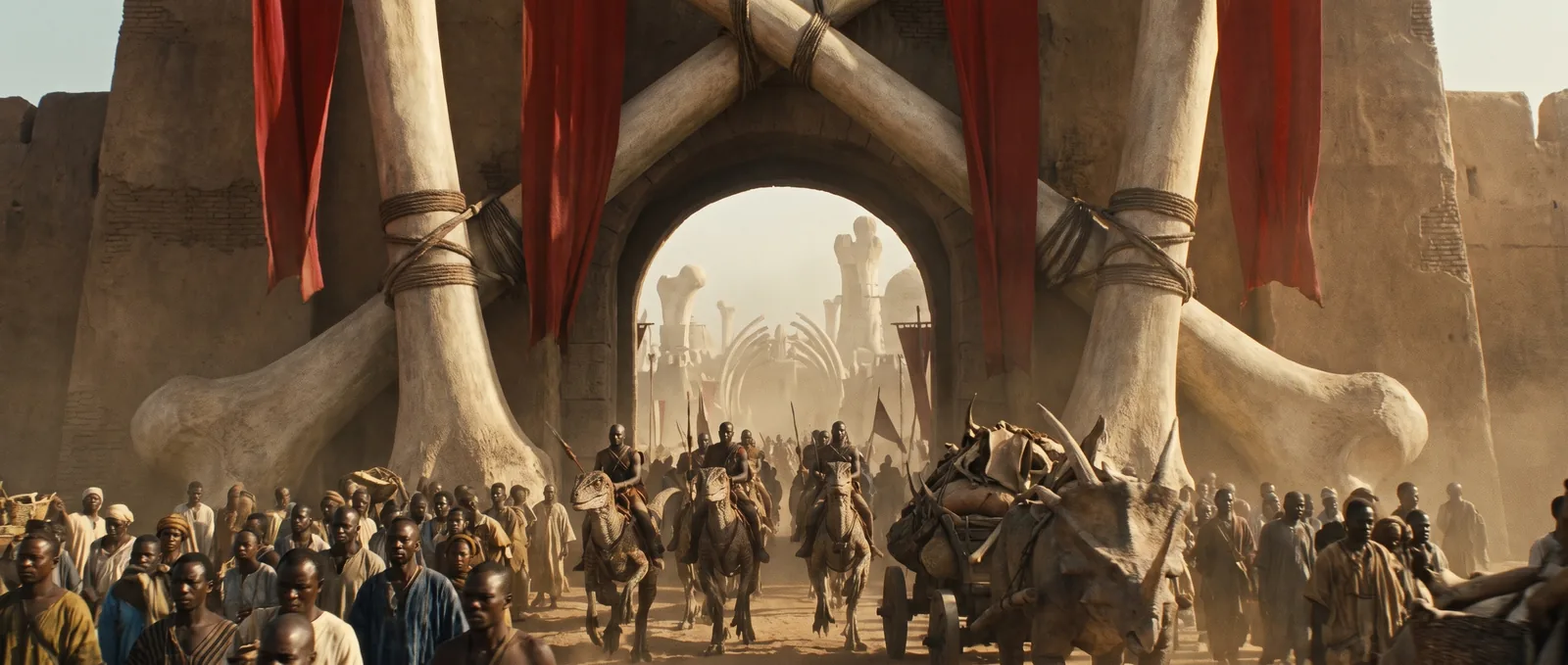
Une grande porte d’os surmontée de défenses ouvre sur la ville ; des raptors se tiennent sur le rempart.
On the façade of a certification hall, a spoils market or a courtyard tied to the Rule of Three, bas-reliefs can serve as memory aids: they show spoils, faults, lineages, debts, precedents and shares. Tablets, notched bones and seals complete the wall. No central tax code is carved everywhere.
The halls of the great khans
The canopied palace, audience hall or ossuary of a great khan belongs to a ceremonial form. A low throne, hides, spear racks, lineage plaques and demountable tiers are enough; spurs become ribs, teeth or buttresses there, never a forest of useless spikes. These halls remain exceptions: no Arkhan city bristles with daggers.
Neither black nor spiked by principle
Arkhan’s architecture does not pair a hard people with black, spiked forms. It can be brutal, inventive, sensual, poor or sumptuous depending on the place, and it stays technically legible; menace arises from the way a passage is used. Its vocabulary is made of structural bone, bone cement, hide, leather, tendon, timber, local stone, moving tracks and the verticality of raptors.
The bone used is animal. Arkhan has always forbidden human bone in craftwork, without exception: it is never a material, a tool or a commodity.
The great gate of Qor-Zaï
The great gate of Qor-Zaï is the most famous of the Jaw-Fortresses, the name builders give to those thresholds designed like a maw. Two arches of fossil bone, as thick as tree trunks, rise towards each other and meet in a vault; a row of fossil teeth lines their inner edge, without aggressive points, like a frieze. The threshold itself, broad and worn, stands for the lower jaw, and of a visitor entering for the first time it is said that he “passes between the teeth”.
The gate is almost never closed. It is not made to stop an army but to oblige everyone to present themselves: behind it opens the weighing court, with its tables, its witness benches and its certification scribes, and every caravan stops there before going any further.
The ossuaries
Arkhan’s ossuaries keep two kinds of dead, which never mix. Some receive the bones of clan people who no longer have a house to rest in, khans and elders above all; the most venerable is the Ossuary of the Supreme Khan, in the Sharvor massif, where every Supreme Khan has his place and his name. These bones remain persons: they are visited, spoken to, and never moved.
The other ossuaries keep the remains of the great beasts whose memory the clans wish to preserve, Apex fallen in battle or famous lineage mounts. Those bones are materials, but they are withdrawn from trade: they go neither to certification nor to the workshop. The Bone Guards watch over both, and a looter caught in an ossuary need not wait for a judgment.
How one builds in bone
A bone monument requires precise knowledge. Bone takes compression well and breaks in bending when badly oriented: builders therefore choose each piece by the direction of its fibres, raise long bones as columns, set ribs as arches and never ask them to work as cantilevers. Joints are made with Ancestor Cement, reinforced with tendon lashings and bone pegs, then the whole is coated with resins that keep it from splitting or rotting.
Upkeep never stops. After every rainy season the wall artisans inspect the cracks, sound the pieces with a mallet and replace those that ring hollow with calibrated bones from the Long-Bones’ kilns. A great bone work is thus renewed piece by piece, and almost none of its elements is as old as the whole.