

Creatures
Arkhan’s open herds
Food, movement and animal materials belong to the same economy of tracks.
Food also moves
Arkhan keeps open herds of common beasts and larger animals guided by flutes and mobile slaughter facilities. Drazka and the Sand Serpents carry a food chain within them. Food thus travels with a society of tracks.
Feeding rider and animal
People eat dried meat, roots, game and farmed flesh; animals receive carcasses and offal. Animal provisioning is not a copy of the human meal. A force preserves mobility only if both needs are met.
L’enclos de repos de la meute
Niches de repos, nourrisseurs périphériques et sorties dégagées composent l’enclos. Les équipements sont déposés pendant la halte.
Material after food
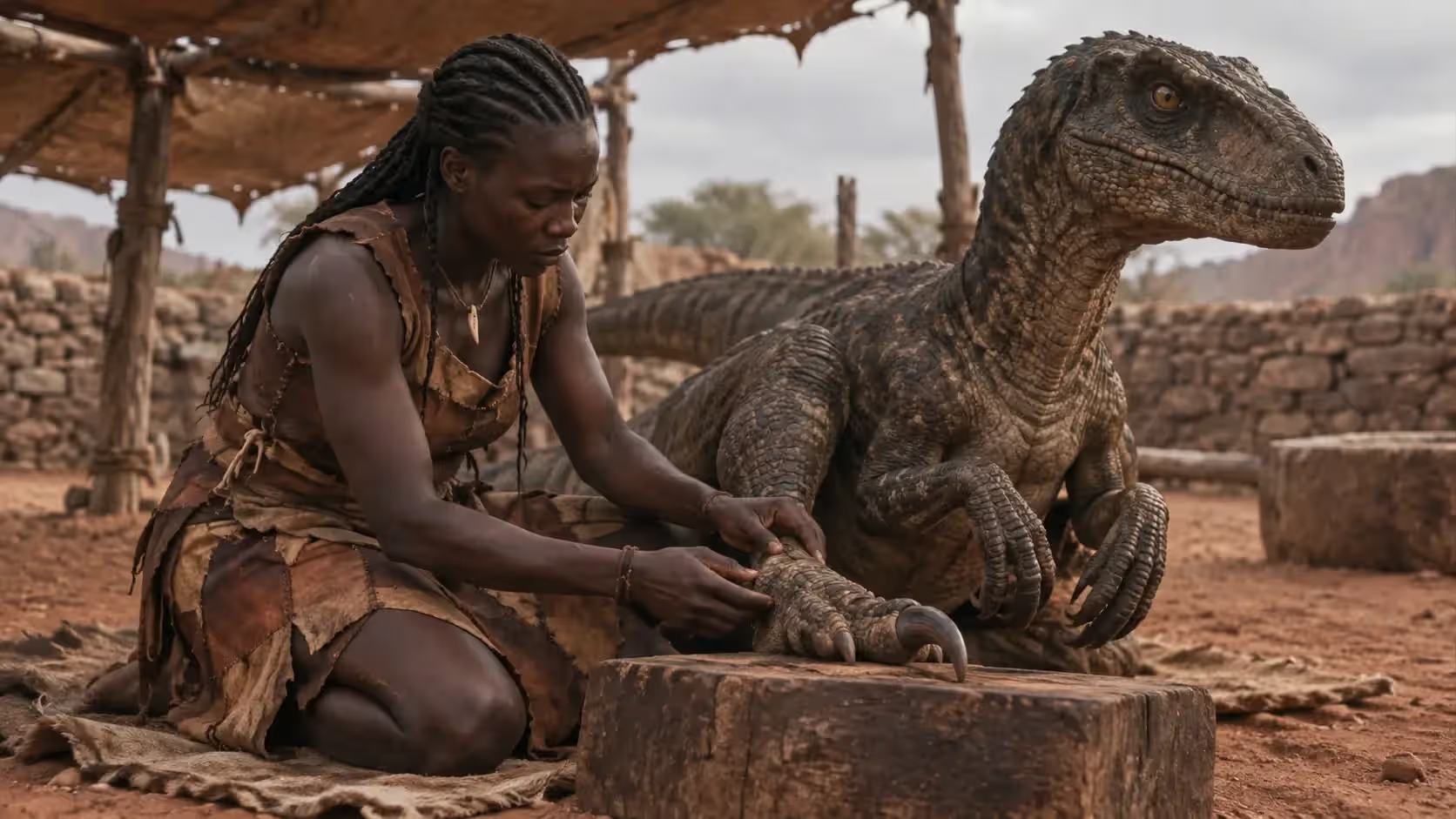
After battle, a legal economy of animal recovery takes over. Leather, bone and sinew enter biocomposite workshops with an absolute separation of human remains. The living chain therefore does not stop at an animal’s use or eating flesh. It continues through sorting, treatment and craft.
The haya griva
The beast of the Arkhan herds is the haya griva, a small ornithopod of about twenty-five kilos, hardy, gregarious and frugal, which follows the camps in all their movements. It grazes the short grass and salt brush that other beasts disdain, drinks little and lays often. It supplies most of the meat, eggs and common leather, and serves as training prey for young raptors. An ordinary camp drives a few dozen to a few hundred head; the great herds of the Serpents de Sable number thousands.
It is not ridden and is given no name. It walks in a tight herd, guided by herders with flutes and watched by a few guard raptors trained not to touch it, which is one of the hardest trainings there is. Camp children often start there: minding the haya grivas, counting heads in the evening, gathering the eggs laid in the grass and learning to spot a sick beast before it infects the others.
The slaughter yards that walk
The mobile slaughter yards follow the herds and the columns. They are teams more than places: a few butchers, skinners, bearers and women who prepare the rations, with their tooth knives, their drying cords and their jars of salt. They set up at the halt, slaughter what is needed for the evening and the next day, and move on with the column. Nothing is lost: the meat for people on one side, offal and carcasses for the packs on the other, hides and sinew for the workshops, bones for the kilns.
For the raptors a pack ration is also prepared, a pressed pâté of meat, offal and fat that keeps for several days and is easy to carry. On marching days it is handed out in the evening in measured portions; on raid days none is given, because the beasts fast. The butchers of the Serpents de Sable are reputed the best in the Confederation, and the other khanates gladly buy their rations when a campaign promises to be long.
Live prey
A pack fed on dead meat does not know how to hunt. Arkhan breeders therefore raise live prey for training young raptors: haya grivas above all, small oasis herbivores, sometimes beasts caught on the steppe. The young learn to chase, to drive, to surround, then to come back to the recall once the prey is taken; a youngster that does not release its prey on command does not join the pack. These enclosure hunts are a spectacle children watch from the stockades, and an examination the trainers take very seriously.
The trade in live prey is one of the busiest on the trails. The great herds sell thousands of them every month to the camps, the training schools and the arenas, and breeders know that prey that is too weak teaches young raptors laziness, while prey that is too strong injures them. Foreigners find the practice cruel; Arkhans answer that a pack that cannot hunt kills more, and less cleanly, on the day it is hungry.