

Institutions
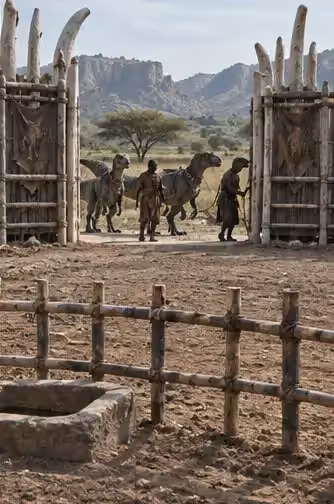
The Great Cleaning
Between the people who leave and those who arrive, the sanitary restoration of Arkhan’s cities: basins emptied, pens burned, membranes renewed, carcasses removed.
Restoring a city
Between the outgoing and incoming populations, the Great Cleaning restores the works and installations. Basins are emptied, the pens concerned are burned, membranes are renewed and carcasses are removed. The succession of peoples opens a period devoted to these operations.
Not passing on the harm
Cleaning has a sanitary stake. A city inhabited by people and carnivores accumulates food scraps, parasites and animal waste; changing inhabitants without treating basins and pens would pass these problems on to the next group. The religious and ecological justification of the Shedding also invokes the wearing-out of land always exploited from the same place, to which pastures, parasites and pens give material reality.
Those who know the state of the place
Basin keepers and wall artisans, who are among the Anchored, know the condition of the installations. Their work links departure to arrival: the state of the works decides which districts can actually reopen. When the new people arrive, it is the Anchored who determine which districts are open and which basins are clean. A lasting structure requires this repeated maintenance.
A few weeks between two peoples
The Great Cleaning fills the interval between the outgoing people’s last horn and the opening of the gates to the incoming people. The interval usually lasts a few weeks, longer in a great city or after a negligent government. Meanwhile the incoming people camps one or two days’ travel away, and its scouts come regularly to ask the Anchored when the gates will open.
The length of the Cleaning is therefore a political matter as much as a sanitary one. A people in a hurry tries to shorten it, at the risk of inheriting parasites and diseased pens; discontented Anchored can lengthen it to make their weight felt. The water masters often settle these disputes, for it is the state of the basins that decides, more than the state of tempers.
Emptying, burning, re-stitching
The work follows a tried order. It begins with water: basins are emptied by jar and bucket, their floors scraped down to the stone, their sides washed with bone lime, then left to dry in the sun before they are refilled. Next come the pens of raptors and carnivores: the litter is burnt on the spot, gnawed posts replaced, the ground turned over and dusted with ash.
Worn roofing membranes are taken down and replaced with new hides, sewn with sinew by tanners and wall craftsmen. Forgotten carcasses, food remains and animal waste go to the bone pits; whatever can be used is sorted for the workshops. Human remains, if any are found, are separated from everything else and handed to the mortuary teams, as everywhere in Arkhan. The work is done by hand, quarter by quarter, and a finished quarter is known by the smell of lime hanging over it.
Who does the work
The Cleaning is directed by the Anchored who know the works, basin keepers and wall craftsmen first among them. The hands come from several sides. The outgoing people usually leaves a team for the first days, especially if it has something to be forgiven for; the incoming people sends workers to hasten the opening; steppe bands hire themselves out for the season, and captives are often put to the hardest tasks.
Each team has its reputation. Basin cleaners, who go down into the depths, are paid more than the others; pen burners, who work in the smoke, can be recognised by their red eyes for weeks. The Anchored keep count of the work each side supplies, and that count goes into the handover: a people that sent no one pays in some other way.
The smoke of the Cleaning
During the Great Cleaning a shell-city can be recognised from afar by its smoke. The burning pens and lime kilns raise grey columns above the bone walls, and travellers who see them know that one people has just left and another is waiting. The Marcheurs du Vent, who read dust, read this smoke too: its colour tells whether litter is still being burnt or lime already fired, and so whether the gates will soon open.
The official justification for this work is religious and ecological. “The raptor that hunts for seven years around the same nest ends up eating its own young,” goes the saying; the Cleaning is its practical translation. It is partly true: pastures, parasites and pens really do wear out, and a city that changed inhabitants without being cleaned would pass its diseases on to the next people.