

Materials and resources
Anti-rot: preserving living material
Binders, enzymes and treatments contribute to the durability of leather, sinew and composites.
A use beyond remedies
N’Goro, Orlantis and Volonia produce glues, resins, enzymes, oils and treatments. These products enter bone cements, composite bows, harnesses, boats and preservatives. N’Goro participates in this treatment economy without holding a worldwide monopoly or a single formula.
A dependency crossing borders
N’Goro anti-rot products, enzymes and glues travel to other civilisations. Their value comes from stabilising organic materials already used elsewhere. Inspections and quarantines condition those passages.
Treatment does not remove maintenance
Sinew remains exposed to moisture, decay and fatigue; leather depends on treatment and environment. A preservative responds to these limits rather than magically removing them. Its presence in a chain recalls that an object must continue to be observed, maintained and replaced when its condition no longer permits its intended use.
A glue, a varnish, treatments
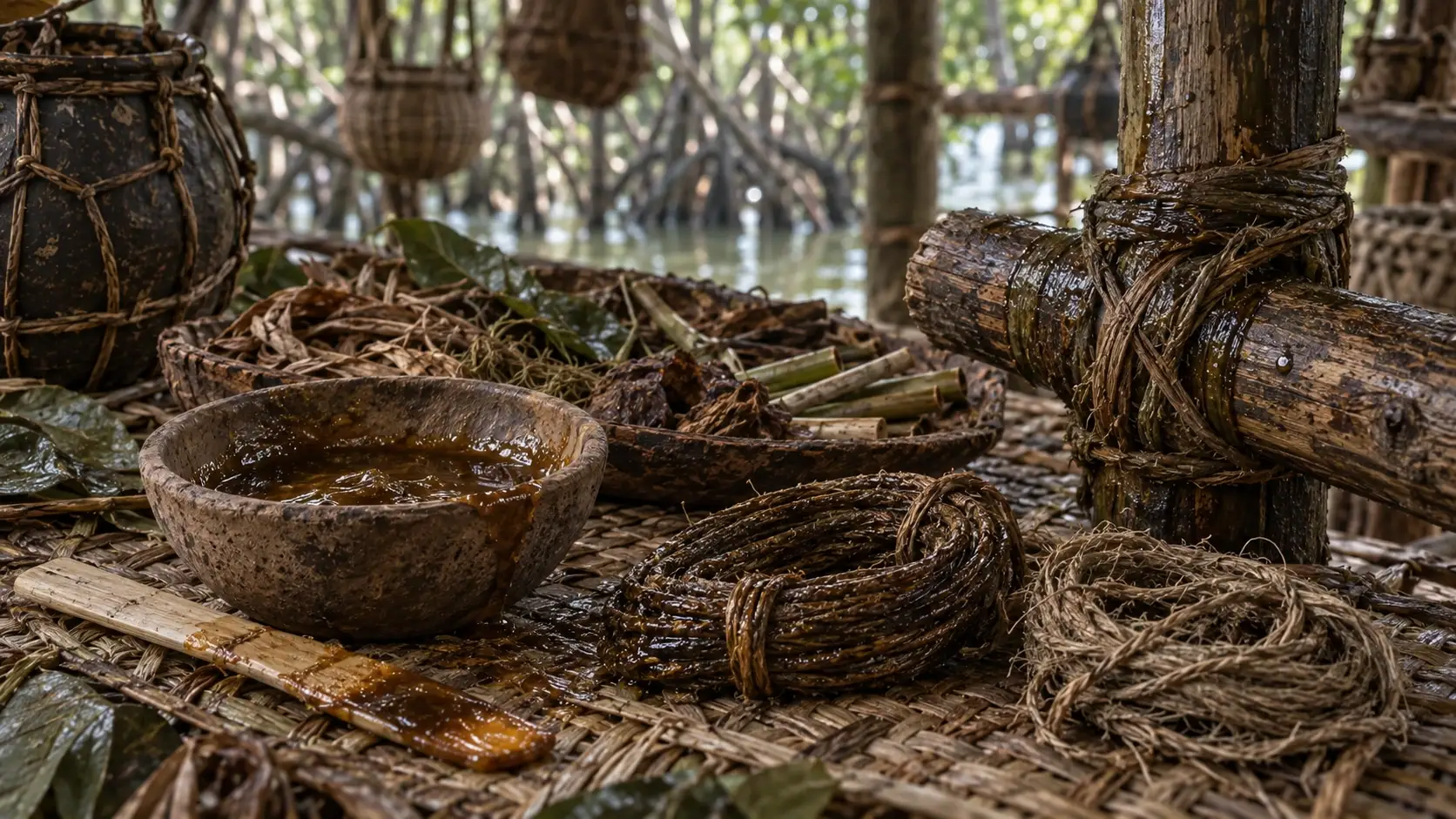
Under the name of anti-rot, N’Goro in fact sells a family of products. Anti-rot glue, sold in sealed jars, is the base of all the others: applied to a hide, a tendon or a piece of wood, it stops them rotting. Anti-rot varnish, more fluid, is used on composite bows, tendon bundles and ballista lashings, which damp would make fail. Campaign anti-rot is a sealed, numbered keg of five jars, enough to protect an army’s gear through a wet season. Surgical anti-rot, purified and kept in wax ampoules, protects a wound, a suture or a stump during a journey. Cargo treatment, finally, is done in approved workshops, where bales of tendons, hides, timber or food are soaked or brushed before they leave.
All these products obey the same rule: what is treated is sold, never the way of doing it. The resin-sealed provisions that N’Goro troops take on campaign, cakes of tuber and black flour sealed under a layer of anti-rot resin, are its most everyday application.
The anti-rot houses
The glue is made in the Sap-Keepers’ anti-rot houses, around the Control Basins. They work materials that come from all over the country and beyond: the blood and glands of beasts hunted in the Terres Englouties or bought from the rendering yards of Urnok and Arkhan, chitin from the Silver Reeds softened in the acid of the muds, sap tapped from the giant mangroves, and rendering enzyme, a ferment drawn from glands and moulds that softens hides and prepares glues. The rest of the formula never leaves the houses.
The work is done in great clay vats heated with peat, under roofs open to the wind to drive off the fumes. Each worker knows only part of the steps, and the masters who know them all have sworn an oath before the Synod. Filled jars are sealed, numbered and marked with their house; every batch is recorded, so that a failing glue can be traced back to its vat of origin. Clans of resin workers such as Tamis-Sève, or apothecaries of preservation such as Bocal-Vert, work on the margins of these houses on humbler ointments and preservatives.
A war glue
Anti-rot is first of all a matter of war. The composite bows of Arkhan’s Wind Walkers, made of raptor tendon and wood, hold together with N’Goro glue; the torsion bundles of Korath’s ballistas, built of tendons and sinews, are sealed with anti-rot; the leather of the harnesses, bards and shields of every army rots within a wet season without treatment. An army setting out on campaign in a rainy country takes its kegs of anti-rot as it takes its fodder, and its quartermasters count the jars as carefully as the arrows.
Military surgeons depend on it as much as armourers do. Surgical anti-rot, which the healers of Volonia and Urnok buy in ampoules, lets an amputee survive the journey back to the rear when the wound would otherwise have rotted in a few days. In the camps of every nation they say that N’Goro fights in no war yet is present in all of them: in the bows, in the ballista ropes and in the bandages.
Markets, controls and forgers
The glue leaves N’Goro by a few known routes. To the north, the march of Gwami, facing Urnok, is the great market where anti-rot is traded for Sarnor fodder and the Empire’s hides; to the west, the coastal ports load it for Volonia; Korath’s caravans pick it up at the posts of the Singing Mists. Every jar travels with its mark and its number, and shrewd buyers insist on seeing both.
The product’s success has bred forgers. Distant markets offer jars of bone glue or fish glue, tinted and scented with peat, sold as N’Goro anti-rot, which hold for a few weeks before letting rot whatever they were meant to protect. The armourers of Arkhan and Korath have learned to recognise them by smell and touch, and the Sap-Keepers refuse any recourse to those who bought off the marked routes. A glue without a number, say the merchants of Gwami, is only a promise.