
Places and landscapes
The Ville-Sauts: a two-speed district
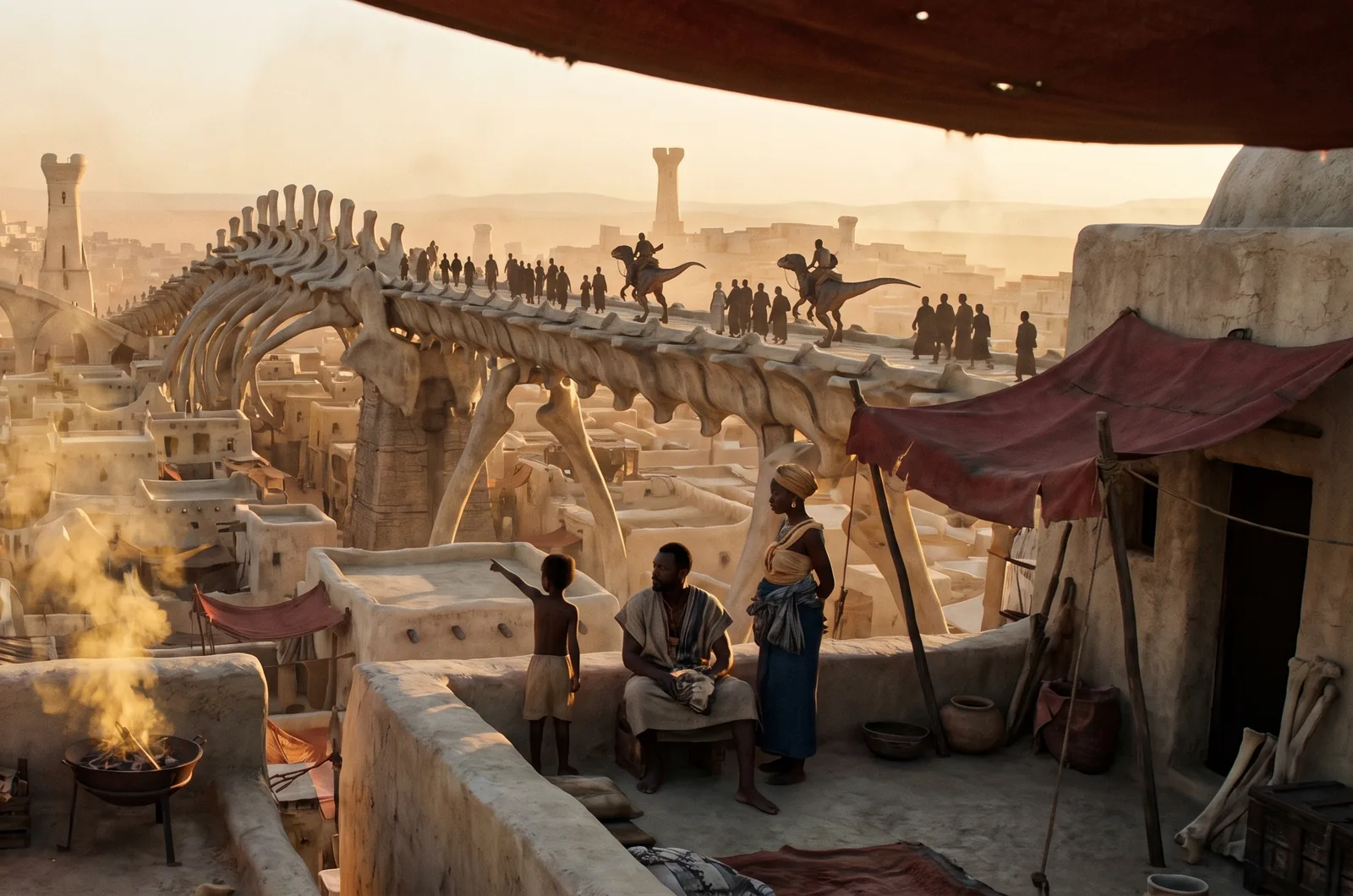
In some raptor-linked districts of Arkhan, a fast track for the animal and its rider runs alongside a slow route for people. Speed becomes an urban privilege there; it is never the planning of a whole city.
Two layered networks
The Ville-Sauts organises a district into two networks. A fast track serves the animal and its rider; a slow route serves people on foot. Turning landings, one-way runs and sand fall zones make the track usable; grip surfaces, shock-absorbing hides, saddle hooks, set-in jars and lashed chests equip the houses. Objects neither roll nor fall when a raptor strikes a structure.
Des cavaliers sur raptors empruntent une voie surélevée au-dessus des étals d’un marché, tandis que les piétons restent en bas.
The form is found in a raptor district of Qor-Zaï, in the camp of the Skull Riders and in a few forts or terrain villages. It never organises an entire megacity. Koraa-Vrii, a poor village of femur, clay and thatch with some thirty houses, borrows only a few gestures from it: a hide shutter, a platform, a broken alley.
Speed as privilege
An able rider can cross the district above the rooftops while an injured person, a child, a captive or a stranger stays in the slow network. Architecture thus produces power, disability, chases and wrong turns. Ramps, stairs, service passages and captives’ paths form a second map of the city; a chase also becomes a contest of urban knowledge, and knowing which hook releases a walkway is sometimes worth more than a title.
Watchtowers and light defences
Watchtowers, cliff relays and One Eye nests extend this verticality without ever forming Qor-Zaï’s skyline: hammocks, folding tables, pulley baskets, bone whistles and signal fires serve there; ramps, ledges and rigid walkways carry the animals, with no cable lift. At the entrance of a fort or frontier camp, demountable partitions and narrow human passages can slip between the raptor lanes, but a supply artery, a route to water and a fire escape always remain legible to residents.
Track camps and poor jump towns
Outside the great cities, the same grammar appears in the semi-mobile camps of the Fils de la Faim and the Plaines de Chasse, tied to raiding and mobility: bone, leather, dust and low cages, where noasaurids also live. A camp has no monument there; it relies on a demountable method — hide, tendon, fibre, modules, track, anchoring — and on repair.
Living to the rhythm of leaps
In a Ville-Sauts one lives with the sound of claws overhead. Riders whistle before crossing a street so that nobody steps onto the walkway at the wrong moment, and every saddle hook carries the pigment of the household that maintains it. Mistakes are part of district life: a raptor landing on the wrong roof, a messenger who misses a ledge and ends up in the drop zone, a walkway released too early by a curious child.
Children learn both networks before they can count. They know the shortcuts of the slow network, the service stairs, the passages an adult cannot get through and the hours when riders come home in numbers. Later the best of them serve as guides to foreigners, who almost always get lost trying to follow a rider glimpsed on the roofs.
Maintaining the high trails
The high trails wear out fast. Every morning teams rake the drop zones and clear them of stones; the grip surfaces, polished by claws, are scraped and coated with a mixture of sand and resin that restores purchase. Saddle hooks are checked one by one, and a walkway that sags is replaced before the next season, never hastily repaired.
This work falls to the trail carpenters, the same trades that build the ramps of the Wall-Trails in wartime. In peacetime each household answers for the stretch that runs over its roof, and neighbourly quarrels concern a badly kept grip more often than a property line.
The war cousin
The Ville-Sauts has a war cousin: the Wall-Trail. The Skull Riders, whose camp is one of the few places laid out this way, train their Vur-vaa in verticality there; fitted with cliff claws, these great raptors climb a rampart as if it were a slope, while carpenters set ramps wherever the beast needs a foothold. “A wall is only an animal lying down,” say the riders.
The leap districts are their training ground. A rider who can cross his own district over the roofs will be able to pass an enemy rampart from above, and the sieges the Horde refuses to conduct are often settled in this way, without ram or ladder.