
Families and social ties
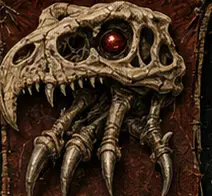
Arkhan’s oldest saddle
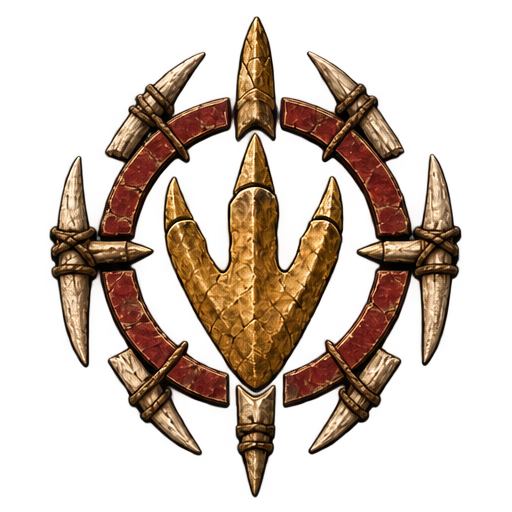
The Cavaliers du Crâne are a saddle lineage about 2,600 years old, settled in the Canyons Rouges and the Badlands de Khor. Their power rests on Vur-vaa raptors, saddles and the prestige of their cavalry: they provide the most respected saddle expertise in Arkhan.
This prestige gives them an authority of judgement. The khanate judges rising clans, those who claim a place among the old trails.
The wall becomes a trail
Vur-vaa are large scaled raptors trained for verticality. With sheathed claws and cleats, they climb rock faces and walls that other mounts cannot take. The Vur-vaa trainer prepares these animals and their sheaths; claws, asymmetric saddles, cliff cleats and lances of teeth and claws come out of the khanate’s workshops.
This technique remains a matter of preparation. The state of the rock, the animal, the harness and the guide’s decision determine whether a passage can be used: a cliff claw does not turn every wall into a safe trail.
Gorak and Kessa
The khan of the Cavaliers du Crâne is Gorak, the one-eyed khan, known for laughing at the highest walls as if they were terrain to read. His sister Kessa is the clan’s technical hand: saddles, climbing claws and the training of mounts go through her. Both lost their parents against a Korathi rampart; they bear a latent blood debt against Korath.
Places and place names
The khanate’s lands include several named places: Nid-des-Vur-vaa, Crocs-du-Couchant, Aire-des-Serres, Lande-de-la-Mue, Mue-Écorchée and Razzia-de-Sable.
The Khan’s Left
The Cavaliers du Crâne are the Supreme Khan’s left arm: they hold the left wing, and their khan bears the title of the Khan’s Left. Their riders wear a ritual eyepatch, echoing their one-eyed chief; eyepatches of rank are cut from black nacre bought in Volonia, which thus sells a shame turned into prestige. Their saddle masters make saddles for the left.
The father of Gorak and Kessa was named Drakor Crâne-Fendu.
Political name, popular name
The khanate has two names. “Cavaliers du Crâne” (Skull Riders) is its political name, the one spoken in the Conseil des Pistes; “One Eye” is its popular exonym, heard in markets and camps, an echo of its one-eyed khan. Its elite riders wear a helmet cut from a predator’s skull, and the Vur-vaa lineage they ride is called Griffe-Lune (Moon-Claw).
Their saddle skill is not limited to Vur-vaa. The khanate’s riders also mount horned dune carnotaurs, bred by the Serpents de Sable, on asymmetric saddles and cleats, to drive into a line at the gallop and open a corridor for the rest of the Horde. Finally, the khanate keeps colossal Vur-vaa, rarely ridden, shock guardians and symbols of lineage, which require specialised trainers and meat from controlled hunts. Losing one’s mount is a dishonour settled, in Port de Sable, by a claw clause.
Judging the rising clans
The Cavaliers du Crâne exercise their authority of judgement mostly in the saddle. A clan claiming a place among the old trails must show its riders and mounts before the khanate’s saddle masters, most often at great seasonal gatherings such as the Great Race. The judges do not look only at speed: they watch how a beast takes a turn grazing the tents, how a rider gets it going again after a fall, and whether the harness holds.
Their verdict does not make a clan a great khanate, but it weighs on reputation, which in Arkhan stands in for part of the administration. A clan the Cavaliers du Crâne declare “well seated” finds alliances and markets more easily; a clan they judge badly mounted will take years to wipe out the word. The Fils de la Faim, a recent clan, know something about it.
The claw that returns
A Vur-vaa’s claw is a prestigious material, which can enter an exchange without the exchange abolishing the sacred clause of return that follows it. The khanate’s claw-cutter protects and ritualises it: he works for the animals’ safety, for hygiene and for the rites. A claw sold in Port de Sable thus stays bound to the lineage that produced it, and the Volonian merchants who buy it know that one day, perhaps, a Skull Rider will come to claim it.
This clause expresses the essence of the khanate’s culture: a beast and what it produces never entirely cease to belong to the saddle. The claw-lance, which needs the claws of dead Vur-vaa, therefore remains a prestige weapon, rare and bound by its clauses; for numbers, the khanate’s workshops make the best bone lances in the Confederation, a graded long bone carrying a point of tooth or claw lashed with sinew. The same attachment to the beast explains Gorak’s glee before obstacles. The one-eyed khan treats a cliff as a gift and sums up his doctrine in a sentence: “A wall is a road that is afraid of the sky.”
Part of this article covers events of season 1. Turn spoilers on in the menu to read it.