
Families and social ties
The khanates and clans of Arkhan
Arkhan does not vest authority in a central state but in great trail khanates, federated by the Supreme Khan and kept in motion by the Great Shedding.
Authority vested in the trails
Arkhan is not a poorly administered central state. The Confederation has vested authority in its trails, its khanates, its meat debts, reputation, the Great Shedding and convergence. Its mobility does not come only from fast raptors: whole populations know how to migrate with their workshops, animals and leaders.
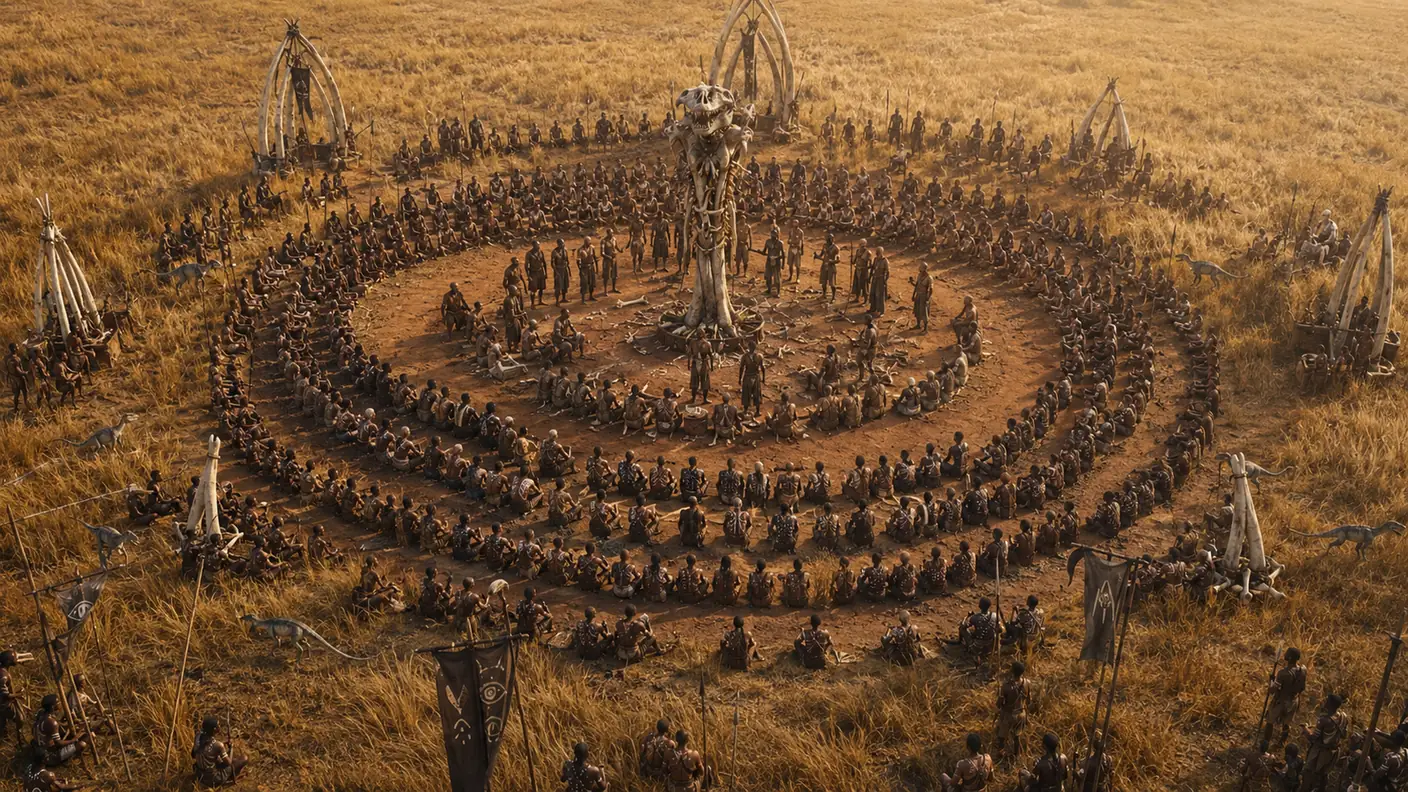
Des délégués des khanats d’Arkhan siègent autour d’une pierre de route sculptée, dans une grande salle de côtes et de peaux.
Administration there is light by choice. Trail memory takes its place: oral tradition, reputation, tracks, songs, debts and rights of passage. Saddle knots and testimony travel with groups when they change city, so an obligation follows the person who carries it.
Seven khanates and a rising clan
The Confederation has seven great khanates. The Première Piste of Qor-Zaï, the oldest with some 3,800 years of ritual continuity, carries the Supreme Khan’s lineage. The Longs-Os, about 3,100 years old, hold the long trails, water and carrying. The Cavaliers du Crâne, about 2,600 years old, are the old lineage of saddles and Vur-vaa raptors. The Marcheurs du Vent, about 2,200 years old, supply scouts and messengers from the high steppes. The Serpents de Sable (Sand Serpents), about 1,700 years old, are the khanate of oblique marches and flutes. The Dents de Pierre (Stone Teeth), about 1,200 years old, hold bone fortresses, plates and defiles. The Peaux de Marée, about 900 years old, were born from pilots, floaters and carcass craftsmen.
Alongside them, the Fils de la Faim have been recognised as a clan for only about 240 years. Coming from the poor steppes, they live by raiding, captives and packs. Their short history earns them the contempt of the old trails; their recognition as a political actor turned a poor clan into a social power able to replace an ancient lineage.
The Supreme Khan federates
The Supreme Khan comes from the Première Piste of Qor-Zaï. He does not own Arkhan: his lineage holds the right to call the trails to convergence as long as it completes the Tour of the Seven Trails. The khanates keep their forces, trades, traditions and leaders. The Supreme Khan federates them, confirms the khans and arbitrates their disputes without governing each of them directly. When the Call of the Horde gathers the khanates, the Horde marches under him, but the forces that make it up remain autonomous and never become a standing army.
Qor-Zaï houses the Conseil des Pistes, the treasury and the archives. The city stays put, but the Supreme Khan must leave it during the Great Shedding to attend the handovers, confirm the khans and inspect the cities; the Guardians of the Empty Saddle then watch over his throne. The rule is well known: Qor-Zaï belongs to the Supreme Khan as long as he remains able to leave it. Orgaï, khan of the Première Piste, holds the office today.
A khan keeps office by feeding
In Arkhan, lineage counts but is not enough. A khan unable to feed his animals, travel the trails and bring about convergence loses the office. The same rule applies at the top: the office of Supreme Khan can pass to another clan after a crisis, and the Première Piste is not protected forever.
The great carnivores explain this demand. An Apex is not merely a mount: it requires a carcass economy, controlled hunts, meat tributes, bone pits, beast-masters, pens and saddleries. A leader does not command because he owns terror; he commands as long as he manages to feed it, calm it and deploy it.
Belonging to a clan
Arkhan kinship is not reduced to blood: one is not born into a clan, one enters it. Captives integrated through the Rule of Three become members of the trail that took them, and some war leaders are former captives themselves. Sher’Khan’s case shows the system’s limit: clanless, he counted himself among the living and owes no trail debt, which makes him impossible for a clan to humiliate.
Beneath the great khanates live clans of lesser power. In a village, raptor statuettes express the belonging and traditions of a clan that has neither the animals nor the power of a great khan. A trail, moreover, is not automatically a genealogical family: it is a territorial and social structure organised around Qor-Zaï.
The Great Shedding against entrenchment
Before the Great Shedding, the great khans took root in their cities: hereditary palaces, their own coinage, and obedience to the Supreme Khan in retreat. The War of the Seven Thrones, fifteen years long, ended this consolidation. A Supreme Khan imposed a common rule: no great people governs the same city twice in a row, and no khan hands a city down to his son.
Since then, roughly every seven years, the governing peoples exchange cities with their families, herds and dismountable workshops; walls, basins and cisterns stay behind with the Anchored. The Shedding stops khans from mistaking influence for ownership. The age of the Seven Trails, which fixed the seven trails and established the Supreme Khan’s Tour, is the basis of this balance.
A chain of materials
Each khanate also holds materials. The Longs-Os are associated with long bones and lime, the Dents de Pierre with teeth, blades and plates, the Marcheurs du Vent with sinew, bows and signals, the Cavaliers du Crâne with claws, saddles and cleats, the Serpents de Sable with open breeding of carnivores, the Fils de la Faim with leather, dried meat and captives. Each trail depends on another: the carcass becomes material, then the material becomes war.
These specialities belong to the peoples and their production networks; they do not turn the khanates into closed guilds, since herding, salvage, craft, trade and war intersect in a single Arkhan life. All this bone is animal: the human-bone taboo allows no exception, not even for an enemy.
Part of this article covers events of season 1. Turn spoilers on in the menu to read it.