

People
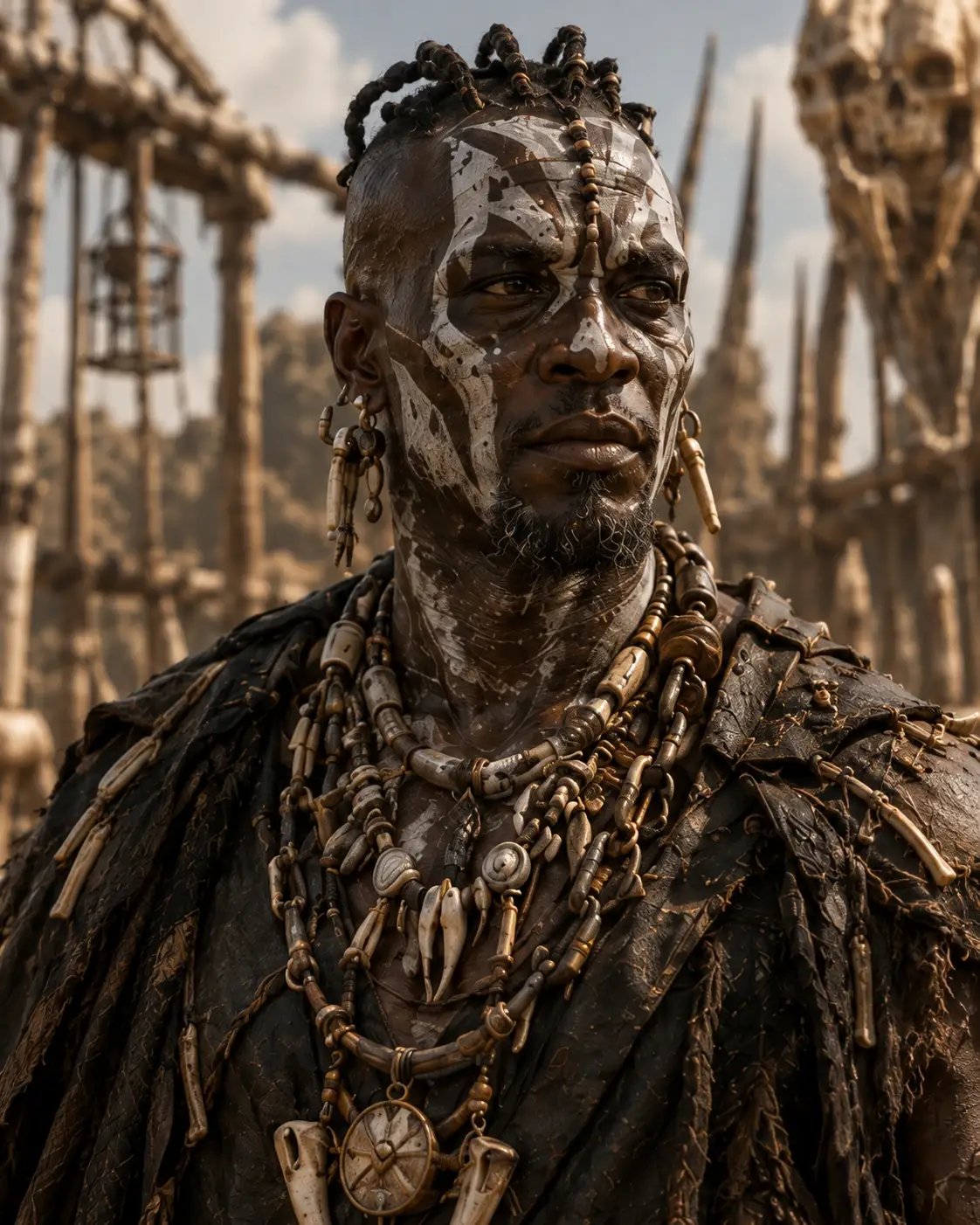
Sher’Khan
A trail rider, tactical prodigy and man of few words.
Seeing a passage
Sher’Khan reads walls, roofs, streets and cliffs as possible passages. His skill is physical and tactical: it rests on terrain and the abilities of his mount. This inventiveness does not turn him into an innocent hero or an already established ruler.
An origin marked by war
Sher is a war orphan raised by the trail. This childhood places him in a society where belonging is built by entering a group and sustaining relationships within it. His life as a rider belongs to this world of mobile kinship and learning through contact with animals.
Speaking when words act
His portrait favours action, movement and short statements. Sher rarely justifies himself; he looks for what makes passage possible. With Ashaïra, expertise in living animals enters an unequal relationship of work and command, which cannot be mistaken for romance or legal equality.
Reading the ground with Falaa
His relationship with Falaa, his raptor, extends his reading of the ground. The animal’s rhythm, posture and reactions make a route passable or dangerous: a good reading of the terrain has to stay compatible with what the beast can cross, endure and learn. Sher speaks little and favours acts that change a situation; his skill does not set him above the violence of the track.
A name taken, not given
“Sher’Khan” is not a birth name. It is a title he took, joining the old word “khan” to the word “Sher,” most often translated as the beast that hunts alone. No one gave it to him and no one can take it away. In arḫán the KH sound belongs to an ancient and prestigious layer of the language, that of very old titles: in the eyes of many elders, a clanless young man who adorns himself with it commits an insolence.
His name is also a bare name. A full Arkhan name joins a given name and a clan name; someone with no clan carries only the first, which sounds like an unfinished sentence. Sher’Khan is attached to the Fils de la Faim without belonging to them, and everyone around him completes the sentence his name leaves open in their own way: with a threat, with a promise, or with a jibe that people no longer dare to say in front of him.
Counting himself among the living
Sher’Khan grew up low enough to be counted as strength, a mouth and a risk before he was recognised as a person. No biological family is known to him. No one claimed him, and no trail wished to give him birth among its own. So he went through the three trials by which one enters a trail, Hunger, March and Bite, alone, and counted himself among the living.
That act has legal consequences. In Arkhan, whoever gave a man birth into a trail can unmake him: the bond creates a debt. Sher’Khan has no trail-father and no trail debt to repay, and no clan can humiliate him by reminding him of what he owes. His childhood was a socialisation for survival, made of ritual violence and of learning animals earlier than political language. He received no administrative or doctrinal education: his training is the trail, the hunt, the raid, reading raptors and fighting.
Habits and gestures
Sher’Khan’s habits are short, physical and repeated. He whistles more than he speaks, keeps a knife within reach, mends bits of harness himself and looks first at the animals and the exits when he walks in somewhere. He always leaves his blade in what he kills and picks up another weapon: he disarms himself out of pride, the way one signs a name.
His speech is rare and almost never runs past ten words. It is made of action verbs and trail images, never abstraction when an image will do; his natural words are share, trail, hunger, head, door, march and alive. He does not justify himself. His tenderness, when it exists, takes the form of space left open, a share, a knife or a way out; he almost never asks what others feel. His way of lying is to deny attachment and to present every choice as a calculation of strength.
Under danger
Under ordinary pressure Sher’Khan answers with violence or with movement; when he cannot act, he becomes dangerously silent. Those who have seen him at his worst describe the opposite of what one expects: when danger peaks, his anger vanishes. He goes still, almost gentle, and sees more. This shift is rare and kept for the gravest situations.
His flaws are well known. He is proud and has very little nuance; he tests other people’s loyalty by disobeying, and sometimes turns his need for recognition into a risk for the whole group. He is thought incapable of administering what he takes. His deepest wound is to have been counted as a mouth and a strength, never as an irreplaceable person; what he wants is to be recognised without ever asking or kneeling. He believes that owing nothing to anyone makes him free.
In Kharûm’s band
Sher’Khan rides under the orders of Kharûm, sub-khan of the Fils de la Faim, who serves him both as a chief and as a refused father figure. Vaëkhan, the disciplined lieutenant of the same band, embodies the order Sher despises and needs: Vaëkhan counts heads one by one and makes what Sher invents repeatable. Rakh the Ashen, an orthodox and mocking raider, condemns his ways, while his own raptor, Cendre, copies the starts of Sher’s mount.
Beyond the band, other eyes weigh on him. The old breeder Morga-Tesh, who has trained several generations of riders with her female Vieille-Dent, stands for an animal authority he does not dispute. Tergha Main-Sèche, khan of the Fils de la Faim, fears him precisely because a clanless man cannot be broken through blood. In the camps his reputation fits in one sentence: a dangerous young man, sparing with words, hard to classify, useful but irritating.
Part of this article covers events of season 1. Turn spoilers on in the menu to read it.
Gallery2 images
Sher'Khan, Falaa's rider.