
Religion and rites
The Great Race
A seasonal gathering of Arkhan’s clans: the best raptors race, and the winner reads omens in the dust.
The pack released
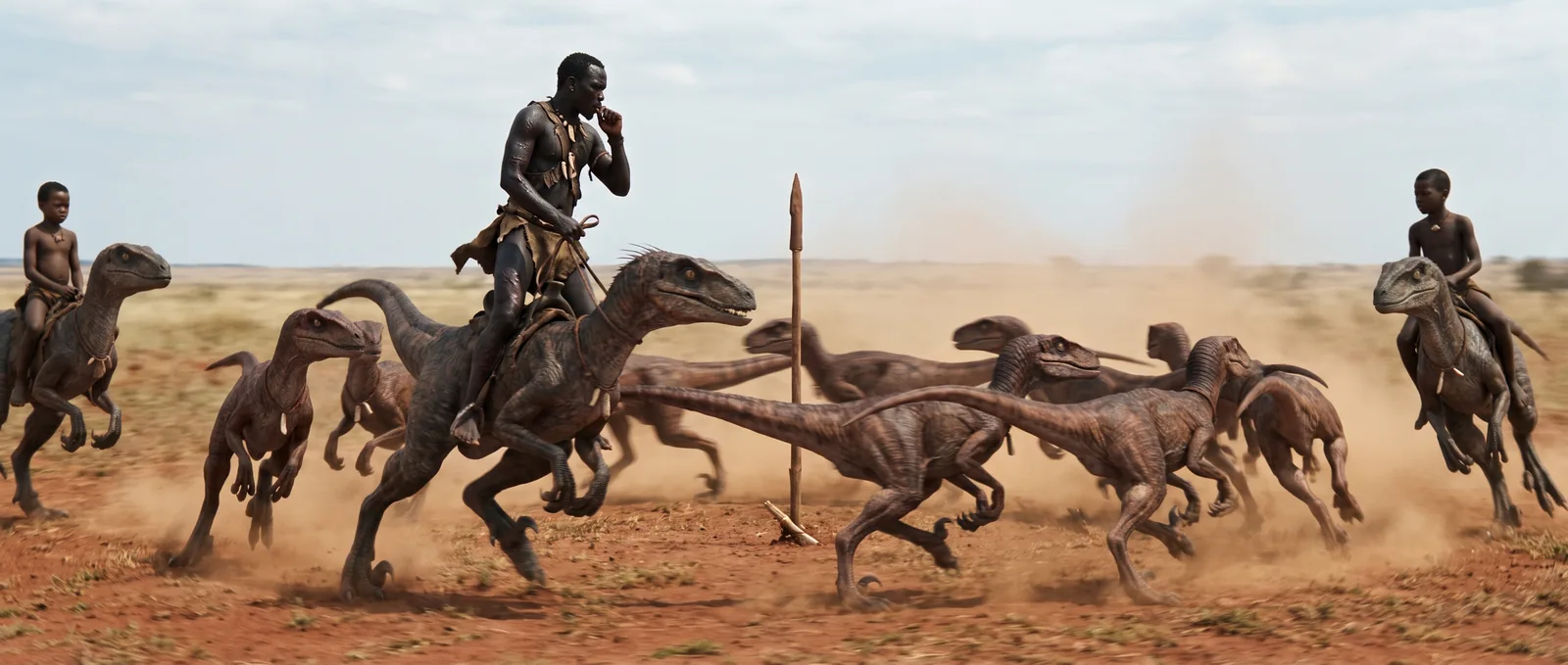
The Great Race (Grande Course) gathers the clans each season. The best raptors, Vur-vaa known as “Moon-Claws”, set off as a pack and take their turns skimming the tents; some fall. The track is marked with animal bones planted in the ground, inside a ring of tents, on the steppe or at the foot of the red canyons.
Reading the dust
At the finish the winner kneels and reads omens in the churned-up track. Omens are a matter of belief: the world does not confirm them, yet they weigh on those who listen. Around them rival clans roar, and bettors knot their mount debts onto cords on the spot.
The gathering of the clans
The Great Race is first of all a gathering. Each season the clans that can do so converge on a place of steppe or foothill, often at the foot of the red canyons, and pitch their tents in a great circle around the track. For several days, before and after the race, the encampment becomes a fair: breedings and marriages are negotiated, mounts are sold, debts are settled and the season’s alliances are prepared.
It is also the moment when rising clans come to show their riders and beasts before the saddle masters of the Skull Riders, who judge their turns, their restarts after a fall and the state of their harness. A clan judged well at the Great Race earns a reputation that will follow it all the way to the Conseil des Pistes.
The track and its rules
The track is a loop several leagues long marked out by animal bones planted in the ground, which brushes the tents at every turn so that the crowd can see the race up close. The rules fit in a few words: no weapons, no blow struck at another rider; one may crowd, cut across and shove with one’s beast, and falls are frequent. A fallen rider who remounts before the pack has passed him can still win.
The great race belongs to the lineage Vur-vaa, the Griffe-Lune, who start all together, as a pack. On the preceding days shorter races pit young riders on small Vrii against one another, and children on smaller beasts still. A jury of elders from several clans judges the finish: the winner is the first beast whose head crosses the line of bones, whatever state its rider is in.
What the dust says
At the finish the winner kneels on the track before his beast has even calmed down. He looks at the dust the pack has raised: the shape of the cloud, the way the wind carries it off, how fast it falls back, and the marks the claws have left in the last turn. Dust that falls back quickly announces, it is said, short rains; dust drifting towards a trail points the way to good pastures; tangled tracks promise a season of quarrels.
These omens belong to belief, and the khans know it. They listen to them all the same, because the crowd listens, and a shrewd winner knows that his reading will be repeated from camp to camp for the whole season. The shamans stand beside him without ever speaking in his place: the dust belongs to the winner, and a shaman who whispered him his reading would lose the trust of the whole gathering.
Bets, debts and winners
Bets are knotted during the race, on the cords, and they commit serious things: beasts, breedings, shares of booty to come. A mount debt contracted at the Great Race is carried like any other and comes back, on the evening of the Counting of Knots, with all the other debts of the year.
The winner receives no object. He wins the right to read the dust, the honour of a knot added to his beast’s lineage, and a new value for its breedings, which are often paid double in the following seasons. The winner’s clan generally chooses the place of the next race, which gives rise to fierce bargaining, for a clan that hosts the Great Race also hosts the fair, the merchants and the alliances that come with it.