

Families and social ties
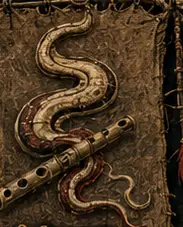
The Serpents de Sable
The khanate of oblique marches, flutes and noasaurids, the Serpents de Sable form the Horde’s hardest ideological wing.
Oblique marches
The Serpents de Sable are a khanate about 1,700 years old, settled in the Dunes Hurlantes. They became famous for oblique marches, the geometry of panic and vertical assaults: rather than charging an enemy, they starve it and channel it.
They are the Horde’s hardest ideological wing.
Herds that follow the flute
The khanate practises open breeding of carnivores. Its meat herds, mobile slaughter grounds and pits supply part of the food of the Horde and its raptors. Noasaurids are trained there for harassment, signals and panic; the dune carnotaur is the khanate’s emblematic animal.
Bone flutes guide these animal masses. Drazka Langue-Sèche, who leads the khanate, moves tens of thousands of animals with her flute without raising her voice.
Places and place names
The Sablières Mordantes are among the named places of the khanate’s lands.
Flûte-Cassée
Drazka’s second, Flûte-Cassée, is an Ishtiri captive integrated into the clan. At his integration, the flute of his solar cult was broken; he was reborn mute and loyal. For the Serpents de Sable he is living proof that the trail devours even Ishtir. Drazka’s control rests on her bone flute and on this second: break one, and the tide of beasts refuses the order.
The Howling Dunes
The khanate’s cradle is the Howling Dunes (Dunes Hurlantes), one of the great deserts of northern Arkhan. The name comes from the noise: in a strong wind the sand slopes rumble and sing for hours, and beasts not born there panic. The Serpents de Sable (Sand Serpents) have made a school of this din. Their animals grow up amid the noise and learn to obey only precise sounds, those of the bone flutes.
The desert also imposes its way of walking. A column does not climb a dune head-on: it takes it at a slant, snaking along the crests, and that is probably where both the khanate’s name and its famous oblique marches come from. The Sablières Mordantes (Biting Sandpits), one of the named places in its lands, are held to be where the sand swallows the most careless beasts.
The geometry of panic
The Serpents de Sable doctrine is to starve and channel rather than charge. Its instruments are the noasaurids, small, light, scaled theropods trained for harassment, signals and panic; the pit carnivores managed by the Master of the Underneath Jaws; and scent corridors, which push a crowd or a herd in the chosen direction. Bone flutes lead these masses, but remove neither hunger nor the animals’ reactions: keepers must preserve distances and exits.
The khanate also breeds its own dune raptors, the Saa-vek, painted sand-coloured, whose claws carry poisoned hooks. Some clans consider the trick dishonourable, and it is worthless on wet ground. The Serpents de Sable do not care: in their eyes a battle won without a charge is worth more than a charge that wins, because it costs almost no beasts.
Drazka Langue-Sèche
Drazka Langue-Sèche (Dry-Tongue), khane of the Serpents de Sable, never raises her voice. Her speech is low and rare, and her best-known saying fits in one sentence: “Even the ground can be hungry.” She rides Miette, a small brown tunnel raptor that serves as her ear: the beast listens to the thousands of small footsteps of a moving pack and signals what Drazka cannot see. She turns hunger into geometry.
Her control rests on two supports, her bone flute and her second, Flûte-Cassée; her enemies know that breaking one or the other would make the tide of beasts refuse the order, and her guard knows it too. Her byname, according to the people of her camp, comes from the fact that she never wets her lips before playing, unlike other flautists; her opponents say it comes from her refusals, dry and final.
The hard wing
The Serpents de Sable form the Horde’s hardest ideological wing. Their creed is Arkhan’s pushed to its limit: hunger is law, and the trail devours everything it meets, including the peoples it takes. They regard compromise as weakness and negotiation as a way of feeding the enemy.
This hardness nonetheless rests on a service the whole Horde benefits from. The khanate’s meat herds, mobile slaughter-yards and pits supply part of the food of riders and raptors; the Marcheurs du Vent draw part of their sinew from its carcass stock, and many khans who despise Drazka’s doctrine eat her meat. In councils it is said that it is hard to contradict for long the one who feeds your pack.
Part of this article covers events of season 1. Turn spoilers on in the menu to read it.