

Armies
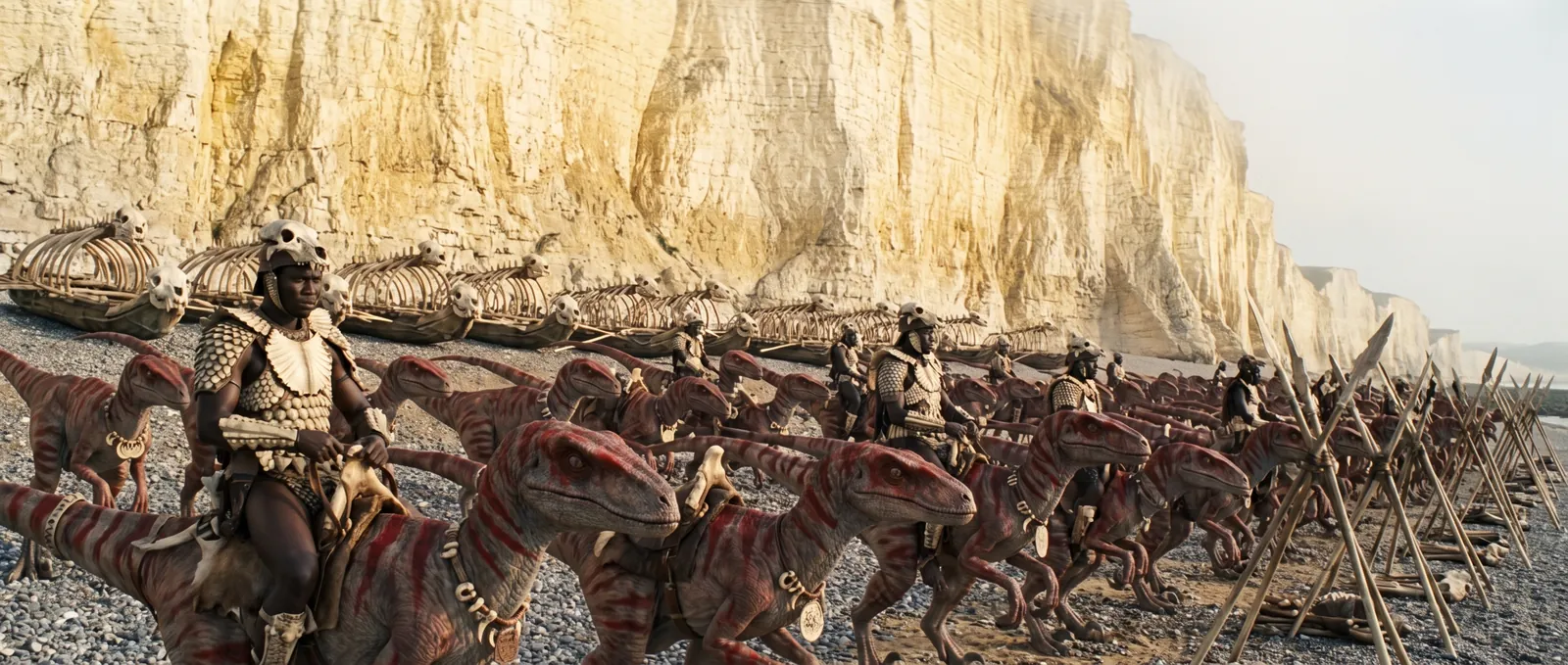
The forces of Arkhan
Mobility, clan ties and reading the terrain.
Clan mobilisation
The Horde is a higher mobilisation under Orgaï. It belongs to a civilisation where trails, memory and reputation carry authority. The Great Moult transforms the balance between clans; the Rule of Three organises the division of spoils and economic violence.
Terrain becomes a trail
Raptors are central to Arkhan’s mobility; noasaurids contribute to harassment, signals and panic. In towns, fast animal routes coexist with slower human paths. Landings, holds and turning spaces give this speed a physical structure.
Equipping movement
Armour combines selected bone, leather, sinew, resin, textiles and metal reinforcement. Its value depends on weight, fastening and the mobility it allows. The taboo on human bone runs through this industry: even an enemy does not become workshop material.
The Horde, a convergence
The Horde is not a permanent bureaucratic army. It is the convergence of forces that remain autonomous, and the Supreme Khan exists only through that convergence. An independent khan may conduct a raid, a seizure, a vendetta or a trail war without committing the Horde; a confederal campaign, with its sharing of spoils and its alliances, requires the consent of the khans and the water-masters.
The Great Horde brings together the seven khanates and the Fils de la Faim. The Première Piste de Qor-Zaï carries the ritual lineage of the Supreme Khan and the right of summons. The Cavaliers du Crâne, an old saddle lineage, ride the Vur-vaa. The Serpents de Sable handle noasaurids, flutes and the geometry of panic. The Longs-Os hold water, endurance and Horde logistics. The Dents de Pierre bring plates, maps, heavy weapons and siegecraft. The Marcheurs du Vent supply reconnaissance, messengers and fast great animals. The Peaux de Marée, a khanate of pilots and mobile workshops, work hides, tendons and rafts. The Fils de la Faim, a recent and despised clan, live by raiding, captives and packs.
See first, strike first, share after
Arkhan doctrine comes in three beats: see first, strike first, share after. It combines raptors, carnosaurs, noasaurids, tendon archers, low and mobile artillery, autonomous units and dispersed reserves; command is decentralised and rests on human-predator pairs. It looks for the part of the field that is no longer built up. Most raids are made without great living animals; these appear for sieges, urban terror, political arbitration, breakthrough or moral collapse.
Its limits are hunger, demographic losses and the difficulty of holding a place; feeding the great carnivores and weak centralisation weigh on any long campaign. An Apex is not just a mount: it demands an economy of carcasses, beast-masters, pens and saddle industries, and a leader commands only as long as he manages to feed it, calm it and deploy it.
Weapons and alliances
The cavalry uses lost-head lances, whose sacrificial point stays in a joint or a wound, and hamstring hooks. Tendon bows draw their power from the animal lineage of the tendon. Running scorpions, light artillery on wheels, fire and then move; some batteries combine Arkhan tendon, Korathi recoil mechanisms and Volonian funding or transit. Arkhan’s relations with Volonia are excellent, fed by a shared hostility to Urnok’s hegemony.
The troops of the Horde
The Horde fields very different troops, each drawn from a trail. The Flayers, light infantry from the Long-Bones, run ahead of the columns with short blades of raptor tooth; they are paid in calibrated bones rather than in metal. The Dune Archers of the Wind Walkers shoot the Vent-Coupant bow, raptor tendon, Orlantis wood and N’Goro glue, and correct their volleys by bone whistle. The Stake Planters, rare and respected, drive stakes of hardened bone into the ground and await the charge of an enemy Apex; the survivors keep a fang of the slain beast as a title.
The beasts do the rest. The Sand Serpents’ velociraptor packs are loosed at the sound of the mass flutes; the Skull Riders break lines on shock carnotaurs; the Vur-vaa pounce on isolated targets and climb walls; austroraptors with long white tails wait on the ridges for the enemy to break, then pursue him. Before battle the warriors paint their faces white: it is the war paint.
Raising the Horde
The Horde is not summoned like an army of Urnok. The Supreme Khan launches the Call, carried by drums and bone relays from trail to trail; each khan then decides whether to answer, with what and how soon. A confederal campaign requires the agreement of the khans and that of the water masters, who say where such a mass will be able to drink and for how long.
Each clan pays and feeds its own fighters: pay, rations and fodder for the beasts come out of the herds and shares of the khanate that raises the troop, and only the guard of the Première Piste depends on the treasury of Qor-Zaï. The meeting place is set around a reliable water source. The contingents camp there by khanate, each under its pigments, and the Butin-Kar starts counting, even before the first fight, what the campaign will have to bring in.
The Hordes of the past
The present Horde is not the first. Several great Hordes have faced Urnok over the centuries, and an ancient war struck Ishtir very hard. The closest in memory is the campaign of the Three Waves, a generation before the present events: three Arkhan armies faced four armies of Urnok across several theatres, and the great battle set a hundred and fifteen thousand Arkhans, reinforced by thirty thousand N’Goro, against Marjory’s hundred and sixty thousand soldiers.
Orgaï already fought there, at about thirty, as one of Arkhan’s foremost generals, without yet being Supreme Khan. The Horde refused a static artillery duel, kept moving its scorpions and opened corridors for its Apex. It lost twenty-two Apex of great value; Urnok, seventeen of its very-great beasts. Old riders still speak of it as the battle in which each side learned something from the other.
What the others fear
Arkhan’s neighbours have built part of their defences against the Horde. On the imperial march of Qor Zaï, Urnok maintains anti-raptor forts, ceratopsians trained against the packs and great march amargasaurs. Korath closes its passes and counts on Arkhan’s weakness before walls, without forgetting that it depends on Arkhan’s tendons for its ballistae.
All know the Horde’s limits: water, the division of the clans, the difficulty of feeding the Apex on a long campaign and, above all, the inability to administer a captured city. Arkhan knows how to win a battle and cross a country; holding a conquered city goes against its nature. Foreign strategists draw a simple rule from this: never offer the Horde the battle it is looking for, and let it take what it will not know how to keep.
Part of this article covers events of season 1. Turn spoilers on in the menu to read it.