
Armies
The Silver Horns
An order of heavy ceratopsians within a doctrine of disciplined shock.
Heavy ceratopsians
The Silver Horns carry the function of heavy ceratopsians and shock. They belong to the rank bringing together command, certifications and great war beasts. Their speciality sits alongside the other Silver functions: Mirrors intelligence and mapping, and Winds aerial extraction and strikes. The orders divide responsibilities within the same rank according to their means and uses.
Force must be able to stop
Silver doctrine channels rage towards a precise target and requires an immediate stop on command. The Horns’ shock function belongs within this discipline. The power of a heavy ceratopsian must meet command able to direct action and end it. Cohesion, animals and movement orders together form Ishtari military effectiveness.
The ground works with the sky
Ishtir’s public capabilities combine ceratopsians with aerial power. The Horns and Winds belong to two distinct Silver orders; their functions meet within an army based on cohesion. Ground shock and aerial extraction or striking capabilities require different uses. Coordination depends on this division as well as on the strength of each animal.
A charge that knows how to stop
The Silver Horns concentrate land tactics and riding certifications; they hold thresholds, organise the shock and coordinate movement on the ground. Their doctrine uses the frontal force of ceratops without believing it invulnerable: a charge needs readable ground, protected flanks, understood signals, a way to withdraw and teams able to recover the wounded. Riding there is a technical trade, marked out by certifications.
The animals of the Horns
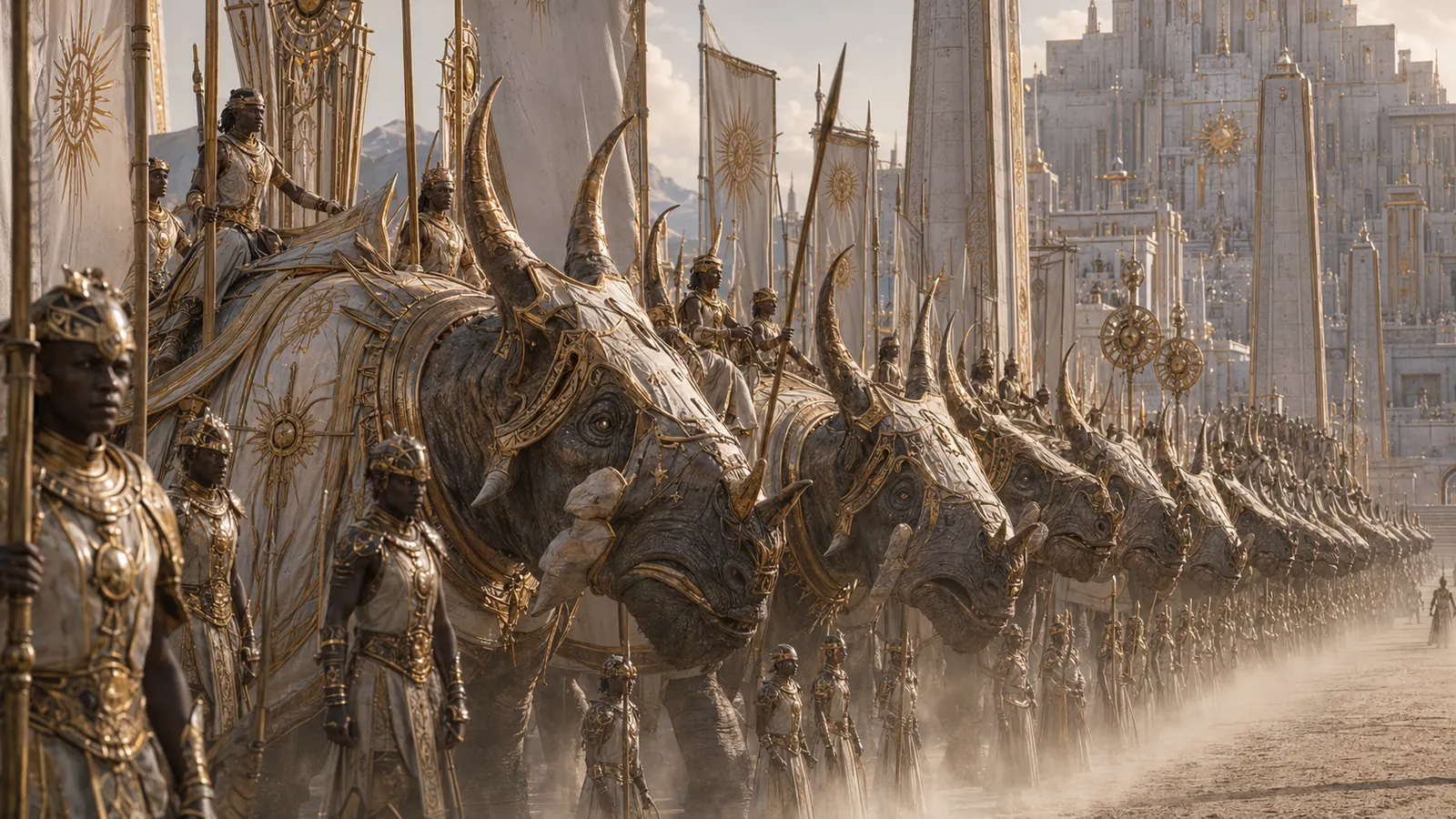
The Silver Horns use several ceratopsian lines. The Sha-Qerim, a sacred triceratops with gilded horns, forms the heart of the heavy line and delivers the shock. The Aru-Qerim, a styracosaur with a spiked frill, holds the mobile guard and the flanks. Chasmosaurs of the Silver Horns form the lines in depth, and the anti-raptor ceratops of the Marche de Keryth, horns low in a tight line, guard the roads against fast cavalry.
The forts of the Plaines des Brontes and those of the Marche de Keryth are the order’s seats. Young animals arrive there from the stud farms of Qer-Brontes, already used to people, and their military training lasts several years before they take their place in a line.
The solar wedge
The best-known formation of the Horns is the solar wedge, a triangle of ceratops launched point first, which asserts a direction and pierces one point of the enemy line. The leading animals wear the solar plate, a frontal caparison of horn, leather and matte gold that protects the brow and throws back the light; behind them the ranks widen to open the breach.
The wedge is never launched alone. It needs readable ground, flanks covered by styracosaurs and infantry, and a command signal able to stop it at any moment. The elders used to say a well-launched wedge never turns; current doctrine demands on the contrary that it know how to stop dead, and that stop is what is drilled most.
The riding path
No one rides a war triceratops without having learned on smaller animals. Cohort children first approach the school leptoceratops and the farm qerik; young adults then move on to styracosaurs and, if they pass their certifications, to the great lines. At every stage the certification covers care and reading the animal as much as riding itself.
A war animal is handled by two people: the rider, on its back, and the leader, who walks at its head in slow manoeuvres and guides it by voice. The best leaders know every animal in their line by its register name, and it is said that a ceratops obeys its leader’s voice before that of any officer.
The stopping drill
The Horns drill above all at stopping. On the gathering fields of the Plaines des Brontes, whole lines of ceratops are sent off at a trot, then at the charge, and must halt on a signal without passing a line of markers. A line that overruns starts again, and the drill is repeated until the stop is clean. The soldiers call it “the Marshal’s prayer”.
Foreign officers who have watched these drills remember above all the silence that follows: hundreds of tonnes of animals standing still, panting, and no one shouting. This stop is the mark of Silver doctrine: rage is channelled towards a target, then ceases.
Harnesses, sheaths and lances
The Horns’ equipment comes from several regions. Charge harnesses come out of the partitioned workshops of Qer-Domar, where each workshop makes only one piece; horn sheaths and charge lances from the Solar Forge of Hélios in Qer-Aton; horn plates from the tanneries that receive dead ceratops. The matte gold of the sheaths is applied in leaves and polished again before every ceremony.
A complete outfit for a war triceratops represents weeks of work by several workshops, and its upkeep occupies the order’s harness makers every day. Nothing on it is decorative without also serving: the gold of the horns, the technicians say, is first of all for seeing from afar where the animals are.
Part of this article covers events of season 1. Turn spoilers on in the menu to read it.