

People
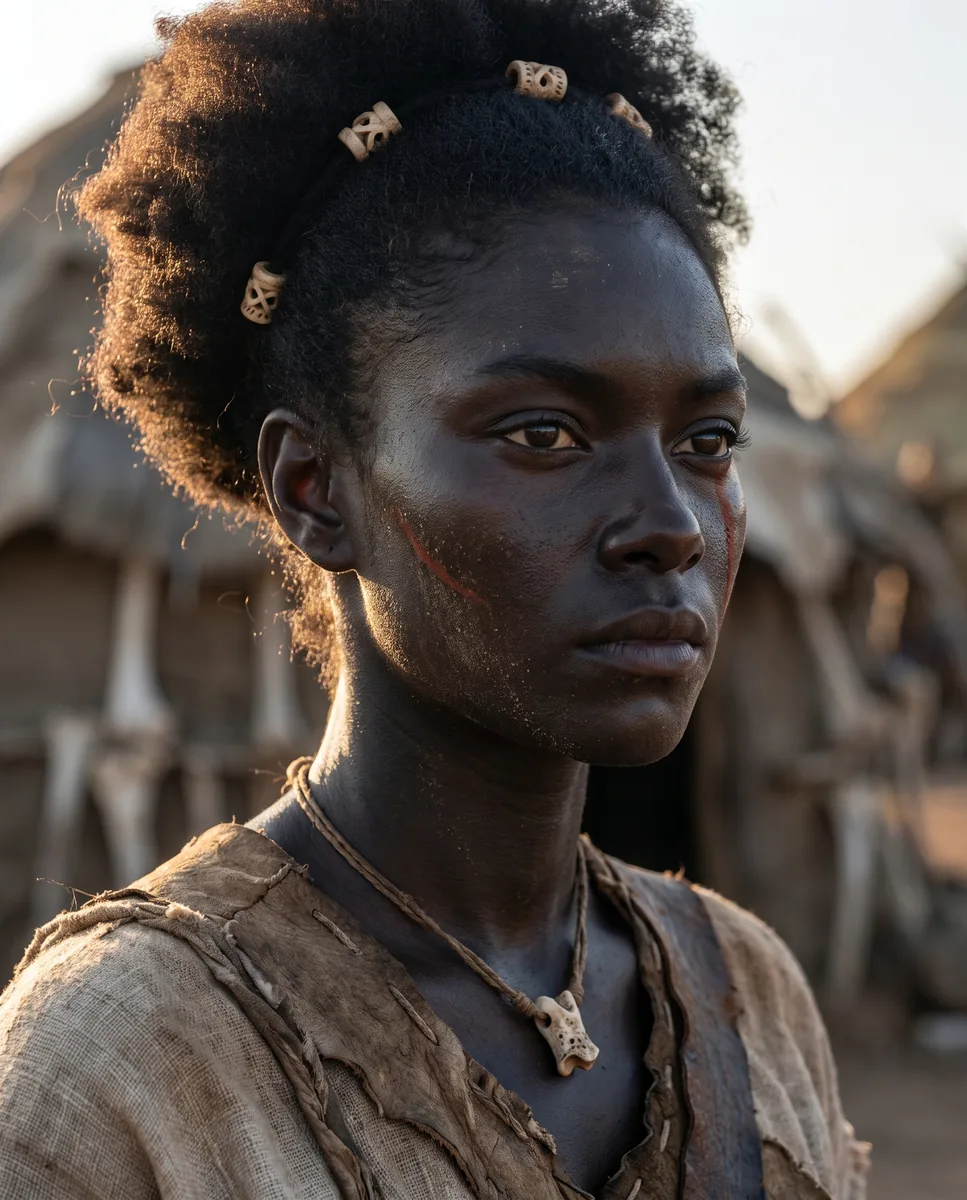
Ashaïra
An expert in living animals: observing beasts and remembering faces.
An understanding of animals
Ashaïra has a specific expertise in living animals. She observes behaviour, approaches beasts and can work beside them in difficult situations. This ability gives weight to her presence on the trail: she can do something the riders need.
Keeping the faces
Memory is another dimension of her portrait. She remembers faces where headcounts become numbers. Her words belong to care and remembrance: recognising someone does not mean approving what they have done, and memory does not erase violence.
Skill is not freedom
Her captivity is not romantic decoration. Her relationship with Sher remains unequal: her usefulness and their shared work do not automatically confer freedom, command or equal status. Her expertise must remain visible without beautifying her condition.
A daughter of the marches
Ashaïra comes from a village of the marches, one of those that live on seed, small herd animals and thatch, far from the great shell-cities. She grew up in a rural world where people tend for themselves whatever limps, bleeds or stops eating: work injuries, bites, swollen legs, clutches that come late. Her training lies in those gestures: herbs, listening to an animal’s breathing, a bandage pulled exactly as tight as it needs to be.
Before her captivity she was known locally as a useful person, someone people came to fetch rather than someone they celebrated. They knocked at her door for a guard beast that refused meat or for a child bitten on the hand; afterwards they forgot to thank her, and that suited her. She learned to recognise pain before she knew how to name it. From that childhood she keeps a habit her guards soon notice: she always locates an exit, in a room as in a pen.
The gestures of care
Ashaïra’s care is made of small objects and slow gestures: seeds, strips of cloth, water, little tools she keeps on her, and hands that are always visible. She approaches a beast from the side where it can see her, stops at the distance of one leap, breathes more slowly than the animal and waits for it to match its breath to hers. Under strain she speaks less, tends, counts breaths and notes which objects could serve as a way out.
This knowledge has a precise value in a trail society. Arkhan treats the knowledge of pack trainers as a strategic asset that cannot be exported as property and reaches foreigners only through marriage, hostage-taking or adoption. A captive who can calm a wounded raptor therefore brings the riders something they can neither buy nor demand, and must nonetheless watch. In the camps it is said that she sleeps better near the pens than under the shelter of the tents, as if the breathing of a nearby animal were what she needed to close her eyes.
A low voice
Ashaïra speaks low. Her voice is sensory: she describes before she judges and uses very few grand words. Her natural words are those of work among animals: breathe, look, too tight, leave it, wound, share. She describes pain precisely without treating the person or the animal as a child, and stays close to a trembling creature without owning it or offering false comfort.
She carries the speech that Sher’Khan lacks. Where the rider keeps silent or acts, she names what the act has cost. Her best-known phrase, “I will keep your face,” sums up her way of being present: she promises neither forgiveness nor revenge, only not to forget. Her way of lying is omission: she says what she can do and keeps quiet about why she does it. Those who spend time near her learn to listen to that silence as much as to her words.
The litany of faces
Her memory of faces takes an oral form. In a low voice Ashaïra recites a litany of the dead that grows longer over time: names when she knows them, and otherwise features, a scar, a way of walking. She does not sort this list by side. Arkhans stand in it beside people of the marches, and some of the living already appear in it through their faces.
The practice finds an unexpected echo in a culture that does not write. Arkhan entrusts its memory to saddle knots, to the Racing Songs and to witnesses; the arḫán language obliges every verb to say how one knows, by song, by eye or by trace. Ashaïra testifies in the manner of the eye: she has seen. The riders who hear her are never quite sure whether they are witnessing a mourning, a register or a threat, and most prefer not to ask her.
Surviving without consenting
Arkhan law does not make a captive a legal person: a taking has no share. The captive is a piece of booty, assigned by the chief and counted by the Butin-Kar; a higher khan may requisition a taking for its talents without the taker having the rank to refuse, and the ration then follows the body. Buying back one’s freedom does not exist: one does not buy oneself, one gets oneself counted. Trail people speak of a mark of share that exceptional service can earn a captive, without amounting to freedom.
Ashaïra’s position has to be read within this frame. Every skill she shows becomes a resource for those who hold her, and some captives see her usefulness as a kind of collaboration. Others choose another way to survive: Neya-Tu, a herbalist taken in the same lot, refuses to give a name to the raptor that carries her, so as not to turn captivity into belonging. Ashaïra wants to survive without her survival being read as consent, and it is a line she holds alone.
What people say of her
Her reputation fits in a few words: a calm, competent, unspectacular village woman. In the camps she is often called the captive who talks to beasts, and people add that she talks to men in the same way. Trainers distrust her as one distrusts knowledge that came from elsewhere; the old breeders, used to judging a person by how an animal tolerates them, watch her more closely than they admit.
Those who see her up close take care not to make her a saint of captivity or her captor’s confidante: she does not soften Sher’Khan and does not try to. She is patient, observant and cautious, carries a contained anger and carefully keeps a part of herself that the victors cannot use.
Part of this article covers events of season 1. Turn spoilers on in the menu to read it.
Gallery3 images
Ashaïra, twenty years old, a captive who will not submit. Temba, Ashaïra's father. Yaraï, Ashaïra's mother.