
Places and landscapes
The shell-city
Arkhan’s seven great cities are shell-cities: bone walls, basins, cisterns, canals, arches and sanctuaries remain, while the peoples who govern them change with every Great Shedding. The skeleton stays; the flesh migrates.
The skeleton stays, the flesh migrates
Arkhan’s seven great cities do not move. Their skeleton stays in place: bone walls, basins, cisterns, canals, arches and sanctuaries of the founding bones. Roughly every seven years, during the Great Shedding, the governing peoples and most of the working population exchange cities. Khans, courts, warriors, families, herds, raptors, demountable workshops, roof membranes and banners leave together; another people arrives.
Vue plongeante sur une vaste cité d'os au crépuscule : arches de côtes géantes, bassins et canaux enjambés de ponts, tentures pourpres et foule.
Architecture therefore separates durable works from transportable elements. Animal bone, bone cement, local stone and timber carry the walls and great works; hide, leather and tendon provide membranes, shutters and awnings, which follow their owners. One saying sums up the spirit of these cities: “We built cities, not cages. Move.”
What walks, what moults, what remains
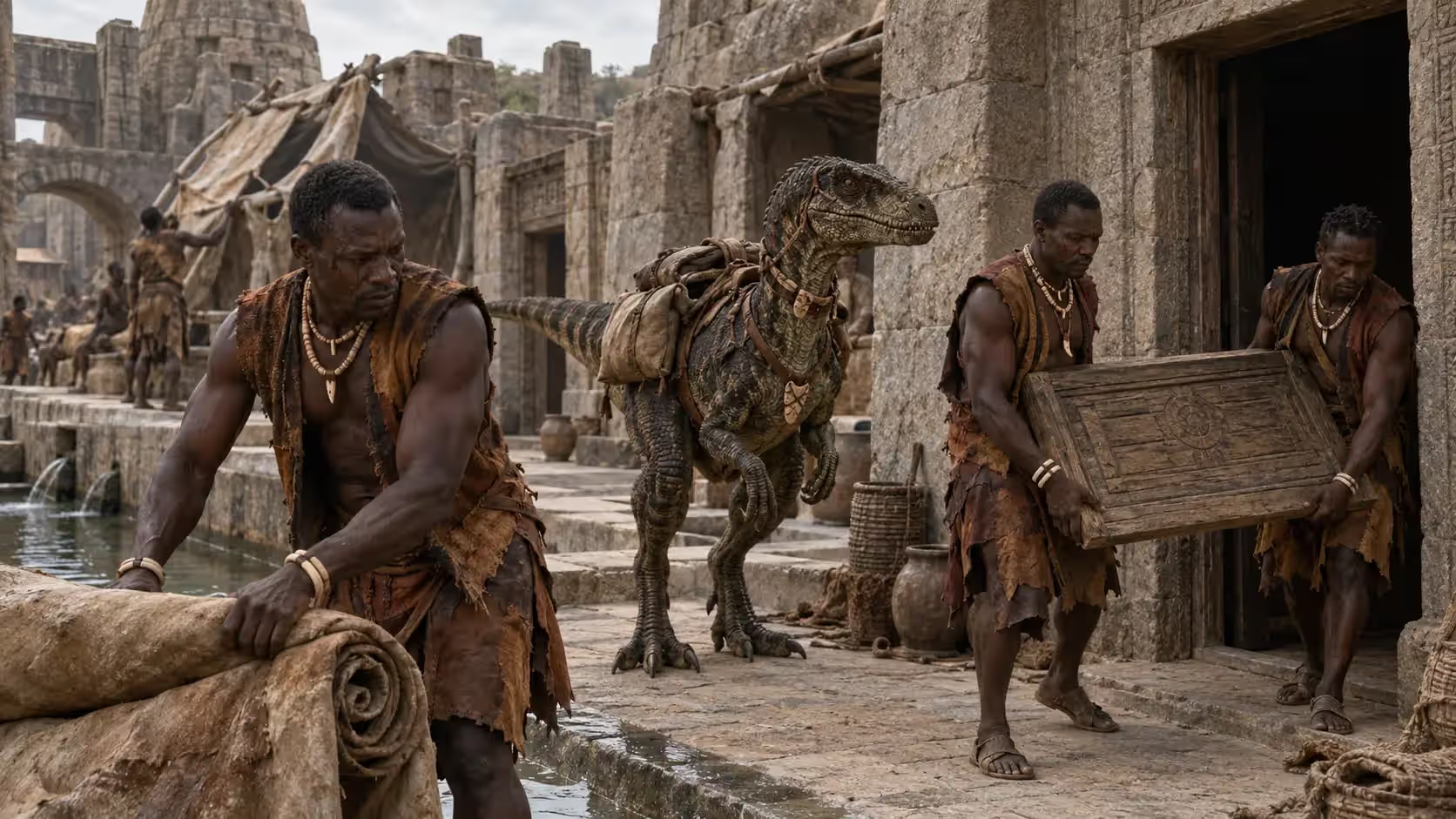
Every departure sorts goods into three categories. What walks, people and animals, leaves with the people. What moults, demountable workshops, membranes, banners and portable altars, is taken down and carried. What remains, walls, cisterns, canals and great works, belongs to the city. A roof often combines a durable structure with transportable parts; any object still fixed to a building when the last horn sounds becomes the city’s property, hence the Night of Doors, when families tear out the doors they want to keep.
The Anchored and the upkeep of the works
A shell-city does not stand empty between two peoples. Elders, the injured, archivists, basin keepers, wall artisans and keepers of the dead remain: they are the Anchored. They know the canals, the stocks, the old debts and the mistakes of past governments, and decide which districts may reopen and which basins are clean. Between two populations, the Grand Curage empties the basins, burns the enclosures concerned, remakes the membranes and removes carcasses. The bone industry supplies the durable materials of walls, arches and ossuaries.
One city, several faces
Each incoming people changes the city’s skin. The same city can take on several identities depending on the khan who occupies it: dark membranes under a warrior people, pale membranes and open markets under a peaceful one, bleached bone and processions under a religious one, night markets and Volonian trading posts under a merchant one. Diplomats must specify which Vulkar they mean, today’s or the one still to come. The city thus has a longer history than any of its governments.
A rule born of a war
Before the Great Shedding, the great khans put down roots: hereditary palaces, their own currencies, refusal to obey. The War of the Seven Thrones, fifteen years long, imposed a common rule: no great people governs the same shell twice in a row, and no khan hands a city down to his son. The shell-city is the built form of that rule.
The seven shells
The seven great cities do not resemble one another, because their fixed works are not the same. Vulkar, in the north-west, is a military node, set on the great trail that guards that side of the Confederation. Vüren, in the south-west, is an economic and migratory node, turned towards Korath and the Hunting Plains. Foreigners know the other shells less well; they change face with every people.
What remains in a city are its kilns, its quarries, its salt pans, its relays and its basins; what leaves are the skills, which follow the peoples. The same city may thus make lances for seven years, then saddles for the seven after, depending on the artisans who live there. Qor-Zaï, the capital, is not a shell: it never changes people.
The sanctuaries of the founding bones
Every shell keeps a sanctuary of the founding bones. According to tradition, it holds the bones of the great beasts whose skeletons served as the city’s first frames, in the days when people still built inside the carcasses of fallen colossi. These bones are never moved; they belong to the city more than to any people.
The first act of an arriving people is to present itself there. The khan lays an offering, often a tooth from his best beast, and the Anchored recite to him the names of the peoples who came before. The last act of a departing people is the same, in reverse: something is left there, and what has been left is never taken back.
Living in a city one will give back
To live in a shell is to be at home in a house one will give back. Families decorate with what can be carried: hangings, painted membranes, mats, chests, portable altars. People avoid drilling, sealing or pegging anything they will not be able to take away, and children are taught to set things down rather than fix them.
The most sought-after houses are not the richest, but those that their successive occupants have kept best; the Anchored know how to point them out, and families compete for the right to settle in them on arrival. Each people nonetheless leaves its trace: a pigment forgotten under a lintel, a notch where children’s heights were marked, a name carved on the back of a niche. Newcomers discover them as they settle in, and almost never erase them.
Part of this article covers events of season 1. Turn spoilers on in the menu to read it.